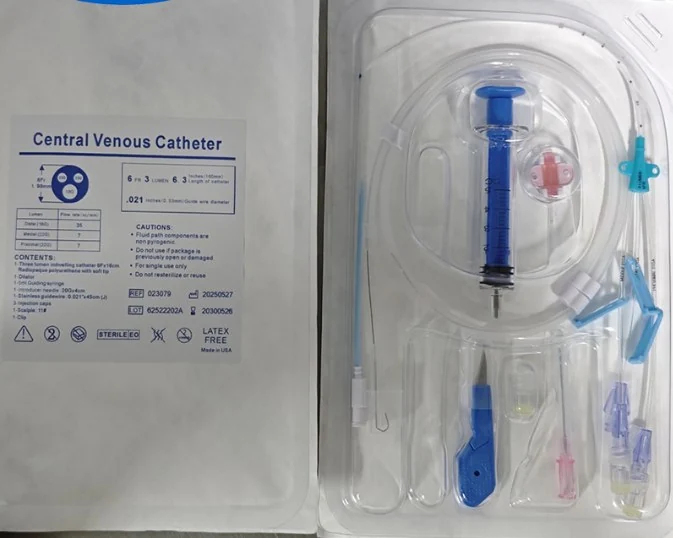
"Catheter" covers a wide range of very different product families: from the Foley urinary catheter to the central venous catheter, and along the way the respiratory suction catheters and the drainage catheters. For a procurement team, a clinic or a distributor the challenge isn't clinical, it's catalogue: knowing which type matches each use, what to order it as, and what spec defines each family. Think of this as a map: it sorts the main types by system (urinary, respiratory, vascular, drainage), explains how they differ, and links to the size guide for each.
Catheter families: a map by body system
The most useful way to organise the catalogue is by the body system the device is meant for. Here are the main families and where to go deeper:
| Family | Examples | Typical gauge | Used for |
|---|---|---|---|
| Urinary | Foley, Nelaton, Coudé | French (F6–F24) | Bladder drainage, retention, surgery |
| Respiratory | Suction catheter, Yankauer | French (F6–F18) | Suction airway secretions |
| Vascular | Peripheral IV, CVC, PICC | Gauge (G) / French | Infusion, medication, monitoring |
| Drainage | Drainage bag, chest/abdominal catheter | Variable | Drain urine, fluid or air |
Two things to keep in mind before going into each family. First, the gauge scale changes per family: urinary and suction are measured in French (the higher the number, the thicker), and peripheral vascular catheters in Gauge (the higher the number, the thinner, the other way round); confusing the two is the most common buying error. Second, the material follows the dwell time: PVC for short-term, high-turnover use, and silicone for long-term use and latex-allergic patients.
Urinary catheters: Foley, Nelaton and Coudé
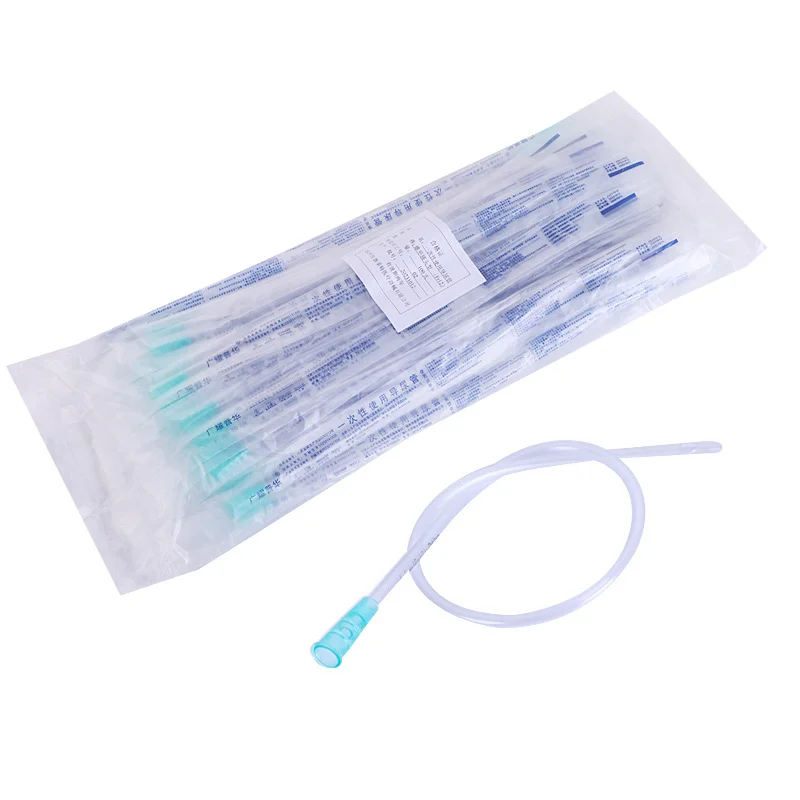
This is the highest-volume family. It's measured in French and chosen by size, tip type, number of ways and balloon. The Foley is the indwelling balloon catheter: it stays fixed in the bladder and drains continuously into a bag, and it's the general-purpose choice in wards, surgery and ICU. The Nelaton is straight and balloon-free, single-use, for intermittent catheterisation or a one-off emptying. And the Coudé or Tiemann tip is the curved one that gets past an enlarged prostate in older men when a straight tip won't pass.
The size decision (14–16 Fr in adults), tip, 2-way vs 3-way and balloon volume are worked out, with a Fr→mm chart and colour code, in our guide to Foley catheter sizes and tip types. The system is completed with the bed bag (2000 ml) or a leg bag for the ambulatory patient; how to choose between them is in the urinary drainage bag guide.
Above the bladder there is one more urinary catheter the map usually leaves out: the double-J ureteral stent, which keeps the ureter open between kidney and bladder with a curl at each end. It is not used to catheterise and it does not drain to a bag: it stays inside for the time the indication calls for, and it is chosen by a pair of measurements, size in French and length in centimetres by the patient's height. It is the fastest-turning consumable in a urology unit, and the double-J guide covers why it is bought as an assortment rather than a single reference.
Respiratory suction catheters
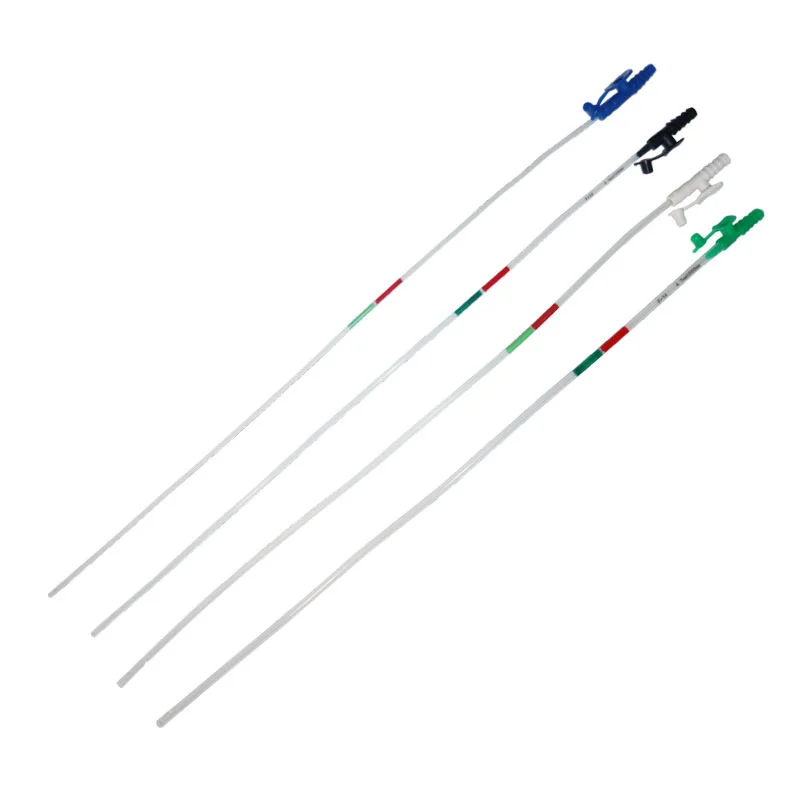
Suction catheters clear secretions from the airway in the ICU, anaesthesia and the ER. They're also measured in French, and the size choice is critical: one too thick for the endotracheal tube generates excessive negative pressure and hypoxaemia. The common sizes are F12–F16 in adults and F6–F10 in paediatrics and neonates. You want an atraumatic tip with side holes so it doesn't injure the mucosa, and a suction control (that thumb-port valve) so it only suctions on withdrawal. Separate from all that is the Yankauer, rigid, for oropharyngeal suction of the mouth, which is a different thing from the flexible tracheal catheter.
The sizing rule by endotracheal tube and the replacement protocol are in the suction catheter sizes and types guide. And for the ER there's the all-in-one suction kit that saves time and keeps things aseptic.
Vascular catheters: peripheral IV, CVC and PICC
These reach the bloodstream to infuse fluids, medication or nutrition, or to monitor, and for the peripherals the scale is usually Gauge (the higher the number, the thinner). The peripheral IV, the cannula, goes into an arm or hand vein, is short-term (72–96 h) and very high-volume, and is chosen by gauge according to the vein size and the flow you need. The CVC goes into a central vein (jugular or subclavian), is medium-term and is used in the ICU, for vasoactive drugs and CVP; it ships as a kit (a 1, 2 or 3-lumen catheter plus guidewire, dilator and drape) because placing it is a full sterile procedure. And the PICC runs from a peripheral arm vein up to a central one, lasts weeks or months and serves chemotherapy, long antibiotics or parenteral nutrition; it's a specialised insertion and a low-competition niche.
To choose the CVC by lumen count and type (tunneled or not), see the central venous catheter guide. And managing the full IV line (catheter, connectors, stopcocks, dressings) is covered in our IV supplies guide for infusion clinics (in Spanish).
How to build the inventory and what to look at
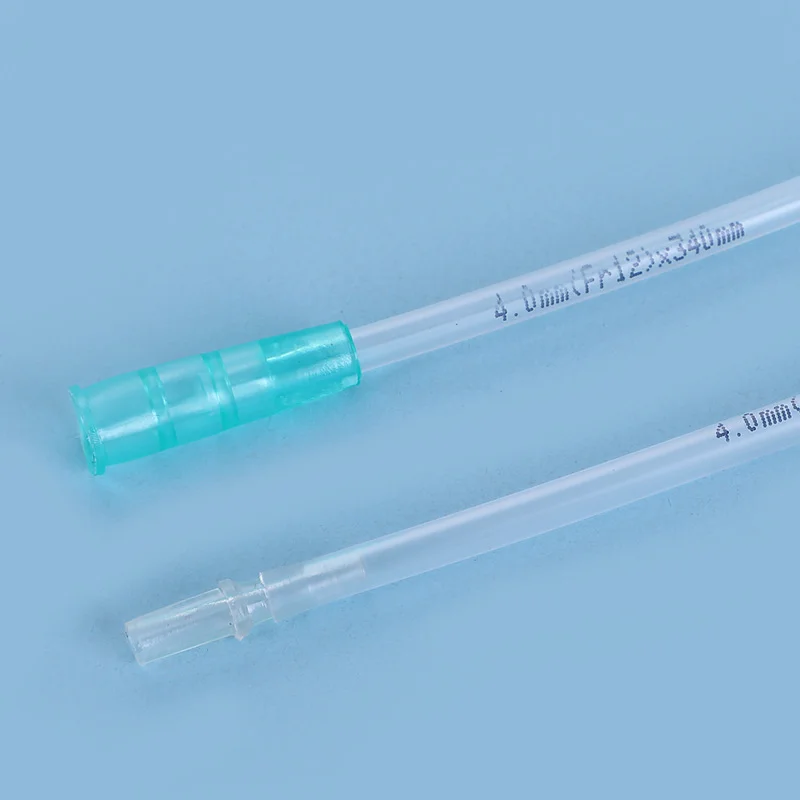
For a clinic or a distributor building a catheter inventory, the practical method is to go by system. First, list the procedures you do (bladder catheterisation, suction, IV lines, CVC) and build the range by family, not by single product. Get the gauge scale right: French for urinary and suction, Gauge for peripheral IV, without mixing the two logics. Cover the core and the edges: in urinary, F14/16/18 as the base plus Coudé for urology; in suction, F12–F16 plus paediatric; in vascular, a multi-lumen CVC kit. Set the material by dwell time (PVC for short-term, latex-free silicone for long-term and allergic patients), and think about the full system with a compatible connector (catheter plus bag, or catheter plus connectors from the same supplier) so you don't hit incompatibilities. And, as always, EO sterilisation with a dated individual pack and a manufacturer with ISO 13485 for registration.
We make and supply the main families — Foley from F6 to F24, suction catheters, the CVC kit, and bed and leg drainage bags — with the quality documentation, a low minimum order, samples to evaluate and a private-label option. Tell us which system you need to equip and we'll put the quote together; message us on WhatsApp and we'll get you a box price.
Frequently Asked Questions
What are the main types of catheters?
Catheters group by body system: urinary (Foley, Nelaton, Coudé), respiratory suction catheters, vascular (peripheral IV, central venous catheter/CVC, PICC) and drainage catheters. Each family has its own gauge scale and specifications, so what defines the choice is the system it goes to, the size and the material — not just the name.
What types of urinary catheter are there?
The main ones are the Foley (balloon, indwelling, for continuous drainage), the Nelaton (straight, balloon-free, single-use for intermittent catheterisation) and the Coudé/Tiemann tip (curved, to negotiate the prostate in older men). They are measured on the French (Fr) scale and the usual adult size is 14–16 Fr.
Why is catheter size measured differently for each type?
Urinary and suction catheters are measured in French (Fr), where a higher number is thicker (1 Fr = 1/3 mm). Peripheral IV catheters are measured in Gauge (G), where a higher number is THINNER. They are inverse scales, and confusing them is a common buying error — always check the unit for each family.
Which vascular catheter is used for long-term treatment?
For long treatments (chemotherapy, weeks of antibiotics, parenteral nutrition) a PICC is used, inserted via a peripheral vein and reaching a central vein. For medium-term ICU use, a central venous catheter (CVC) is used, usually as a multi-lumen kit. The peripheral IV (cannula) is for short-term use only (72–96 h).
When do you choose a silicone catheter over PVC?
PVC is economical and used for short-term, high-turnover needs. Silicone is more biocompatible, latex-free and resists encrustation better, so it's chosen for long-term use (weeks of bladder catheterisation) and latex-allergic patients. Many institutions keep both lines depending on the patient.
Does Edaochi offer all families, and with private label (OEM)?
Yes. We supply the main families — Foley catheter (F6–F24), suction catheters, the central venous catheter (CVC) kit, urinary bed bags and leg bags — with quality documentation (ISO 13485), a low minimum order, samples to evaluate and private-label packaging for distributors. Message us on WhatsApp with what you need and we'll get you a box price.