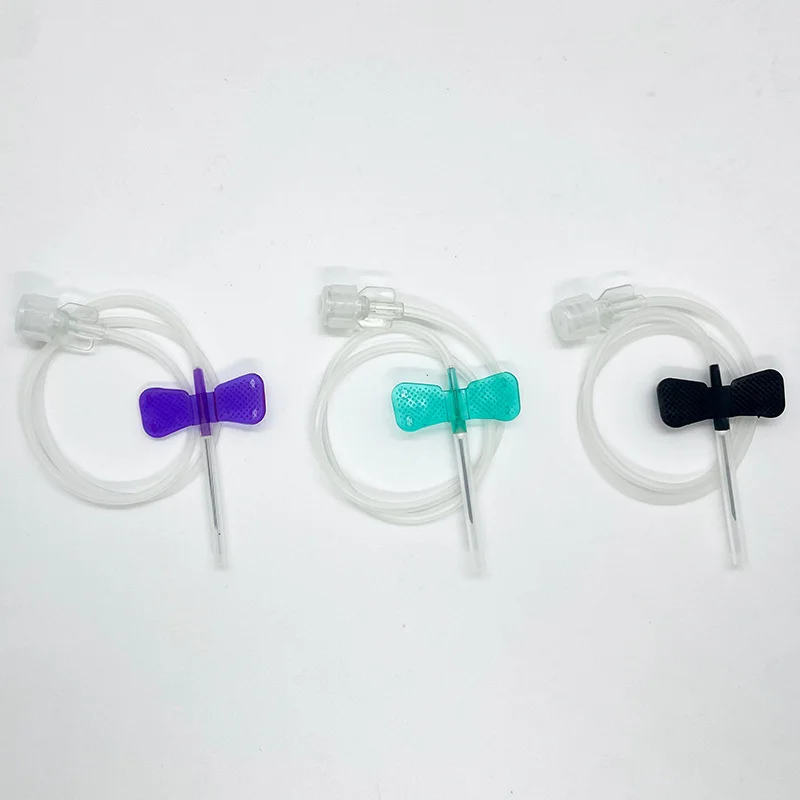
In paediatrics, in geriatrics, and above all when you need to draw blood from a small vein, the butterfly needle is usually the first choice. People also call it a winged infusion set or a scalp vein set, and what sets it apart is simple: two little plastic wings to hold it precisely, and a length of flexible tubing that keeps it from pulling out at the slightest movement. Below we go through the gauges and their colours, how it differs from a catheter, how to place it, and what to look for when you buy in volume.
So what is a butterfly needle?
It's a small venipuncture set: a short steel needle, two plastic wings that act as a grip and a spot to tape it down, a length of flexible tubing, and a Luer connector at the end for the syringe, the vacuum tube or the IV line. The "butterfly" name comes from those two wings.
You use it to draw blood and for short infusions or a one-off dose, and it shines on the awkward veins: the back of the hand, the wrist, and, in small children, the scalp. The catch is that what stays in the vein is the metal needle, not a plastic cannula, so it's meant for brief access. For therapy that will run for hours, you cannulate with a catheter instead.
The gauges and their colours
Like every other needle and catheter, the butterfly is identified by its gauge, and each gauge has a colour. The higher the number, the finer the needle.
| Gauge | Colour | Common use |
|---|---|---|
| 21G | Green | Drawing blood in adults with a good vein |
| 23G | Blue | The everyday one: paediatrics and medium veins |
| 25G | Orange | Children, neonates, fine veins |
| 27G | Grey | Neonatology, very small veins |
The 23G blue is the one that moves most, because it handles almost everything. For blood draws, don't go finer than 25G: too thin a needle can rupture red cells (that's haemolysis) and ruin the lab sample. If gauges trip you up, the needle and catheter gauge chart has the full breakdown.
Butterfly or catheter? It comes down to how long the access lasts
The real difference is what stays inside the vein. The butterfly leaves the metal needle; the catheter leaves a flexible plastic cannula. Almost everything else follows from that.
If the patient is going to move, or the access has to hold for hours or days, hydration or a course of IV antibiotics, the catheter is the right call, because the soft cannula won't pierce the vein when the arm shifts. The butterfly shines in the opposite case: when you only need to puncture for a moment, a blood draw, a single dose, a tricky vein in a child. And when that access has to stay open, you cap it with a needle-free connector and, if you need to keep the line away from the patient, add an extension line.
How to place it, step by step
There's nothing mysterious about it, but a few details make the difference:
- Hand hygiene, gloves, tourniquet, and palpate the vein.
- Disinfect the skin and let it dry.
- Hold the butterfly by its two folded wings and puncture bevel-up, almost flat against the skin (around 10–30°).
- The moment blood shows in the tubing, drop the angle further and advance a touch.
- Tape the wings down and connect the syringe, the vacuum tube or the line.
- Release the tourniquet before you finish and, as you pull the needle out, trigger the safety so you don't stick yourself.
The slip-ups are nearly always the same ones: too steep an angle and you go through the vein, wings not taped and the needle wanders, too fine a gauge for blood, and forgetting to activate the safety device on withdrawal.
Buying in volume: what to look at
If you're buying for a clinic, a lab or to resell, there are three things to check first. That the full gauge range comes in, 21G through 27G, with the colours clearly marked, so you're not caught without the paediatric size right when you need it. That it has a safety device, the mechanism that shields the needle on its own as you withdraw; these days that's all but mandatory for biosafety and to keep staff from getting stuck. And that the tubing is a comfortable length with a Luer-lock that matches your syringes, vacuum tubes and lines.
Then come the quality details you can't see in a photo: a siliconised needle with a good bevel hurts less, which really shows in children; latex-free and DEHP-free material; and, for registration and tenders, the CE / ISO 13485 certificate with lot traceability.
We make them across the full gauge range, with the safety and without, and we send samples so you can try them before committing to an order. If it helps, message us on WhatsApp with the references and we'll get you pricing.
Frequently Asked Questions
What gauge butterfly needle is used to draw blood?
For adult blood collection, 21G (green) or 23G (blue) is typical. Avoid going finer than 25G, because too fine a gauge can haemolyse the sample (rupture red cells) and skew the lab result. In paediatrics and neonates, 23G–27G is used depending on vein size.
What is the difference between a butterfly needle and an IV catheter?
The butterfly leaves a metal needle in the vein and is for short access (blood draw, a single dose). The IV catheter leaves a flexible plastic cannula and is the choice for prolonged intravenous therapy, because it tolerates patient movement better without displacing or infiltrating.
Why is the butterfly needle preferred in paediatrics and geriatrics?
Because the wings allow a fine grip and secure anchoring, and the flexible tubing reduces displacement in small, fragile veins. This makes puncture easier in children and older adults, where a rigid straight access is harder to control.
Do butterfly needles come with a safety device?
There are versions with and without a safety device. The safety mechanism shields the needle automatically after use to reduce staff needlestick and meet biosafety standards. We recommend the safety version for hospital settings.