Buying disposable medical consumables in bulk is not complicated — but it does require confirming the right information before you commit to volume. Whether you're a hospital procurement manager, a medical device distributor or an importer, the same five questions determine whether a shipment arrives right or triggers a costly return: the spec, the MOQ, the packaging, the documentation and the lead time. This guide covers each one.
Start with the specification, not the price
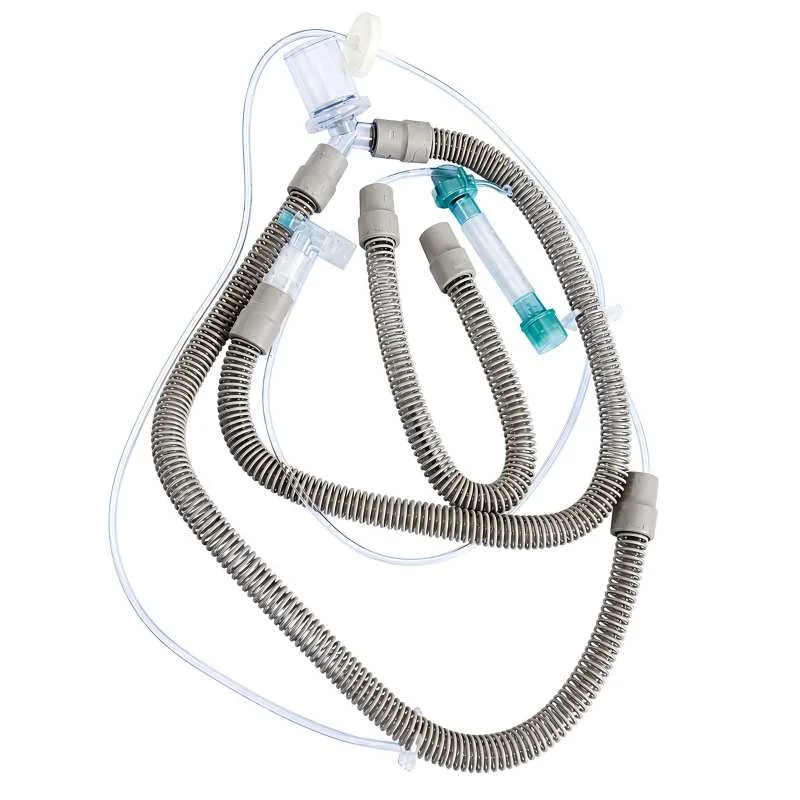
The most common source of procurement problems is ordering by product name without confirming the specification. "Nasal cannula" covers single-bore and dual-bore prongs, adult and neonatal sizes, 2.1 m and 1.8 m tube lengths, and at least three connector standards. "Breathing circuit" covers adult and paediatric diameters, corrugated and smooth tubing, and multiple limb configurations. The unit price is irrelevant if the spec doesn't match your device, your stock standard or your tender terms.
Before sending a quote request, confirm:
- Product name and local trade name (what you call it in your market)
- Size or capacity (French / ml / L/min / mm — whatever the relevant measure is)
- Connector type (Luer-lock, ISO 15 mm / 22 mm, Foley-compatible — be specific)
- Material requirements (DEHP-free? Latex-free? Specific PVC grade?)
- Sterility (EO sterilised individually packed, or non-sterile bulk?)
- Certification (CE, ISO 13485 — specify which are mandatory for registration in your market)
Send this list with your quote request. It takes two minutes and avoids two weeks of returns.
MOQ: what it means in practice and how to negotiate it
MOQ — minimum order quantity — is the smallest volume a supplier will produce or ship at the quoted unit price. For medical consumables sourced from direct manufacturers, a typical MOQ ranges from 500 to 5,000 units per reference depending on the product. Individually sterile-packed items (more assembly) usually have higher MOQs than bulk-packed ones.
Three things worth knowing:
- MOQ is not fixed. Most manufacturers accept orders below MOQ at a higher unit price. If you need 1,000 units but the MOQ is 3,000, ask — the answer is almost always a small price premium, not a refusal.
- Mixed orders lower per-product MOQ. Consolidating several references into one shipment often lets you reach the minimum per line with lower quantities each, because the container space is shared.
- MOQ for sterile vs non-sterile differs. If you only need bulk non-sterile (for non-sterile use or in-house repackaging), the MOQ is typically lower. Confirm which presentation you need.
For a working reference: our 3-way stopcock manifold has a 5,000-unit MOQ at a reference price of US$2.00–2.50/unit; smaller orders are possible at a slightly higher unit cost. Most of our other consumables sit in the same range.
Packaging options: individual, bulk, OEM and sterile
Packaging is a procurement decision, not an afterthought — it affects your unit cost, your storage, and what your customer or tender requires.
| Packaging type | Typical use case | Cost impact |
|---|---|---|
| Individual sterile (EO) | Hospital procurement, tender requirements, high-risk applications | Higher — more assembly |
| Individual PE-packed (non-sterile) | Home-care distribution, clinic supply, most standard products | Standard |
| Bulk (carton, non-sterile) | In-house repackaging, OEM buyers, non-sterile environments | Lower |
| OEM / private label | Distributor brands, large contracts | MOQ-dependent; usually 10,000+ |
If your customers are hospitals and tender specifications say "individually sterile packed", that's what you confirm with the factory before ordering. If you're building your own distribution brand, the OEM route makes more sense at volume. Confirm packaging with every quote — do not assume the factory default matches your need.
Regulatory documentation: what to request from your supplier
For market entry, tender qualification and customs clearance, you will typically need some or all of the following from your supplier:
- ISO 13485 certificate — quality management system for medical devices. Confirm it is current and covers the product category.
- CE Declaration of Conformity — for products sold into EU markets or markets that accept CE.
- Free Sale Certificate (CFS) — certifies the product is legally sold in the country of manufacture. Required for regulatory registration in many Latin American and Southeast Asian markets.
- Product data sheet / IFU (Instructions for Use) — required for device registration dossiers.
- Biocompatibility report (ISO 10993) — required for products in contact with the body.
- Sterilisation validation (EO) — required for sterile products.
- Manufacturer / authorisation letter — for distributors bidding in public tenders.
- Lot traceability documentation — required for hospital and regulated-institution supply.
A direct manufacturer holds all of these. An intermediary often cannot supply the full set. If your supplier hesitates on any of these documents, that is useful information before you place a bulk order.
We compile the full package on our quality & certifications page and send it alongside sample requests — no need to chase it separately.
Using sample orders effectively
A sample order is not a formality — it is how you confirm the product in your hands matches the written specification before committing to volume. For medical consumables, three things matter in a sample evaluation:
Physical spec check: measure what you specified. Connector dimensions, tube length, print graduation on a urinary bag, prong diameter on a cannula. Mismatch here is invisible in photos.
Packaging review: confirm the label language, lot number format, expiry date format, and carton count. This is where customs and tender requirements often trip up an otherwise good product.
Compatibility test: if the product connects to an existing device (circuit to ventilator, cannula to flowmeter, stopcock to infusion set), test the connection in your facility before ordering. Connector standards are "standard" until they're not.
We send samples for all product lines. Tell us the quantity needed for your evaluation (usually 5–20 units) and the specific reference and we'll arrange it with the quote.
Comparing quotes: total landed cost, not unit price
The final thing that trips up procurement decisions is comparing quotes on unit price when the real variable is total landed cost. Two quotes at different unit prices can arrive at the same cost once you add freight, duties and clearance — or the cheaper-per-unit one can be significantly more expensive in total.
For a proper comparison, calculate: unit price × quantity + freight + import duties + customs clearance agent + any local certification or registration cost = total landed cost per unit.
Freight mode matters: air freight is fast but roughly 4–6× the cost of sea freight per kg. For consumables that go through stock quickly (breathing circuits, suction catheters, IV stopcocks), sea freight with a 45–60 day lead time and a standing safety stock level is usually the right cost structure. For urgent first orders or spot gaps, air freight is the tool.
If you send us your destination country and port, we quote FOB and can estimate the sea freight for your volume. From there you know your total cost before committing. Write on WhatsApp with your reference list and we'll put together a consolidated quote.
Frequently Asked Questions
What information should I send to get a quotation for medical consumables?
Product name, specific size or capacity, connector type, material requirements (DEHP-free, latex-free), sterility requirement (EO sterile individual or bulk non-sterile), certification needed (CE, ISO 13485), quantity, destination country, and whether you need OEM packaging. That covers most variables and avoids back-and-forth.
How do I confirm whether a product is compatible with my existing devices?
Request a sample and test the physical connector before bulk ordering. Specify the device make/model when you request a quote — we'll confirm which configuration to send. For standard ISO connectors (15 mm / 22 mm taper, Luer-lock), compatibility is usually straightforward but always worth confirming with a sample for critical applications.
What is the difference between CE marked and ISO 13485 certified?
CE marking means the product meets EU safety and performance requirements (Regulation EU 2017/745 for medical devices). ISO 13485 certification means the manufacturer's quality management system meets the international standard for medical device manufacturing. Many markets require both: CE for the product, ISO 13485 for the factory. We hold both — documentation available on request.
Can you supply both sterile and non-sterile versions of the same product?
Yes, for most consumables in our range. Non-sterile bulk is typically the factory default and the lower-cost option. Individually EO-sterile packed is available for products where that's required. Specify when requesting a quote — the unit price and MOQ differ between presentations.
How long does a first bulk order take?
For in-stock references: 3–7 business days production + transit (sea 25–45 days depending on destination; air 5–10 days). For made-to-order or OEM: add 15–30 days production. We confirm the real lead time per reference before you place the order — not an estimate after.