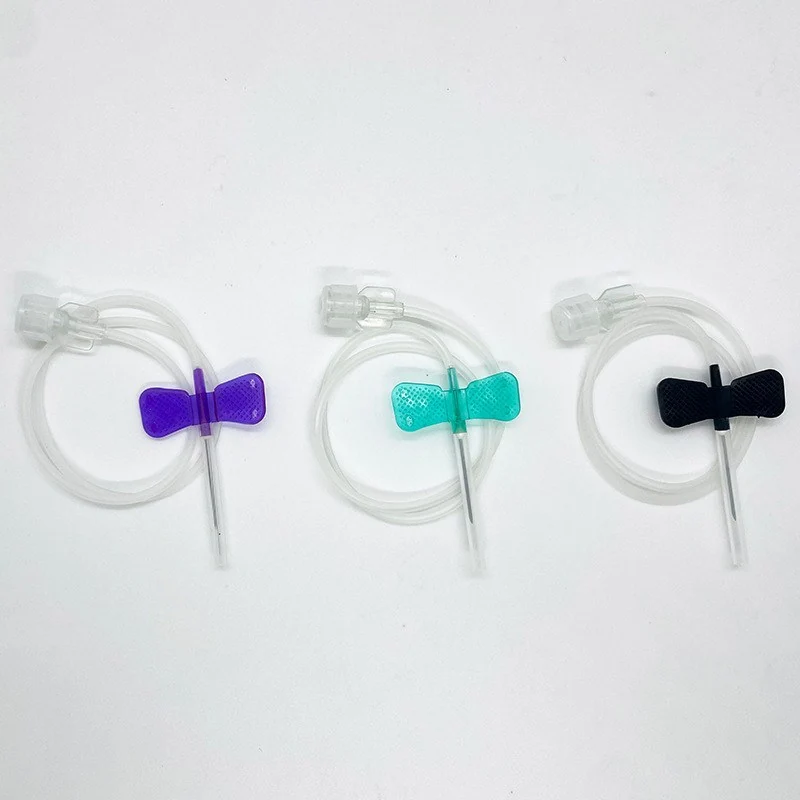
The Gauge (G) defines the thickness of needles, winged sets and IV catheters, and its colour code is universal. This is the quick reference for Gauge by colour, the approximate flow each size allows and which patient it is used for, plus the key difference from the French scale. It complements the guide on how to calculate the IV drip rate.
Gauge chart: colour, flow and use
On the Gauge scale, the higher the number, the thinner the device. The colour code is standard (ISO) and identifies the size at a glance. Approximate values for a short IV catheter:
| Gauge | Colour | Outer diameter | Approx. flow | Typical use |
|---|---|---|---|---|
| 14 G | Orange | 2.1 mm | ~240 ml/min | Trauma, major surgery, massive resuscitation |
| 16 G | Grey | 1.8 mm | ~180 ml/min | Surgery, polytrauma |
| 18 G | Green | 1.3 mm | ~90 ml/min | Blood products, contrast, standard adult |
| 20 G | Pink | 1.1 mm | ~60 ml/min | General adult, fluid therapy |
| 22 G | Blue | 0.9 mm | ~36 ml/min | Small veins, elderly, paediatrics |
| 24 G | Yellow | 0.7 mm | ~20 ml/min | Neonates, paediatrics, very small veins |
Practical rule: use the smallest cannula (highest number) that meets the indication; large gauges (14–16 G) only when fast flow is needed (trauma, transfusion), because they are more traumatic to the vein.
Gauge determines flow (and the drip)
The flow a catheter allows depends mainly on its gauge and length (Poiseuille's law): the larger the diameter and the shorter the length, the higher the flow. That is why rapid volume resuscitation uses a short, large cannula (14–16 G), not a long, thin central line.
This maximum flow is different from the prescribed drip rate, which is set with the IV set's roller clamp. The gauge sets the flow "ceiling"; the drip is calculated and regulated separately — see how to calculate drops per minute.
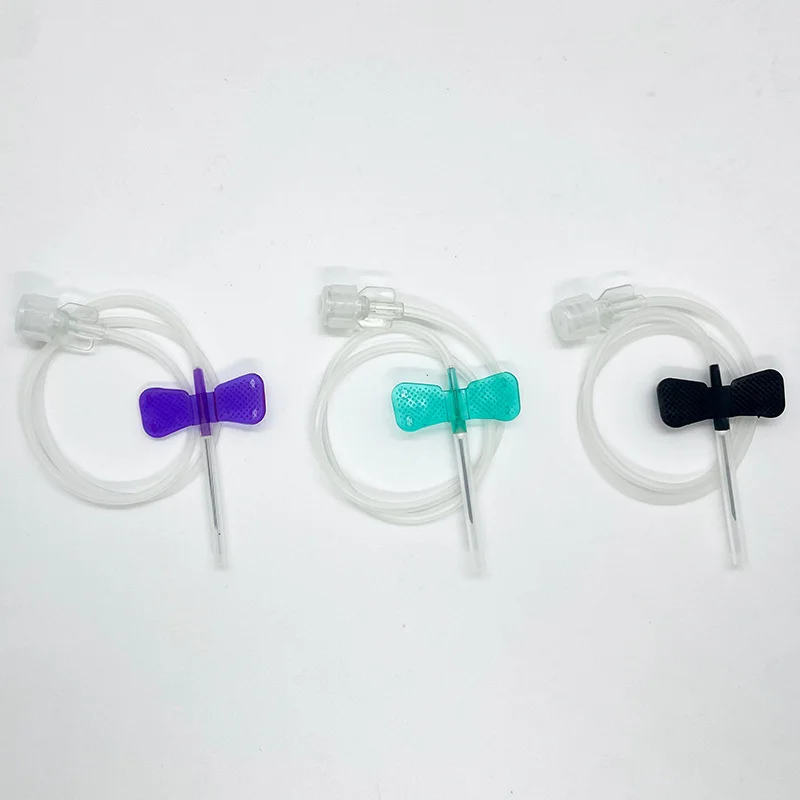
In the butterfly / scalp needle, the usual gauges (e.g. 21–25 G) carry the same colour code and are chosen the same way: thinner for difficult veins, paediatrics and geriatrics.
That reasoning does not stop at the needle. The tubing behind it has its own lumen and the same consequence for flow, only it is specified in millimetres rather than gauge: a needle-free extension line is ordered with a 1.6 mm lumen for general infusion, 1.0 mm where dead volume matters, or 3.0 mm where high flow is needed. Getting the cannula gauge right counts for little if the line feeding it throttles the flow.
Gauge vs French: opposite scales
Don't confuse the two size scales:
| Gauge scale (G) | French scale (Fr) | |
|---|---|---|
| Used on | Needles, winged sets, short IV catheters | Catheters and tubes (Foley, suction, NG) |
| Direction | Higher number = thinner | Higher number = thicker |
A 24 G needle is very thin; a 24 Fr catheter is thick. For catheter sizing and the mm conversion, see the French size chart.
Choosing needles and winged sets for your stock
In an infusion clinic or a warehouse that supplies several departments, the first thing is a sharp, ISO-compliant colour code by gauge; that alone heads off half the selection errors. The range has to run from the fine neonatal and paediatric gauges (24 to 22 G) up to the thicker adult and fast-flow ones (18 to 14 G), because running out of a size forces people to improvise.
On the winged set, look at the triple-cut bevel, the fixation wings and a Luer-lock that mates with the needle-free connectors, IV sets and extensions you already use. All latex-free; DEHP-free too for oncology and paediatrics. EO sterilisation and individual packaging.
We make the needles and winged sets ourselves, with CE, ISO 13485 and lot traceability. We'll send samples of the gauges that move most so you can test the bevel and colour before ordering volume; message us on WhatsApp and we'll quote by the box for your destination.
Frequently Asked Questions
What colour matches each Gauge size?
The standard code is: 14 G orange, 16 G grey, 18 G green, 20 G pink, 22 G blue and 24 G yellow. On the Gauge scale the higher the number the thinner the device, so 24 G (yellow) is very thin and 14 G (orange) is the thickest.
Which IV gauge is used in each case?
Approximately: 14–16 G for trauma, major surgery and massive resuscitation; 18 G for blood products, contrast and the standard adult; 20 G for general fluid therapy; 22 G for small veins, the elderly and paediatrics; and 24 G for neonates and very small veins. Use the smallest gauge that meets the indication.
Does a higher Gauge mean thicker or thinner?
A higher Gauge number means a thinner device. It is the opposite of the French scale used on catheters, where a higher number means thicker. That is why a 24 G needle is very thin and a 24 Fr catheter is thick.
Does the catheter gauge change the infusion speed?
Yes: the gauge sets the maximum possible flow (a 14–16 G allows rapid resuscitation; a 22–24 G, low flows). But the prescribed drip rate is set separately with the IV set's roller clamp. The gauge fixes the flow ceiling; the drip is calculated and regulated separately.