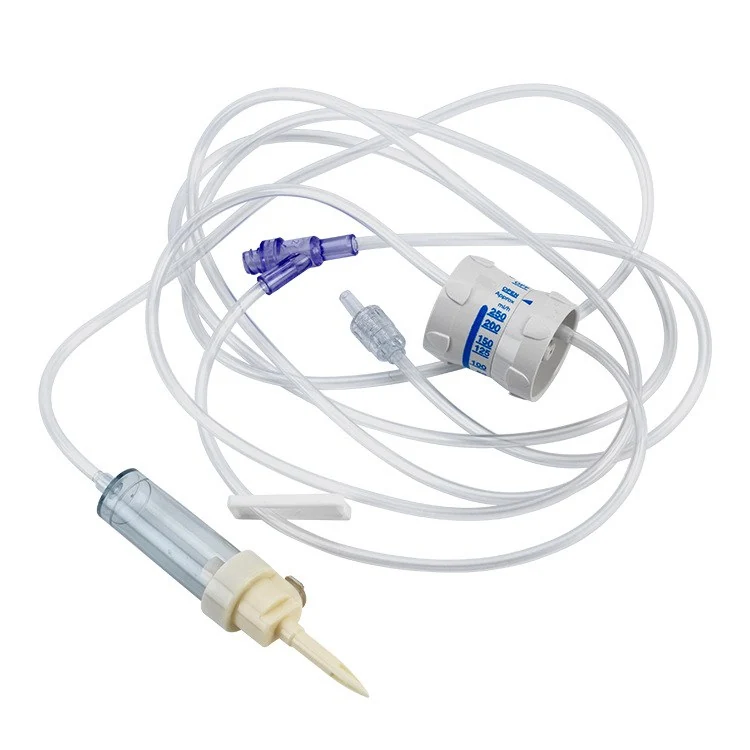
The IV infusion set (giving set, drip set) is one of the most-used nursing supplies, and two questions always come with it: "how often is it changed?" and "how do I calculate the drops per minute?". This guide sums up the change frequency by type of solution, the drip formula with the set's drop factor (macrodrip vs microdrip), worked examples and what to check when buying IV sets wholesale for clinics, hospitals and distributors. It complements our IV supplies guide for infusion clinics.
How often to change the IV set
Change frequency depends on what is being given, not on a single interval. Reference rules:
| Fluid / set type | Change frequency |
|---|---|
| Continuous IV solutions (non-lipid) | Up to every 96 h (4 to 7 days) |
| Blood and blood products | With each unit, or every 4 h |
| Parenteral nutrition with lipids | Every 24 h |
| Lipids alone / propofol | Every 12 h |
| Intermittent sets / frequent disconnection | Per protocol, higher contamination risk |
Always change sooner if contamination is suspected, blood residue that won't clear, compromised integrity (crack, leak) or when changing patients. The needle-free connector is changed with the set — see how often to change the needle-free connector and how to disinfect it.
Do not change the set more often than indicated: every opening of the system is a chance for contamination.
The drop factor: macrodrip vs microdrip
Each set delivers a fixed number of drops per millilitre: the drop factor (gtt/ml), printed on the package. It is the key to the calculation.
| Set type | Drop factor | Typical use |
|---|---|---|
| Macrodrip | 20 gtt/ml (some 10 or 15) | Adults, high volumes |
| Microdrip | 60 gtt/ml (microdrops) | Paediatrics, neonates, precision drugs |
The microdrip (60 gtt/ml) lets you fine-tune small volumes precisely; that is why it is used in children and in infusions that demand accuracy. Always confirm the factor on the specific set's package, because it varies between manufacturers.
How to calculate drops per minute (with examples)
The universal formula:
Drops/min = (Total volume in ml × Drop factor in gtt/ml) ÷ Total time in minutes
Example 1 — macrodrip (20 gtt/ml): give 1000 ml over 8 hours.
- Time = 8 × 60 = 480 min.
- Drops/min = (1000 × 20) ÷ 480 = 20,000 ÷ 480 ≈ 42 drops/min.
Example 2 — macrodrip (20 gtt/ml): give 500 ml over 4 hours.
- Drops/min = (500 × 20) ÷ 240 = 10,000 ÷ 240 ≈ 42 drops/min.
Example 3 — microdrip (60 gtt/ml): give 100 ml over 2 hours (paediatrics).
- Drops/min = (100 × 60) ÷ 120 = 6,000 ÷ 120 = 50 microdrops/min.
Shortcut for a 20 gtt/ml macrodrip: drops/min equal ml/hour ÷ 3. In example 1: 125 ml/h ÷ 3 ≈ 42 drops/min.
Shortcut for a 60 gtt/ml microdrip: microdrops/min equal the ml/hour (100 ml over 2 h = 50 ml/h = 50 microdrops/min).
If an infusion pump is available, it is programmed directly in ml/h and there is no need to count drops; the manual calculation is for gravity drips.
Setting, monitoring and common mistakes
Setting by gravity: hang the bag about 60–100 cm above the puncture site, open the roller clamp and count drops in the chamber for one minute (or 15 s × 4), adjusting to the calculated rate.
Monitoring: the gravity rate varies with arm position, bag height and line patency; recount periodically. Check the puncture site for extravasation or phlebitis.
Common mistakes:
- Using the wrong drop factor (calculating with 20 when the set is 60, or vice versa): a serious dosing error.
- Not priming the set properly: air in the line distorts the drip.
- Relying on a gravity drip for critical drugs: use a pump.
- Not recounting after moving the patient.
- Leaving the set beyond its change interval.
Choosing IV sets
With an IV set, the first thing is the drop factor clearly printed on the package: macrodrip at 20 gtt/ml for general use and microdrip at 60 gtt/ml for paediatrics and precision. The drip chamber should be transparent so you can count, with a particle filter, and graduated on precision microdrip sets. The roller clamp has to hold the rate without creeping, and the spike has to seal the bag well. On compatibility, look for a universal Luer-lock connection with the needle-free connectors, three-way stopcocks and extensions you already use; for paediatrics, oncology and many tenders, the DEHP-free and latex-free set is the one to have.
To cover special cases it helps to stock the precision microdrip set, the burette set for controlled paediatric volumes, the light-protected one for light-sensitive drugs and the pump set. We make them with CE, ISO 13485, EO sterilisation and lot traceability; ask us for samples before quoting volume and we'll take it to WhatsApp.
Frequently Asked Questions
How do you calculate drops per minute?
With the formula: Drops/min = (Volume in ml × Drop factor in gtt/ml) ÷ Time in minutes. For example, 1000 ml over 8 hours with a 20 gtt/ml macrodrip: (1000 × 20) ÷ 480 = 42 drops/min. With a 60 gtt/ml microdrip, the microdrops/min match the ml/hour.
What is the drop factor of a macrodrip and a microdrip?
A macrodrip usually delivers 20 drops per ml (some models 10 or 15) and is used in adults and high volumes. A microdrip delivers 60 microdrops per ml and is used in paediatrics, neonates and precision drugs. Always confirm the factor printed on the specific set's package.
How often is the IV infusion set changed?
Continuous non-lipid IV solutions allow changing the set up to every 96 h (4–7 days). Parenteral nutrition with lipids is changed every 24 h, lipids alone or propofol every 12 h, and blood with each unit or every 4 h. Always sooner if there is contamination, blood residue or a patient change.
Is there a shortcut to calculate the drip with a 20 gtt/ml macrodrip?
Yes: drops per minute roughly equal ml/hour divided by 3. For example, 125 ml/h ÷ 3 ≈ 42 drops/min. With a 60 gtt/ml microdrip the shortcut is even simpler: microdrops/min equal the ml/hour.