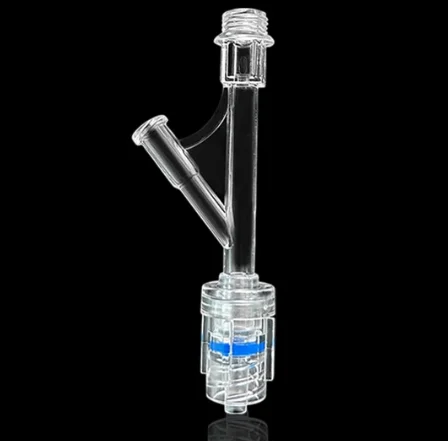
The needle-free connector (bioconnector) is the gateway to the intravenous line: if it gets contaminated, bacteria reach the bloodstream directly and cause catheter-associated bloodstream infection (CLABSI). The two questions that define its safe use are "how often is it changed?" and "how is it disinfected before each access?". This guide sums up the change frequency, the scrub-the-hub friction technique, the SAS and SASH flushing protocols, and what to check when buying needle-free connectors wholesale for an infusion clinic, ICU or distributor. It complements our needle-free connector selection guide.
How often to change the needle-free connector
The needle-free connector is changed at the same frequency as the administration set (IV set), not independently. Reference frequencies:
| Situation | Change frequency |
|---|---|
| With the administration set (general rule) | Every 4 to 7 days (96 h, up to 7 days) |
| Parenteral nutrition, lipids, blood products | Every 24 h (with its set) |
| If disconnected, contaminated or with blood residue | Immediate change |
| Compromised integrity (crack, leak) | Immediate change |
Rules that force an early change:
- If it is removed for any reason (the same one is not put back).
- If there is visible blood or residue that flushing does not clear.
- After drawing blood products or taking blood samples through that line.
- If contamination is suspected or the manufacturer's interval has been reached.
Do not change it more often than indicated: every manipulation is a chance for contamination. The balance is respecting the interval and changing it whenever there is a clinical indication.
How to disinfect the connector before each access (scrub the hub)
Disinfecting the connector before every access is the single measure that most reduces bloodstream infection. The technique, known as *scrub the hub*:
- Vigorous friction of the surface and sides of the connector with a 70% isopropyl alcohol wipe, or alcoholic chlorhexidine >0.5%, or povidone-iodine.
- Scrub for at least 15 seconds (some protocols indicate up to 30 s with chlorhexidine).
- Let it dry the necessary time before connecting — the antiseptic works as it dries; connecting wet carries the product into the lumen.
- Access only with sterile equipment.
Disinfecting caps (port protectors): alcohol-impregnated caps that screw onto the connector between uses. They maintain passive disinfection and are a good complementary measure in high-risk patients, but they do not replace active friction before each access.
A connector clean on the outside but poorly scrubbed is still an entry route: the key is mechanical friction, not just "wiping with alcohol".
Flushing the line: SAS and SASH protocols
Keeping the catheter lumen patent and free of residue is the other half of the care. It is done with two flushing protocols:
SAS — Saline / Administer / Saline:
- S: flush with sterile saline before administering.
- A: administer the drug or solution.
- S: flush again with saline afterwards.
It is the standard protocol before and after any drug, to clear residue and avoid incompatibilities between medications.
SASH — Saline / Administer / Saline / Heparin (lock):
- The same as SAS, but adds a final lock (H) with a heparinised or locking solution when the catheter is going to be at rest, to prevent clot occlusion.
Pulsatile flush technique (push-pause): pushing the saline in small bursts creates turbulence that cleans the inner walls better than a continuous push. Closing with positive pressure according to the connector type avoids the blood reflux that occludes the lumen.
The connector type (positive, negative or neutral pressure) determines the exact clamping and disconnection sequence — check the manufacturer's instructions.
How to choose needle-free connectors
For an infusion clinic, an ICU or a distributor, the first criterion is the displacement mechanism: positive pressure, which reduces blood reflux on disconnection, negative or neutral; since each mechanism defines the clamping protocol, standardising a single type in the centre avoids nursing errors. The friction surface should be a flat, smooth septum with no recesses, that can be scrubbed and dried well, because that's what eases scrub-the-hub. The fluid path, transparent and with no dead space, to see blood residue and allow a complete flush, since dead spaces trap blood and biofilm. Universal Luer-lock compatibility with syringes, sets and extensions, with resistance to infusion-pump pressure and to a contrast injector if used in radiology. And latex-free and DEHP-free, with EO sterilisation and ISO 10993 biocompatibility, which is a requirement in paediatrics and many tenders.
We make them with CE (MDR 2017/745), ISO 13485 and lot traceability, with national registration per country; ask us for the technical documentation and samples before quoting volume and we'll take it to WhatsApp.
One decision comes before all of these: whether the connector is bought loose to be fitted at the bedside, or arrives already fitted to the tubing. The needle-free extension line carries the valve assembled and sterilised at the factory on every branch, with its clamp. That is one less bedside manipulation, one less open connection point, and one stock reference instead of three.
Frequently Asked Questions
How often is the needle-free connector changed?
The needle-free connector is changed together with the administration set, as a general rule every 4 to 7 days (up to 96 h–7 days). It is changed every 24 h if used for parenteral nutrition, lipids or blood products. And it is changed immediately if it is disconnected, left with blood residue, cracked or contamination is suspected.
How do you disinfect the connector before using it?
With the scrub-the-hub technique: vigorously scrub the surface and sides of the connector with 70% isopropyl alcohol or alcoholic chlorhexidine >0.5% for at least 15 seconds, and let it dry before connecting. Mechanical friction is what removes the bacteria; just "wiping with alcohol" without scrubbing is not enough.
What is the difference between SAS and SASH?
SAS (Saline–Administer–Saline) is flushing with sterile saline before and after each drug, to clear residue and avoid incompatibilities. SASH adds a fourth step: Heparin or lock the line with a locking solution when the catheter is going to rest, to prevent clot occlusion.
Do disinfecting caps replace scrubbing with alcohol?
No. Alcohol-impregnated caps (port protectors) maintain passive disinfection between uses and are useful in high-risk patients, but they do not replace active scrub-the-hub before each access. Mechanical friction remains mandatory.