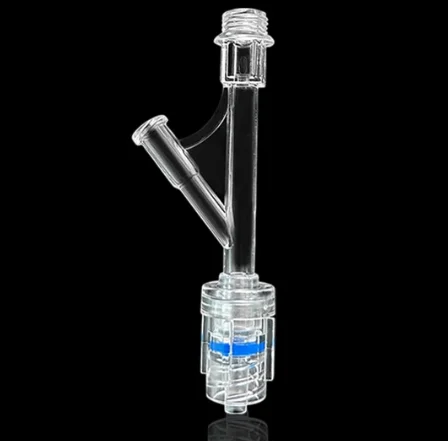
The needle-free connector (needleless connector), the Y injection site and the three-way stopcock are small but critical pieces: they form the access system of almost all intravenous therapy. They allow injecting medication, flushing the line, taking samples and combining several infusions without needle sticks. This guide explains what each component does, how they differ, how they help reduce catheter-related bloodstream infections (CLABSI) and why injecting contrast media in CT and MRI requires a specific high-pressure version. Written for ICU, radiology, nursing and hospital procurement.
What is a needle-free connector?
A needle-free connector is a Luer-activated valve installed at the access point of an IV line. At rest it stays closed; when a Luer-lock syringe or set is connected, the valve opens and allows fluid through. When the syringe is removed, it seals again automatically.
The name says it all: it removes the need for a needle to access the line. Before its adoption, staff pierced a rubber port with a needle every time they gave a medication, with constant risk of needle-stick injury and contamination. The needle-free connector replaces that port with a closed system actuated only by the Luer connection.
Its five basic functions: administering medication (boluses or infusion), flushing the line (saline or heparin), drawing blood samples, switching between solutions and connecting additional infusion sets — all without opening the system or using a needle.
Y-connector, three-way stopcock and manifold: how they differ
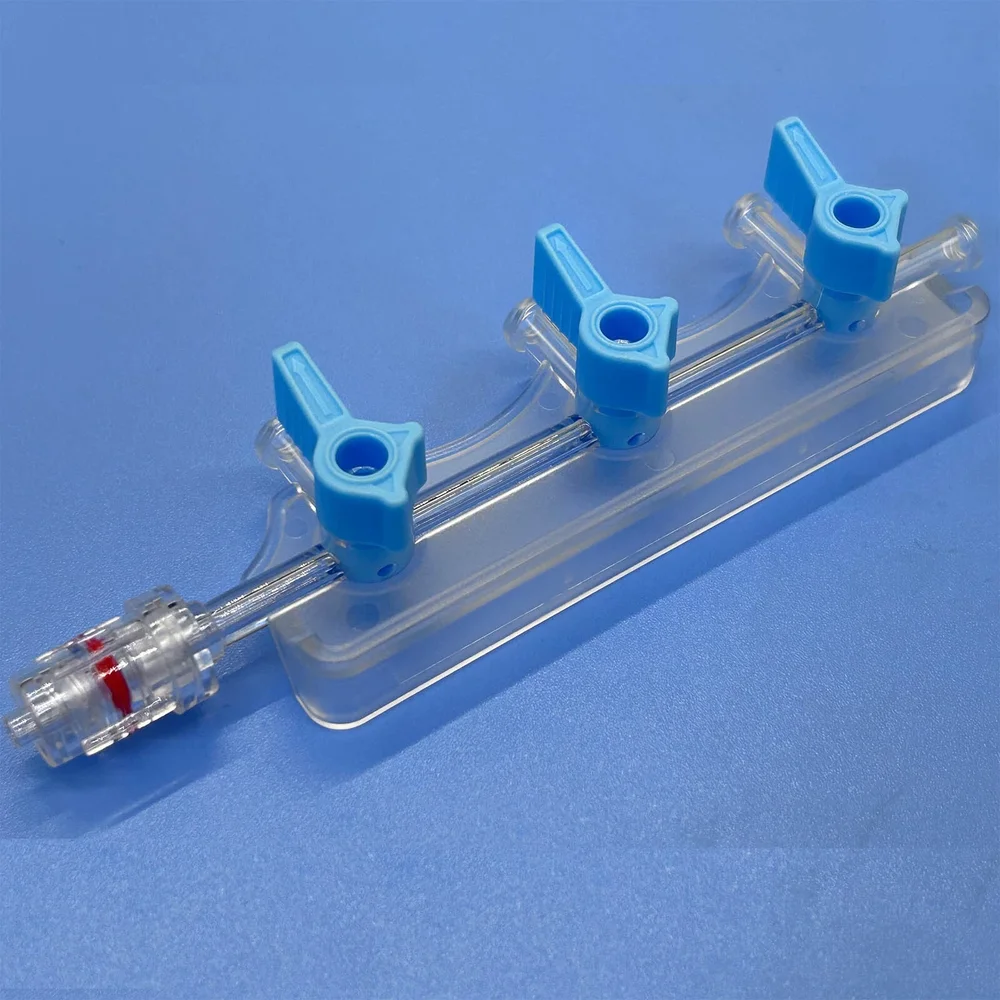
Although they belong to the same family and are sometimes confused, each component has a distinct function:
Y injection site (Y connector): adds a side port to the main line in a "Y" shape. It allows injecting a medication or flushing the line without interrupting the running infusion. The simplest option for intermittent access.
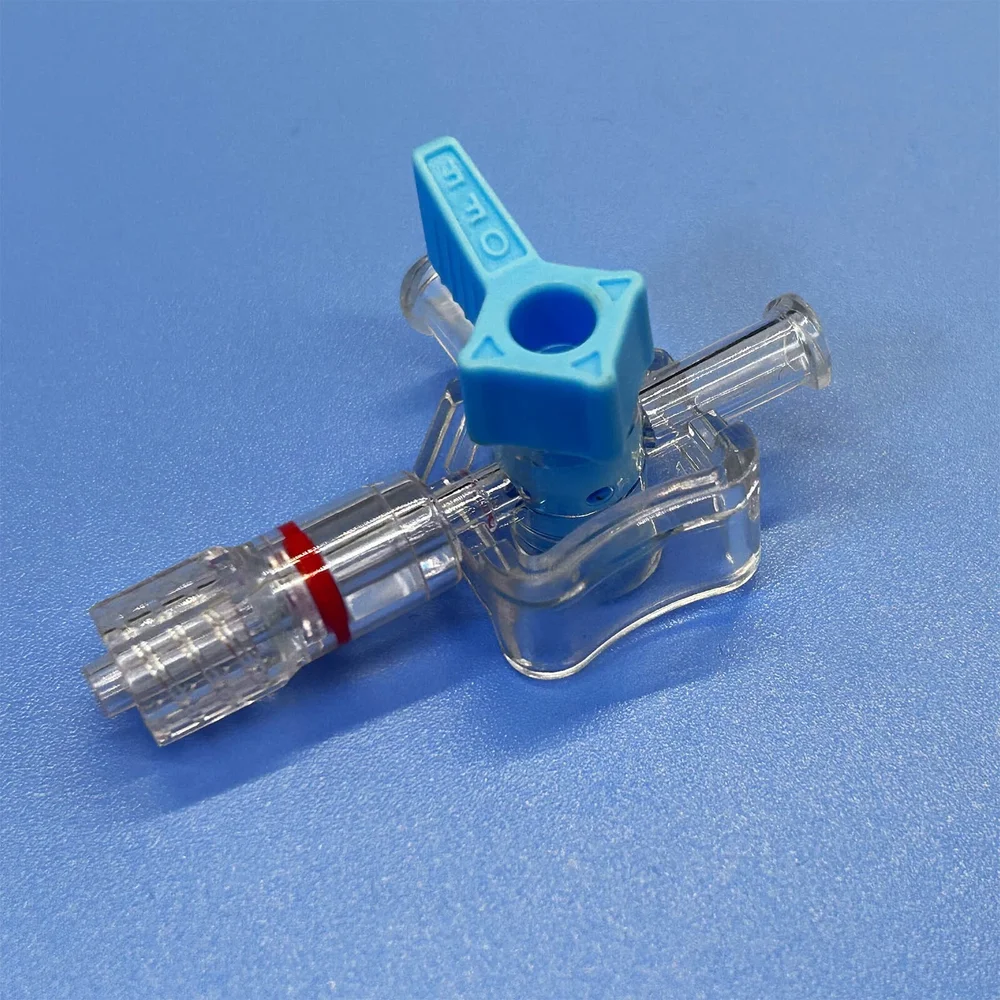
Three-way stopcock: has a rotating handle that connects or isolates three ports. By turning the handle, the operator decides which path stays open: close the line, redirect flow or switch between two solutions. The flow-control piece par excellence.
3-gang manifold: groups several three-way stopcocks mounted in series on one base. It allows several syringes or lines connected at once, each opened independently. Indispensable when a patient receives many drugs simultaneously.
| Component | What it's for | When to use it |
|---|---|---|
| Y-site | Side access port without interrupting flow | Intermittent injection and line flushing |
| Three-way stopcock | Directs, closes or redirects flow between three ports | Switching solutions and controlling flow |
| 3-gang manifold | Groups several stopcocks for multiple access | Several drugs at once (ICU) |
Practical rule: if you only need an occasional injection point, use the Y-site; if you need to control or divert flow, use the three-way stopcock; if you need to give several drugs at once, use the manifold.
How the closed system reduces catheter infections (CLABSI)
Central line-associated bloodstream infections (CLABSI) are one of the most serious and costly complications of prolonged IV therapy. Every line manipulation is an opportunity for microorganisms to enter the system.
The needle-free connector helps in three ways:
- Closed system: the valve seals the line between uses, preventing direct contact of the interior with the environment. Fewer open points means fewer entry routes for bacteria.
- Disinfectable surface: the connector's membrane or septum can be scrubbed with an antiseptic ("scrub the hub") before each access. A smooth, flat surface disinfects better than an irregular port.
- Fewer needle-stick injuries: with no needle, the risk of staff injury is eliminated, a key goal of hospital biosafety programmes.
For the benefit to be real, the connector must be paired with good practice: disinfecting the port before each use, flushing the line after each medication, and replacing the connector per the institution's protocol (usually every 72–96 hours or per the manufacturer). It is commonly used on a central venous catheter (CVC) and peripheral lines alike.
Contrast injection in CT and MRI: why the high-pressure version is needed
Contrast radiology is one of the fields where these connectors are most used, and also where most errors occur if the wrong product is chosen.
Computed tomography (CT), magnetic resonance imaging (MRI), angiography and digital subtraction angiography (DSA) require injecting the contrast medium quickly and at high pressure, usually with a power injector. These injectors generate pressures far above gravity or pump infusion: they can reach several hundred psi.
A standard needle-free connector, designed for low-pressure infusion, can crack, disconnect or burst under that pressure, with risk of contrast extravasation and patient injury. That's why the high-pressure version (high-pressure connector / contrast injection connector) exists, made with reinforced materials and joints and validated to withstand the injector pressure (usually up to 300 psi).
The typical contrast delivery set-up is:
power contrast injector → high-pressure extension line → high-pressure Y-connector → patient.
| Parameter | Standard connector | High-pressure connector |
|---|---|---|
| Working pressure | Low (gravity / pump) | Up to 300 psi |
| Use with contrast injector | Not suitable | Suitable (CT, MRI, DSA) |
| Typical application | IV infusion and medication | Contrast medium injection |
| Materials/joints | Standard | Reinforced |
Safety rule: in CT and MRI with a power injector, ALWAYS use components labelled high-pressure (including the extension line). Never use a standard connector or infusion line for contrast injection.
Where it's used and what to check before buying
These connectors are used in virtually every service: ICU, ER, OR, radiology, CT and MRI suites, the interventional centre, cardiology and oncology, plus home infusion — a strongly growing segment in Europe and North America.
For procurement teams and distributors, the key points to verify before an order:
- Connection type: standard Luer-lock per ISO 80369-7, to guarantee compatibility with peripheral catheters, PICC, CVC, syringes and injectors.
- Correct version: define from the start whether you need the standard version (infusion) or high-pressure (contrast). They are different products.
- Priming volume: a low volume reduces dead space and medication loss, important in paediatrics and costly drugs.
- Material and absence of latex/DEHP: clear medical polycarbonate, latex- and DEHP-free.
- Sterilisation and packaging: ethylene oxide (EO), individual peel-pouch with sterility indicator.
- Regulatory documentation: ISO 13485 certificate, CE marking, datasheet and free-sale certificate.
- OEM options: logo printing and private-label packaging if distributed under own brand.
Edaochi Medical offers the needle-free connector in all three configurations (Y-site, three-way stopcock and 3-gang manifold), in standard and high-pressure contrast versions, with full CE and ISO 13485 documentation. Samples and quote on WhatsApp in under 24 hours.
Frequently Asked Questions
What is the difference between a needle-free connector and a Y injection site?
The needle-free connector is the general concept: a Luer-activated valve that gives needle-free access to the line. The Y injection site is a specific configuration that adds a Y-shaped side port to the main line, allowing injection or flushing without interrupting the infusion. Many Y-sites incorporate a needle-free valve at that port.
When do you use a three-way stopcock instead of a Y-connector?
Use the three-way stopcock when you need to control or divert flow: close the line, redirect it or switch between two solutions by turning the handle. The Y-connector only adds an injection point; it cannot close or redirect flow.
Can I use a standard needle-free connector for contrast injection in CT?
No. Contrast injection with a power injector generates very high pressures (up to ~300 psi) that a standard connector cannot withstand, with risk of cracking or disconnection. You must use the high-pressure version (high-pressure / contrast injection connector) together with a high-pressure extension line.
Do these connectors help reduce infections?
Yes, as part of a protocol. Their closed-system design and disinfectable surface reduce microorganism entry and therefore the risk of catheter-related infection (CLABSI), provided the port is disinfected before each access and periodic replacement is respected.
How often should the needle-free connector be changed?
It depends on each institution's protocol and the manufacturer's instructions, but it is usually replaced every 72–96 hours, or sooner if there are signs of obstruction, blood residue or loss of integrity. It is a single-patient, single-use device.
Do you offer an OEM or private-label version?
Yes. Edaochi Medical offers all three configurations (Y-site, three-way stopcock and manifold) in standard and high-pressure versions, with logo printing and private-label packaging options, and full CE and ISO 13485 documentation for export.