
IV infusion clinics are one of the fastest-growing settings in outpatient medicine. Each infusion session consumes between 5 and 12 disposable supplies. Optimising your clinic's inventory can mean 15–25% savings in annual operating costs. This guide covers the core IV consumables and what to look for when buying them wholesale.
Disposable tourniquet: the change with the biggest cross-infection impact
An ECDC study found that reusable tourniquets are the number-one vector for MRSA and VRE transmission in phlebotomy rooms. The disposable tourniquet is soft latex-free TPE, discarded after each patient. The incremental cost versus a reusable tourniquet is less than USD 0.08 per use — one of the highest-impact, lowest-cost infection-control upgrades a clinic can make.
Examination gloves: when to use latex vs film

Film gloves are economical and suitable for low-risk procedures. For IV cannulation and blood draws, latex gloves offer greater tactile sensitivity and mechanical resistance, both essential for locating difficult veins. Many clinics stock both: film for routine handling, latex (or nitrile for latex-allergic staff) for the venipuncture itself.
IV bottle sealing patch and the access line

After inserting the infusion set into the IV bottle, the hole is exposed to the environment. The sealing patch covers it with a medical adhesive that prevents particles and microorganisms entering throughout the infusion — mandatory in long infusions and immunocompromised patients.
The access line itself (needle-free connectors, Y-sites, stopcocks) is where most manipulation happens; choosing a closed system reduces catheter-related infection. See our needle-free connector and IV access guide and, for central access, the CVC guide.
Running several lines on one access? Stopcocks and manifolds
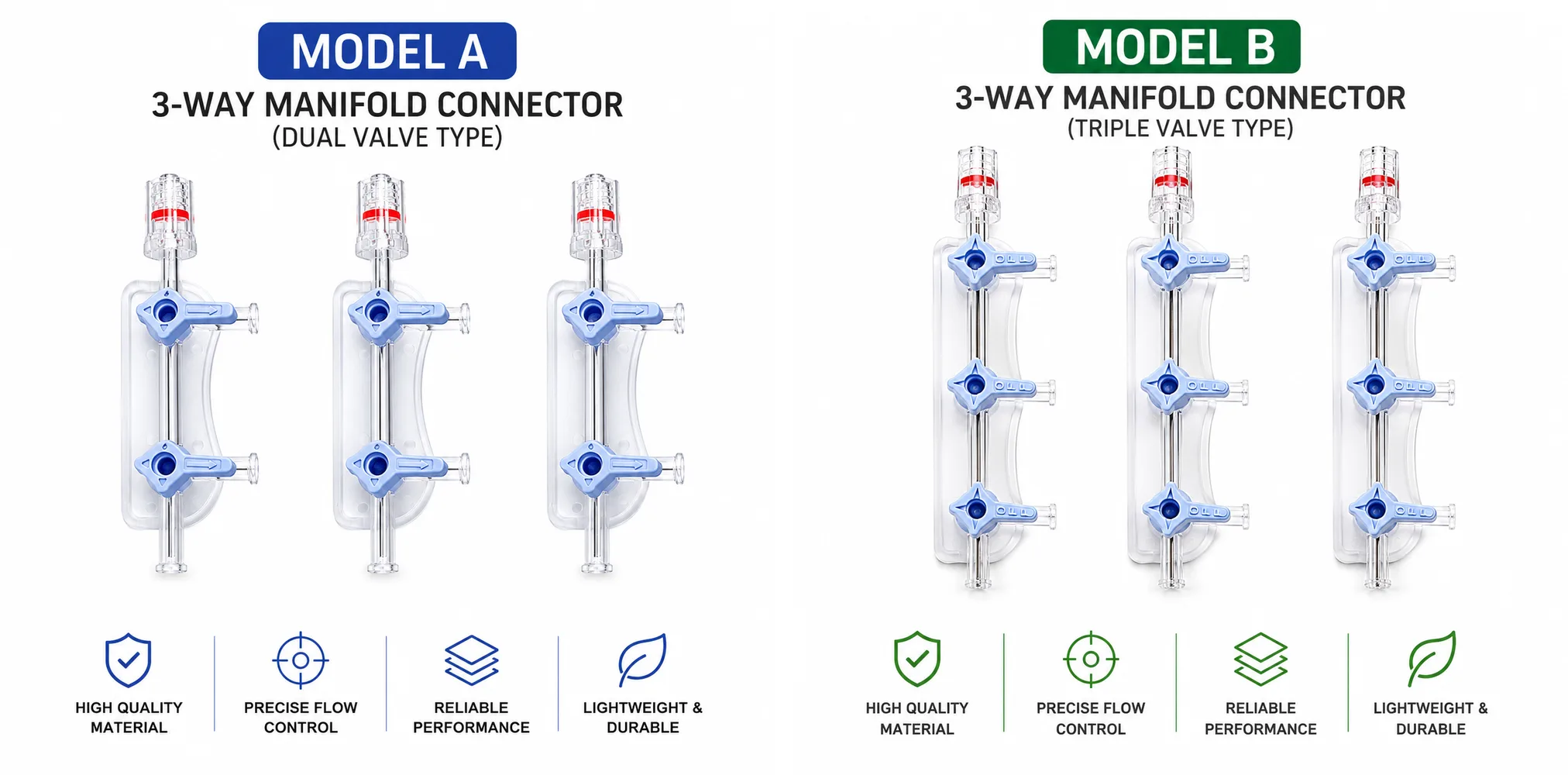
When a clinic gives more than one drug through the same access, chaining loose 3-way stopcocks multiplies connection points and stock references. A 3-way stopcock manifold connector integrates two or three stopcocks into one moulded body: a single part number that covers multi-line flow control. It comes in a dual-valve type (2 stopcocks) and a triple-valve type (3 stopcocks), both Luer-compatible. Station counts, colour coding, packaging options and MOQ for the whole range are set out on the IV infusion manifold sourcing page.
Frequently Asked Questions
Which IV supplies does an infusion clinic need?
The basics include: disposable tourniquets, examination gloves (latex or nitrile), bottle sealing patches, sterile gauze, transparent catheter dressings and infusion sets. For chemotherapy clinics, add in-line filters and special sets.