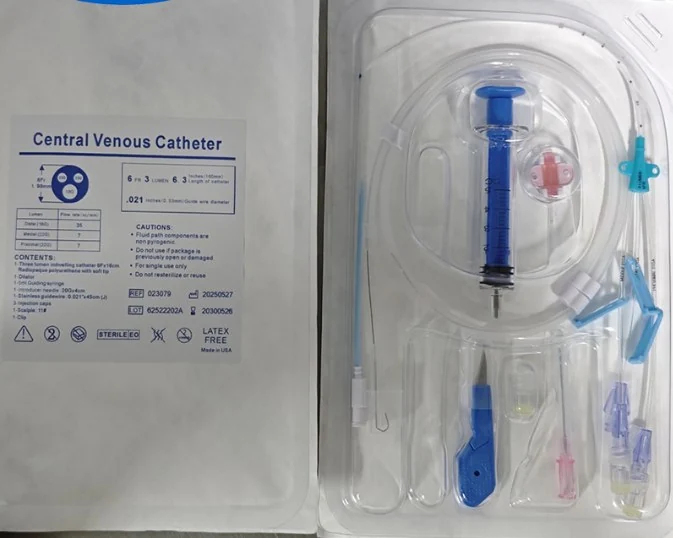
The central venous catheter (CVC) is the vascular access for critically ill patients: through it you give vasoactive drugs, parenteral nutrition or chemotherapy and monitor central venous pressure, when a peripheral line no longer cuts it. But "CVC" isn't one product: it changes with the number of lumens (one, two or three), the insertion route and the expected dwell time (non-tunneled, tunneled, PICC or port), and choosing wrong means a repeat puncture or running out of the right configuration. Let's look at the types, how to choose the number of lumens, what the Seldinger kit contains and what to check before buying in volume. It pairs with our guide to the types of catheters.
What it is and how it differs from a peripheral line
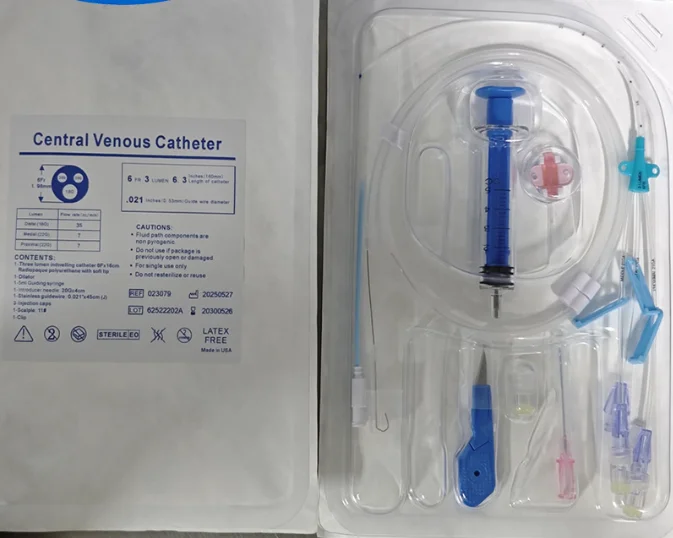
A central venous catheter is a long catheter whose tip sits in a central vein, usually the superior vena cava, while a peripheral line — the everyday cannula — leaves its tip in an arm or hand vein. That difference defines what each is for.
The peripheral line is short-term (72–96 h), for fluids and routine medication; high volume, low cost. The CVC, by contrast, reaches a high-flow stream that dilutes irritant or concentrated drugs well (vasoactives, chemotherapy, parenteral nutrition) and also lets you monitor central venous pressure. That's why it shows up in the critically ill ICU patient, in total parenteral nutrition, in chemotherapy and dialysis, and when venous access is difficult and no peripheral line can be obtained. The purchase comes down to three variables: number of lumens, type by insertion and dwell time, and what the kit contains.
How many lumens: 1, 2 or 3
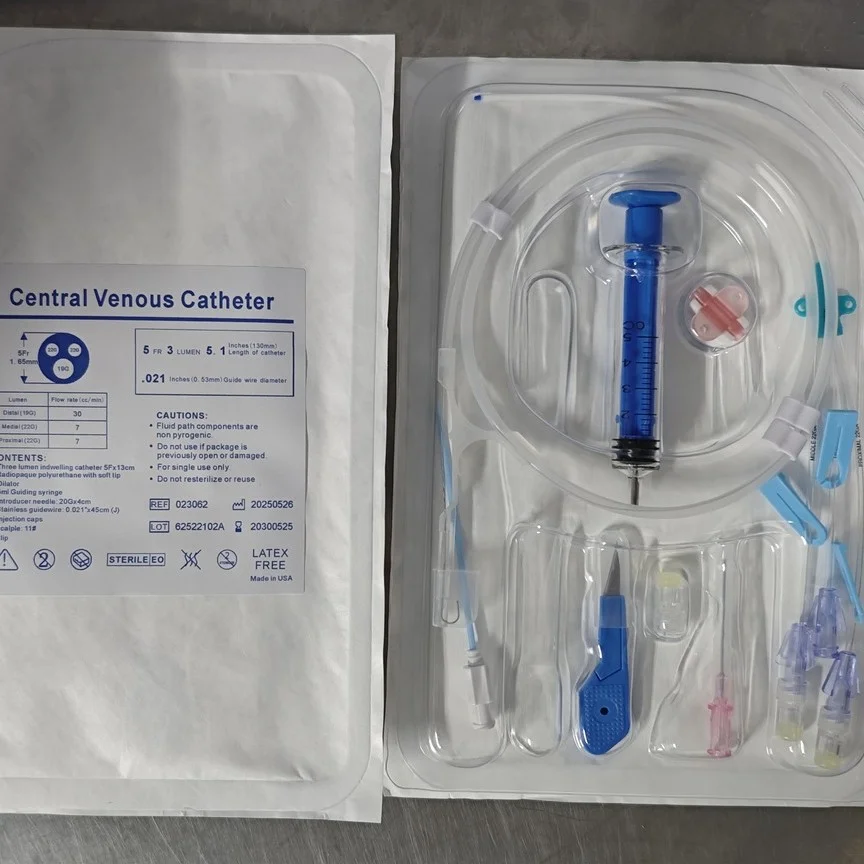
The first decision is how many lumens (independent channels) you need. Each lumen delivers something different at the same time without mixing. A single lumen is enough for simple access, chemotherapy or a single-line parenteral nutrition. A double lumen is for when two incompatible infusions have to run at once. And a triple lumen is the ICU standard, because the critical patient usually has vasoactives, nutrition and medication or CVP monitoring going at the same time.
The rule is not to overdo it: the more lumens, the more versatile, but also the larger the size and the more manipulation points, and therefore the higher the infection risk. Use only the lumens you'll actually need. In practice an ICU mostly stocks triple lumen with a few single lumens as backup, and oncology mixes single lumen with long-dwell access devices.
Types by insertion and dwell time
The other big variable is how and for how long the catheter goes in, and here's the most-searched distinction: tunneled or non-tunneled.
| Type | Dwell time | Insertion | Typical use |
|---|---|---|---|
| Non-tunneled | Days to weeks | Direct puncture into a central vein (jugular/subclavian/femoral) | ICU, emergency, the "classic" CVC |
| Tunneled | Weeks to months | Tunneled under the skin before entering the vein | Dialysis, prolonged chemotherapy |
| PICC | Weeks to months | Via an arm vein up to a central vein | Long antibiotics, TPN, outpatient chemo |
| Port (reservoir) | Months to years | Fully implanted under the skin | Intermittent long-term chemotherapy |
For buying, the part that matters: the non-tunneled is the highest-turnover hospital item and the one sold as a Seldinger kit; the tunneled and the port are surgical insertions and lower volume; and the PICC is a low-competition niche with growing home-care demand. For most ICU purchasing, the key product is the non-tunneled CVC kit, in whichever lumen configuration fits.
The Seldinger method and what the kit contains
The non-tunneled CVC is placed by the Seldinger technique, and that's why it ships as a complete kit rather than a loose catheter: it's a sterile procedure that needs every component at hand. A typical kit brings the radiopaque polyurethane catheter (the radiopaque line confirms where the tip ends up on a chest X-ray), the J-tip 0.035" Seldinger guidewire the catheter is advanced over, a dilator to open the tract, the 18G introducer needle with its syringe, and the scalpel, the dressing and sometimes a suture or fixation clamp.
In short: puncture the vein, pass the guidewire, remove the needle, dilate, advance the catheter over the wire, remove the wire and secure it. So when buying, what matters isn't just the catheter but that the kit comes complete and that the guidewire and dilator are the right size, because an incomplete kit stops the procedure dead.
Before buying in volume
For a hospital restocking ICU inventory or a distributor, what makes the difference is concrete. That the lumen configurations are there, single, double and triple, to cover everything from simple access to the ICU. That the catheter is radiopaque polyurethane, which softens at body temperature and is gentler on the vein, with a radiopaque line to confirm the tip on X-ray. That the Seldinger kit comes complete (catheter, J-tip 0.035" guidewire, dilator, needle, syringe, scalpel and dressing), because an incomplete kit stops the procedure. That the gauge per lumen and the length match the insertion site (16G/20 cm, say). EO sterilisation with packaging that preserves the sterile order. And, since the CVC is a higher-risk device, a manufacturer with ISO 13485 and the documentation registration tends to ask for, which is more than for a simple consumable.
We make the Seldinger CVC kit, with a radiopaque polyurethane catheter, J-tip 0.035" guidewire, dilator, needle and accessories, in single lumen and, on request, double and triple lumen. Tell us the lumen configuration and the size and we'll put the quote together; message us on WhatsApp with the quantities and we'll get you a box price.
Frequently Asked Questions
What is the difference between a CVC and a peripheral line?
A peripheral line (cannula) leaves the tip in an arm or hand vein and is for short-term use and routine medication. A central venous catheter leaves the tip in a central vein (superior vena cava), tolerates irritant or concentrated drugs (vasoactives, chemotherapy, parenteral nutrition) and allows central venous pressure monitoring. It is used in the critically ill patient when a peripheral line is not enough.
How many lumens should the CVC have?
It depends on how many simultaneous infusions the patient needs. A single lumen is enough for simple access; a double lumen allows two incompatible infusions at once; a triple lumen is the ICU standard, for delivering vasoactives, nutrition and medication at the same time. The rule is to use only the lumens needed, because more lumens mean a larger size and more manipulation points.
What is the difference between a tunneled and a non-tunneled catheter?
The non-tunneled is inserted by direct puncture into the central vein and used for days to weeks (the classic ICU and emergency CVC). The tunneled passes under the skin first before entering the vein, which lowers infection risk and lets it be used for weeks to months; it is common in dialysis and prolonged chemotherapy. The tunneled requires specialised insertion.
What is the Seldinger method and why is the CVC sold as a kit?
The Seldinger technique means puncturing the vein with a needle, passing a guidewire, removing the needle, dilating the tract and advancing the catheter over the wire. Because it is a sterile procedure requiring every component at once (catheter, guidewire, dilator, needle, syringe, scalpel, dressing), the CVC is supplied as a complete kit rather than a loose catheter.
Is the central venous catheter radiopaque, and why does it matter?
Yes, the polyurethane catheter has a radiopaque line. It matters because it lets you confirm on a chest X-ray that the tip is correctly positioned (superior vena cava) after insertion, per clinical practice guidelines. Polyurethane also softens at body temperature and reduces damage to the vein wall.
Does Edaochi offer multi-lumen CVC and private label (OEM)?
Yes. The standard kit is single lumen (16G/20 cm), and double and triple lumen are made on request. We supply the complete Seldinger kit with the quality documentation (ISO 13485) for registration, a low minimum order, samples to evaluate and private-label packaging for distributors. Message us on WhatsApp with the configuration and quantities and we'll get you a box price.