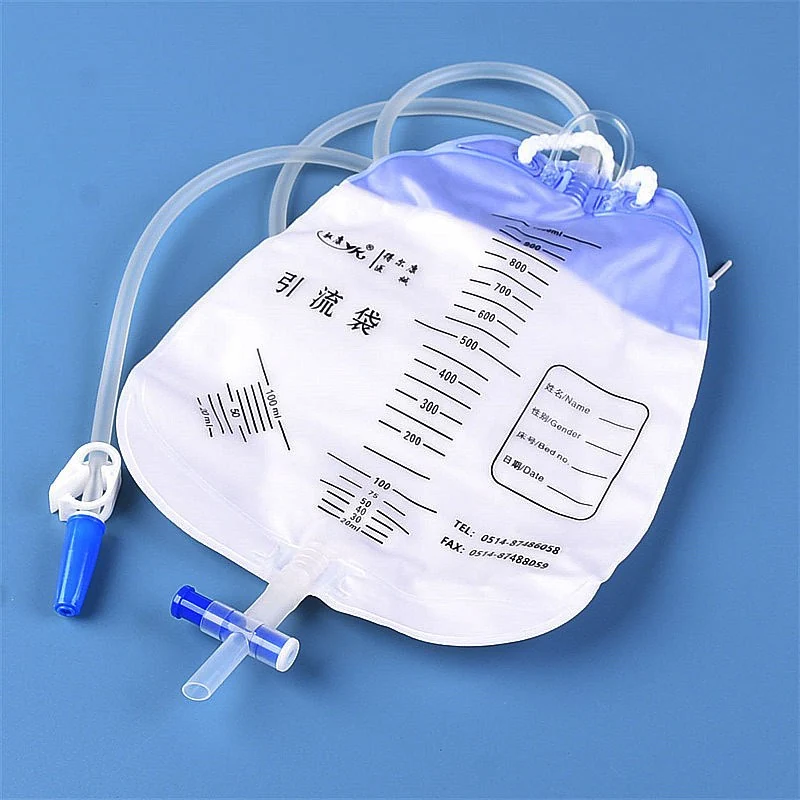
The urinary drainage bag is the Foley catheter's inseparable companion: it collects urine in a closed system that lowers the risk of catheter-associated urinary tract infection (CAUTI). But it isn't one product. There's the 2000 ml bed bag for the bed-bound patient and the 750 or 1000 ml leg bag for the one who walks, and picking the wrong one shows up as extra night emptying, lost mobility or connectors that won't fit. Let's go through the bag's parts, how the bed bag and the leg bag differ, how they combine in the day/night system, why the anti-reflux valve is the key to preventing infection, and what to look at before buying in volume. It pairs with our guide to the types of catheters.
What it is and what it's made of
It's a sterile bag that connects to the Foley catheter to collect urine without opening the circuit between emptyings; that closed system is what holds bacteria back. It's worth knowing its parts, because that's where most of the buying decision lives.
At the inlet it has a connector that fits onto the catheter end and should be a universal size. From there runs the drainage tube that carries urine down to the bag: the longer it is (around 1.2 m on the bed bag), the more freedom to hang it. Inside sits the anti-reflux valve, which stops drained urine from flowing back toward the bladder, and the printed scale for measuring output. At the bottom, a drain tap lets you empty without disconnecting anything, and a sampling port lets you take a sample without opening the system.
In the end it all comes down to one question: where will the patient be, in bed or walking? That decides the capacity and the format.
The bed bag (2000 ml) versus the leg bag (750/1000 ml)
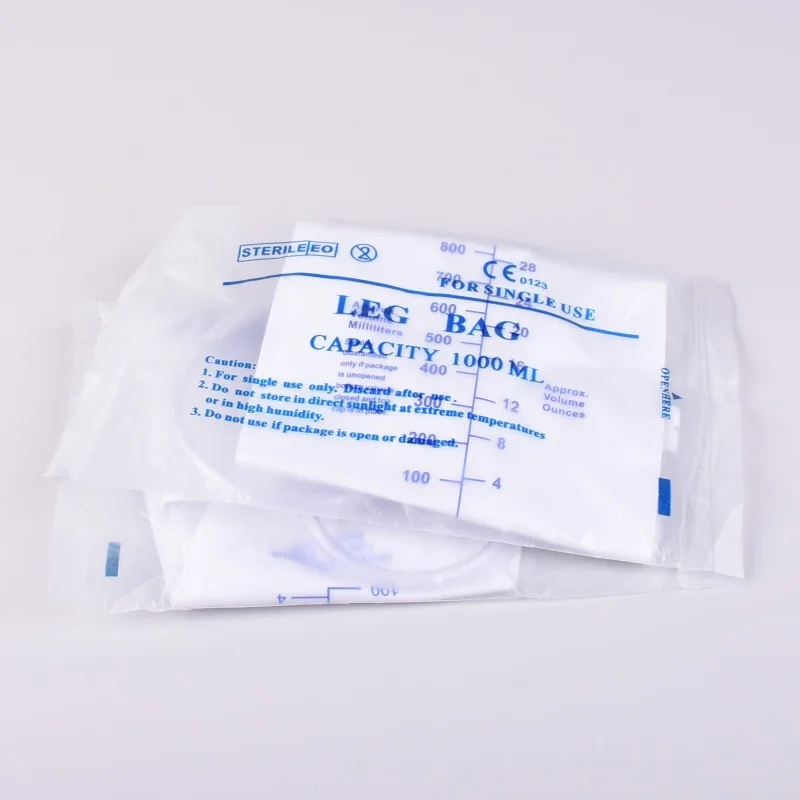
This is the main decision. Both do the same thing, collect urine, but they're built for opposite situations.
| Feature | Bed bag (2000 ml) | Leg bag (750/1000 ml) |
|---|---|---|
| Patient | Bed-bound, hospitalised, post-op | Ambulatory, at home, walking |
| Capacity | 2000 ml (fewer emptyings, ideal at night) | 750 ml (discreet) / 1000 ml (more autonomy) |
| Tube | Long (~1.2 m), to hang from the bed | Short, strapped to the leg |
| Fixation | Handle for bed or wheelchair | Elastic straps to thigh or calf |
| Use | Hospitalisation and output monitoring | Daytime mobility, home care, discretion |
In practice: for the hospitalised or bed-bound patient, the 2000 ml bed bag, because its capacity avoids night emptying and lets you measure cumulative output. For the one walking or at home, the leg bag: the 750 ml is more discreet for everyday use and the 1000 ml gives a bit more autonomy. And when output has to be watched closely, as in the ICU, the bed bag, ideally with a graduated chamber.
The day/night system
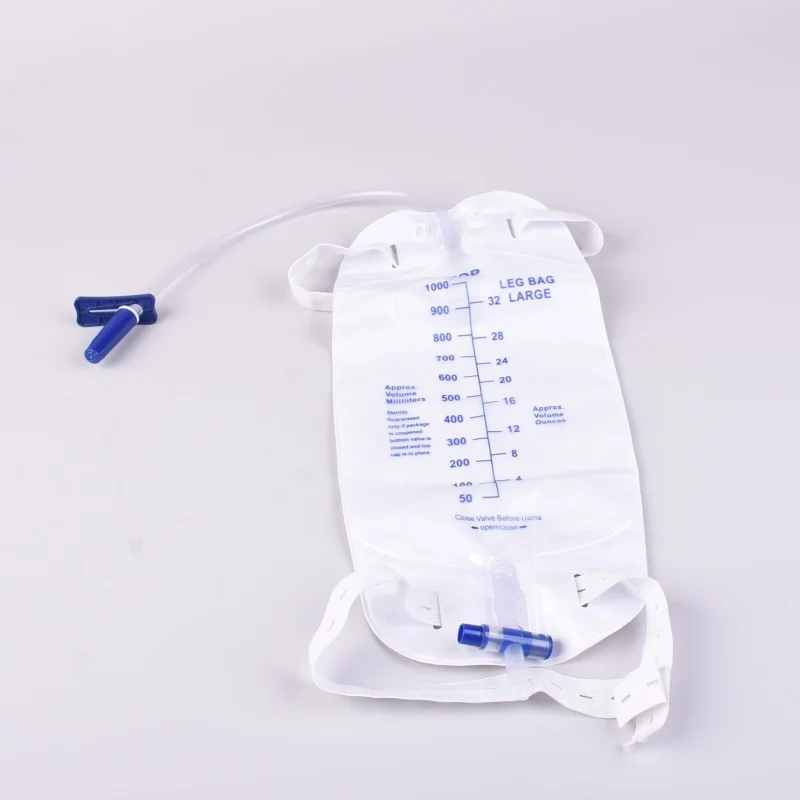
For a patient with a long-term catheter (home care, spinal injury, chronic retention) the usual approach isn't to pick one bag but to use both. By day they wear the leg bag under their clothes, held by straps, and live normally with discretion. By night a 2000 ml bed bag is connected to the bottom tap of the leg bag, without touching the catheter, and that capacity covers the whole night without getting up to empty.
Two things follow for buying: the supplier needs to offer both formats with connectors that fit each other, and it's worth standardising catheter, leg bag and bed bag from the same manufacturer, to avoid the classic problem of connectors that don't match between brands.
The anti-reflux valve and CAUTI prevention
Catheter-associated urinary tract infection is one of the most common and costly complications of hospitalisation, and the bag design matters more than you'd think. What really makes the difference is the anti-reflux valve, which stops drained urine from flowing back toward the catheter and bladder when the patient is moved or the bag is lifted; it's probably the single most important feature for reducing infection. Alongside it, the sampling port lets you take a sample with clean technique without disconnecting anything (every disconnection is an entry point for bacteria), and the drain tap should be usable without the tip touching the floor or the measuring container.
The rest is clinical practice: keep the bag always below bladder level so it drains by gravity and doesn't reflux, don't disconnect the system unless you must, and empty it regularly. A bag that's well designed here directly supports the hospital's CAUTI-prevention protocols.
Before buying in volume
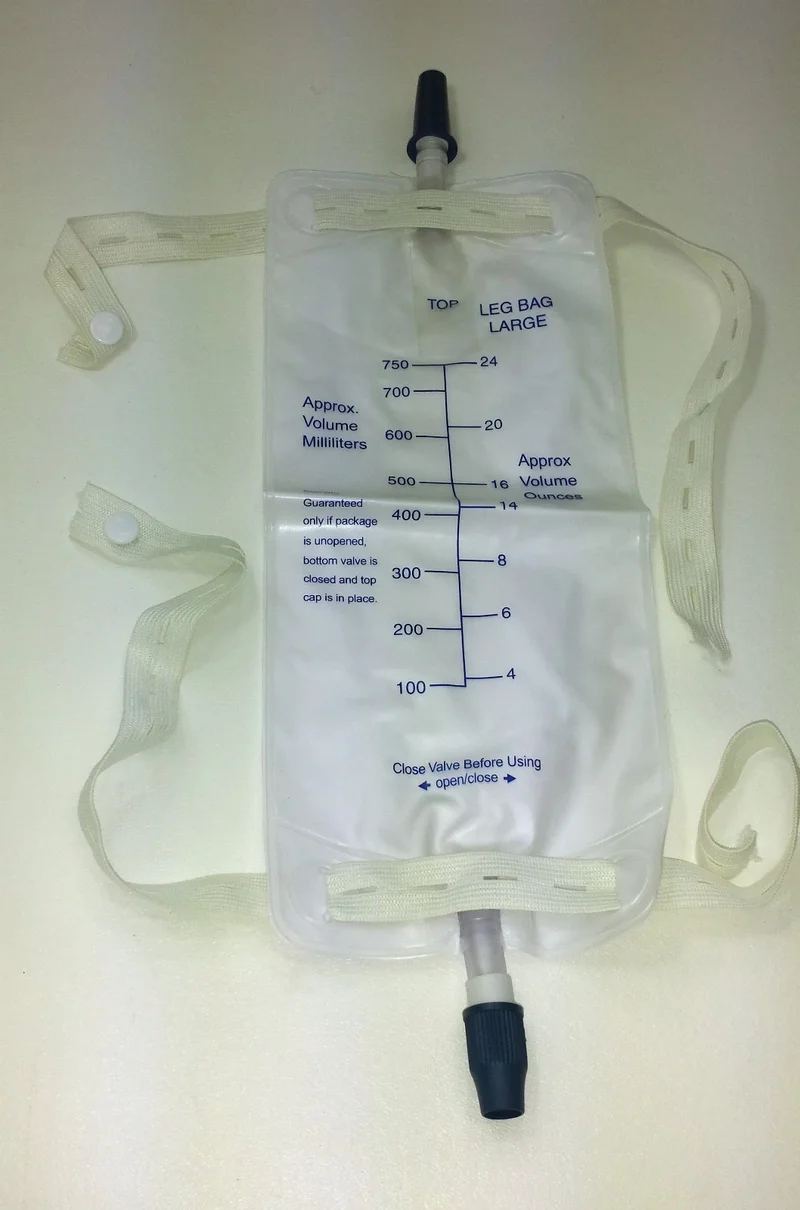
For a hospital, a home-care provider or a distributor, what separates a reliable bag from one that draws complaints is fairly concrete. That both formats are there, the 2000 ml bed bag and the 750/1000 ml leg bag, to cover the bed-bound and the ambulatory patient. That it carries a real anti-reflux valve (ask for it explicitly) and a sampling port. That the connector is universal and fits between the leg bag and the bed bag, and with standard Foley catheters. That the PVC is clear and the scale legible, so you can read the volume and the colour of the urine. On the leg bag, that the straps are elastic, adjustable and non-slip. And, depending on the use, a sterile (EO) version for post-op, individual packaging and single use.
We make the 2000 ml bed bag — with anti-reflux valve, 1.2 m tube, sampling port and bottom tap — and the 750 and 1000 ml leg bag with elastic straps, both in clear PVC and with a compatible connector for the day/night system. There's a sterile version on request and a private-label option. Message us on WhatsApp with the quantities and we'll get you a box price.
Frequently Asked Questions
What is the difference between a bed bag and a leg bag?
The bed bag (2000 ml) is for the bed-bound or hospitalised patient: large capacity, long tube and a handle to hang from the bed. The leg bag (750/1000 ml) is for the walking or at-home patient: strapped to the thigh with elastic bands for mobility and discretion. Many long-term patients use both: leg bag by day and bed bag by night.
Which leg bag capacity should I choose, 750 or 1000 ml?
The 750 ml is more discreet and comfortable for active daytime use. The 1000 ml gives more autonomy (fewer emptyings), useful if the patient can't empty often or produces more urine. For the night, a 2000 ml bed bag is connected to the leg bag's tap.
How does the day/night system work?
By day the patient wears the leg bag strapped under clothing. By night a 2000 ml bed bag is connected to the bottom tap of the leg bag, without disconnecting the catheter, so the larger capacity covers the whole night. For it to work, both bags must have compatible connectors, ideally from the same manufacturer.
What is the anti-reflux valve for?
The anti-reflux valve stops drained urine from flowing back toward the catheter and bladder when the patient is moved or the bag is raised. It is one of the most important features for reducing catheter-associated urinary tract infection (CAUTI), because it prevents potentially contaminated urine from returning to the urinary tract.
How do you take a urine sample without opening the closed system?
Through the bag's sampling port: clean the port and aspirate the sample with clean technique without disconnecting the bag from the catheter. This keeps the system closed, since every disconnection of the circuit is an entry point for bacteria and raises the infection risk.
Does Edaochi offer both formats and private label (OEM)?
Yes. Edaochi Medical manufactures the 2000 ml bed bag (with anti-reflux valve, sampling port and 1.2 m tube) and the 750 and 1000 ml leg bag (with elastic straps), with a compatible connector for the day/night system. Low minimum order, samples for evaluation, sterile version on request and private-label (OEM) packaging for distributors. A quote is delivered on WhatsApp in under 24 hours.
How often should the urine bag be changed or emptied? (care at home)
The leg bag is usually changed every 5–7 days or as directed; the 2000 ml bed bag is replaced when the catheter is changed or if the closed system is broken. Empty it through the bottom tap when it reaches about two-thirds full, with clean technique and without the tap touching the floor or container. It is a single-use, single-patient device — not reused. Always keep the bag below bladder level.
Is it normal to see blood or sediment in the catheter bag?
Slightly tinged urine can appear after catheter insertion or a change. Frank blood or clots is not normal and needs clinical review; in those cases a 3-way Foley catheter with continuous bladder irrigation is used so clots don't block drainage. This is exactly why a clear PVC bag is useful — it lets you monitor the colour and sediment of the urine at a glance.