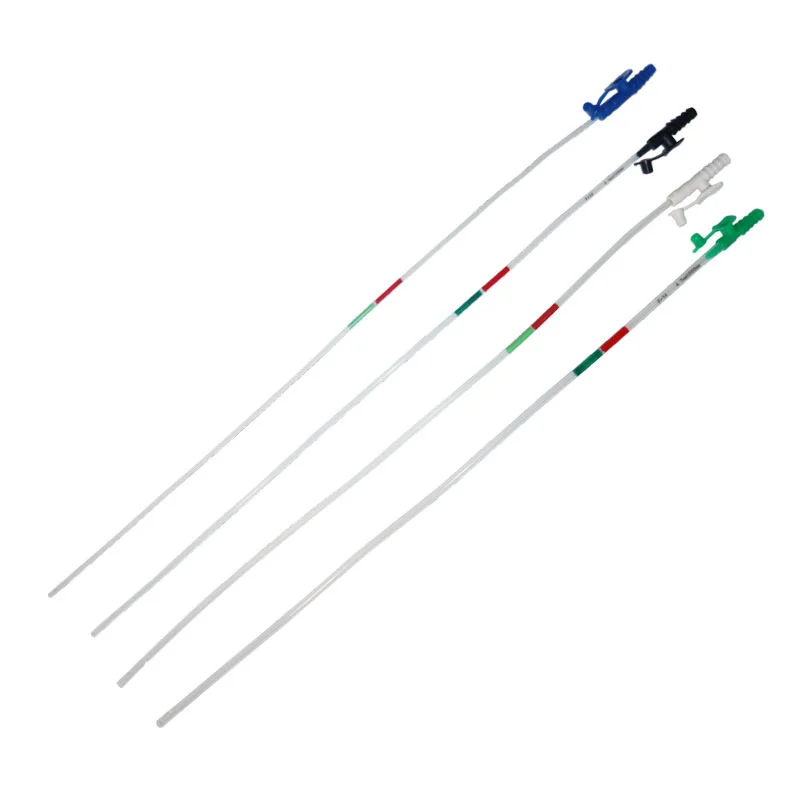
The suction catheter clears secretions from the airway in the ICU, anaesthesia, the ER and home care, and getting the size wrong is one of the most common nursing errors: too small and it won't shift thick secretions, too large and it causes deep hypoxia, trauma to the tracheal mucosa, even bronchospasm. "Suction catheter" also covers more than one product: the flexible tracheal catheter, the rigid Yankauer for the mouth, the closed-system catheter for ventilated patients, and the all-in-one kit. Below we go through the French sizing scale with a colour chart, the half rule for matching the endotracheal tube, the sizes by patient age, the tip types, and what to check before buying in volume. It pairs with our guide to the types of catheters.
The French (Fr) scale for suction catheters
Suction catheters are sized on the French scale (Fr or CH), the same universal scale used for catheters and tubes. The rule is that 1 French equals 0.33 mm of outer diameter, so to go from millimetres to French you multiply by 3 (a 4 mm catheter is F12). The higher the number, the thicker.
Most makers colour-code the size on the connector, an international standard that lets nursing pick the right one at a glance:
| Size (Fr) | Colour | Typical patient |
|---|---|---|
| F6 – F8 | Light green / orange | Neonate / infant |
| F10 | Black | Infant / small child |
| F12 | White | Child / small adult |
| F14 | Green | Adult, standard |
| F16 | Orange / red | Adult, thick secretions |
| F18 | Red | High-volume oropharyngeal suction |
What the French number doesn't tell you is the inner lumen, which depends on the wall thickness: a thin-wall PVC F14 has a wider lumen than a silicone F14. For high-flow suction of thick secretions, a thin-wall design matters as much as the French size.
The half rule: sizing to the endotracheal tube
In an intubated or tracheostomy patient, the size is driven by the tube, not just the patient. The most-used guideline is the half rule: the outer diameter of the suction catheter shouldn't exceed half the inner diameter of the endotracheal tube. In practice, the catheter size in French should be at most the tube's inner diameter in millimetres times two, so an 8.0 mm ID tube allows up to an F16. Some more conservative protocols use ×1.5 instead of ×2, which gives a slightly smaller catheter and less risk of hypoxia, at the cost of slightly less effective suction with very thick secretions.
Why it matters: a catheter too large for the tube blocks the airflow, and the vacuum then draws gas straight from the lungs, causing fast desaturation and atelectasis. Keep each suction pass under 10–15 seconds, and in critically ill patients on high FiO₂, pre-oxygenate at 100% for 30–60 seconds first.
Sizes by patient: neonate, paediatric and adult
For non-intubated suctioning, whether nasotracheal or oropharyngeal, the size goes by age and body size. As a summary:
| Patient | Size (Fr) | Note |
|---|---|---|
| Premature neonate | F4 – F6 | Thin-wall; vacuum only 40–60 mmHg |
| Term neonate | F6 – F8 | Vacuum 60–80 mmHg |
| Infant (0–12 mo) | F6 – F8 | — |
| Child (1–4 yr) | F8 – F10 | — |
| Child (5–12 yr) | F10 – F12 | — |
| Adult | F12 – F16 | F12 clear secretions; F14–F16 thick |
| Special / surgical | F18 – F20 | High-volume or open-field only |
The key safety point is that the neonatal airway is so small that an adult vacuum pressure can collapse the alveoli on the spot, so the vacuum has to be set far lower in neonates than in adults. And always use a water-soluble lubricant for nasotracheal passes to spare the mucosa.
Tip types and features: flexible, Yankauer and closed-system
"Suction catheter" is a family, not a single product. The standard one is the flexible tracheal catheter, the soft PVC tube for the airway and the ET tube; look for an atraumatic tip and side holes so it doesn't grab and tear the mucosa, and a thumb suction-control port so the operator applies suction only on withdrawal, not on the way in. Then there's the Yankauer, a rigid tonsil-tip device for oropharyngeal suction, clearing vomit, blood or large-volume secretions in the ER and surgery, a different thing from the flexible catheter. The closed-system or in-line catheter stays connected inside the ventilator circuit so the patient isn't disconnected to be suctioned, which lowers infection risk and desaturation in the ICU and gets changed every 24–72 h. And the all-in-one kit puts catheter, sterile glove and connector in one pack for fast aseptic suctioning in the ER.
The material is usually clear PVC so you can see the colour of the aspirate; side holes and a smooth moulded tip are the marks of a good catheter.
Before buying in volume
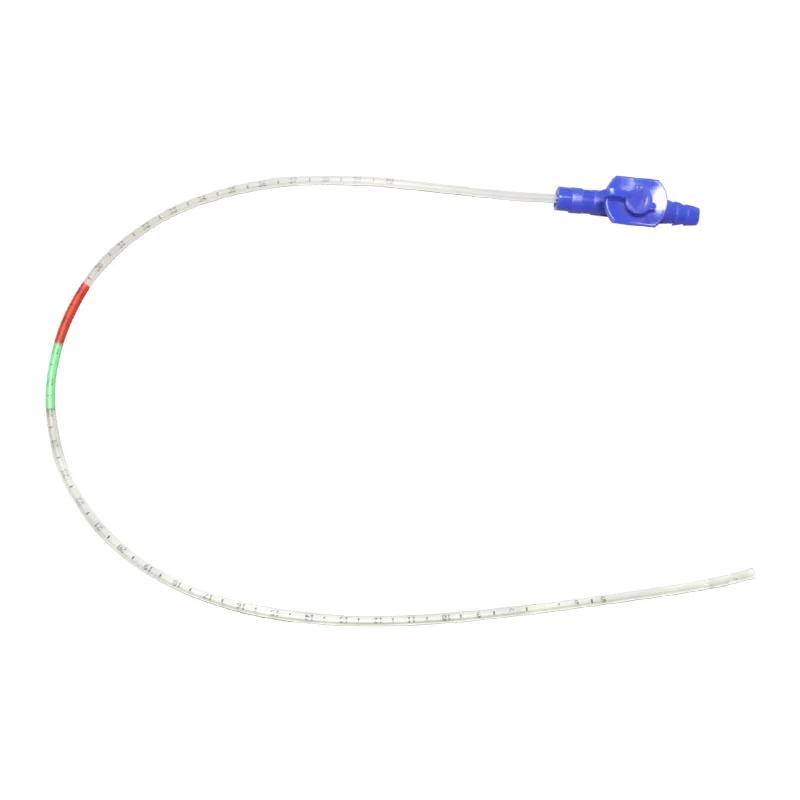
For a hospital restocking or a distributor, what separates a reliable suction catheter from one that draws complaints is concrete. The full size range, F4 to F20, with a colour-coded connector so nursing reads the size instantly. A thin-wall lumen, because a wider inner lumen for the same French size means more effective suction of thick secretions. An atraumatic moulded tip with side holes, so it doesn't injure the mucosa or grab the airway wall, plus the thumb control port for suction on withdrawal. Clear, latex-free PVC so the aspirate is visible. And that the supplier carries the Yankauer and the closed-system line too, not just the flexible catheter. The usual rest applies: EO-sterilised, individually packed, single use.
We make disposable suction catheters from F4 to F20 in clear PVC, with an atraumatic tip, side holes and a thumb suction-control port, colour-coded by size, plus the all-in-one kit (catheter, glove and connector). Tell us the sizes and volumes you need and we'll put the quote together; message us on WhatsApp and we'll get you a box price.
Frequently Asked Questions
What size suction catheter is used for an adult?
For an adult, F12–F16 covers most cases: F12 for clear, moderate secretions and F14–F16 for thick secretions or when more effective suction is needed. F18–F20 is reserved for high-volume oropharyngeal suction or open surgical fields. In an intubated patient, apply the half rule (catheter Fr ≤ ETT inner diameter in mm × 2).
How do you choose a suction catheter size for an intubated patient?
Use the half rule: the suction catheter's outer diameter should not exceed half the inner diameter of the endotracheal tube. In practice, catheter size in Fr ≤ ETT inner diameter in mm × 2. For example, an 8.0 mm ID tube allows up to F16. A catheter too large occludes the tube and the vacuum pulls gas from the lungs, causing desaturation.
What is the difference between a Yankauer and a flexible suction catheter?
The Yankauer is a rigid, tonsil-tip device for oropharyngeal (mouth) suction — clearing vomit, blood or large-volume secretions in the ER and surgery. The flexible suction catheter is a soft PVC tube for the airway and endotracheal tube, with an atraumatic tip and side holes. They are different products for different jobs and most facilities stock both.
What size suction catheter is used for a neonate?
Premature neonates use F4–F6 and term neonates F6–F8, always thin-wall to maximise the lumen at minimum diameter. Critically, the vacuum pressure must be much lower than in adults — about 40–60 mmHg for premature and 60–80 mmHg for term neonates — because an adult vacuum can cause immediate alveolar collapse in the tiny neonatal airway.
What is a closed-system (in-line) suction catheter?
A closed-system or in-line suction catheter stays connected within the ventilator circuit, so the patient is not disconnected from the ventilator to be suctioned. This lowers the risk of ventilator-associated infection and desaturation in ICU patients. It is typically changed every 24–72 hours, versus single-use for the open flexible catheter.
Does Edaochi supply the full size range and private label (OEM)?
Yes. We make disposable suction catheters from F4 to F20 in clear PVC with an atraumatic tip, side holes and a thumb suction-control port, colour-coded by size, plus an all-in-one suction kit. There's a low minimum order, samples to evaluate, quality documentation (ISO 13485) for registration and private-label packaging for distributors. Message us on WhatsApp with the sizes and quantities and we'll get you a box price.