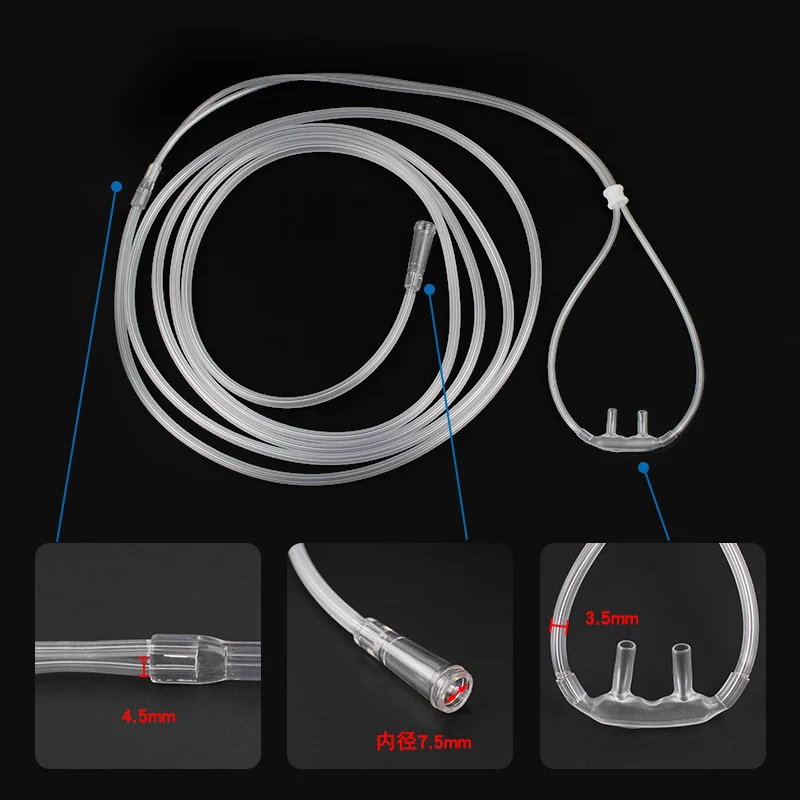
The nasal cannula (nasal prongs) is the most-used way to deliver oxygen at home and on the ward. The questions carers and patients ask are always the same: "how many litres?", "what FiO₂ is that?", "how often is the cannula changed?" and "do I need a humidifier?". This guide sums up the flow-to-FiO₂ chart, daily care and home cleaning, warning signs, and what to check when buying nasal cannulas wholesale for home care, clinics and distributors. It complements our complete nasal cannula guide.
Flow in litres and FiO₂: the equivalence chart
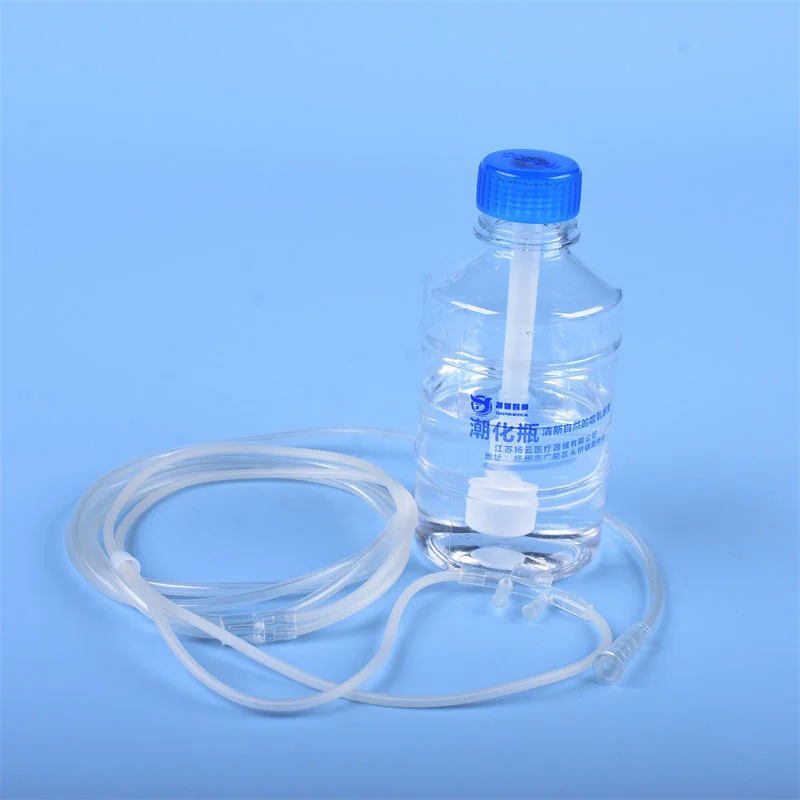
The nasal cannula is a low-flow system: it delivers oxygen that mixes with the air the patient breathes, so the real FiO₂ (fraction of inspired oxygen) also depends on how they breathe. Approximate values:
| Flow (L/min) | Approx. FiO₂ |
|---|---|
| 1 L/min | 24 % |
| 2 L/min | 28 % |
| 3 L/min | 32 % |
| 4 L/min | 36 % |
| 5 L/min | 40 % |
| 6 L/min | 44 % |
Rule of thumb: each litre adds ≈4 % to the baseline FiO₂ of air (21 %).
Important limit: above 6 L/min a conventional nasal cannula adds no more FiO₂ and only dries and irritates the mucosa. If more is needed, move to a simple, Venturi or reservoir mask (see the comparison in the nasal cannula guide), or to a high-flow cannula with its dedicated system.
The flow is prescribed by the physician against the target saturation (usually SpO₂ 94–98 %, or 88–92 % in COPD CO₂ retainers). The carer should not raise the flow "just in case".
Do you need a humidifier?
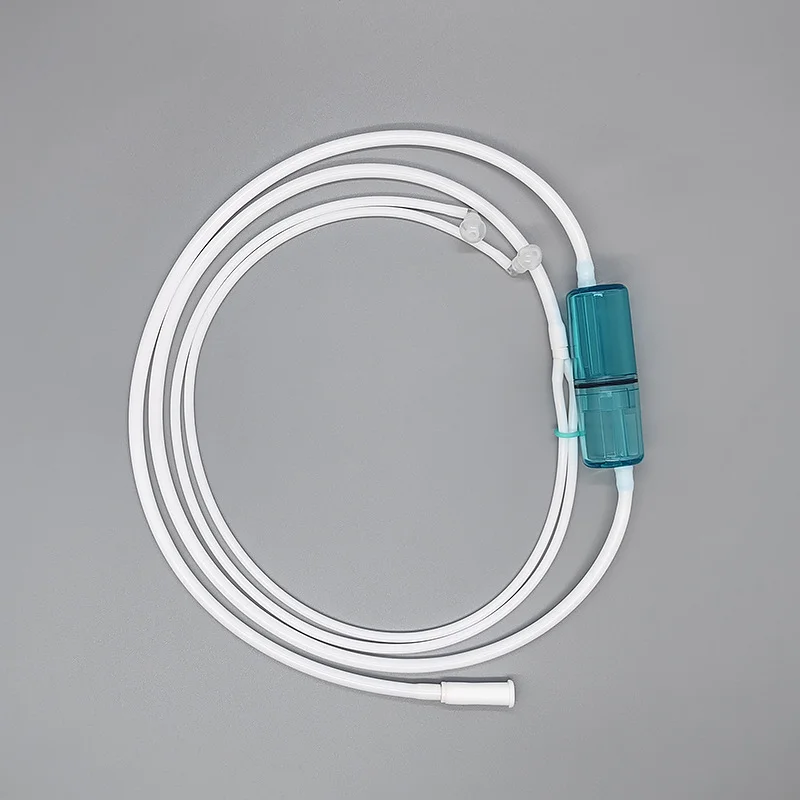
Oxygen from a concentrator or cylinder is a dry gas. At low flows most patients tolerate it without humidification, but humidifying helps when dryness appears:
- Flows ≤ 2 L/min: usually need no humidifier.
- Flows ≥ 3–4 L/min, or nasal dryness/bleeding: add a humidifier bottle with sterile distilled water between the oxygen source and the cannula.
- Humidifier water: use sterile distilled water, change it daily and wash the bottle; stagnant water is a contamination source.
An option for sensitive mucosa is the silicone cannula, softer than PVC for prolonged use. A cannula with an integrated humidifier-bottle connection simplifies set-up in home care.
Daily care and home cleaning
Correct placement:
- Both prongs curved downward, inside the nostrils; the tubing over the ears and snug under the chin without squeezing.
- Check the prongs are not blocked and that oxygen is flowing (you can feel the air on your hand).
Skin care:
- Watch for redness or sores behind the ears, on the cheeks and at the nasal septum; pad the tubing where it rubs.
- Moisturise lips and the area around the nose with water-based products (never petroleum jelly or petroleum-based creams near oxygen: they are flammable).
Cleaning:
- Wipe the prongs daily with a damp cloth; wash the cannula with warm water and mild soap 1–2 times a week and air-dry.
- Change the nasal cannula every 2–4 weeks, or sooner if it is stiff, cracked, smelly or after a respiratory infection. In hospital it is changed between patients (single patient).
Oxygen safety:
- No smoking or open flames nearby; keep equipment away from heat sources.
- Do not change the prescribed flow without medical instruction.
Warning signs: when to call the professional
The carer should recognise when oxygen therapy is not enough or something is wrong:
- SpO₂ below target despite the cannula being correctly placed and the flow correct.
- Increased work of breathing: fast breathing, neck-muscle use, nasal flaring, retractions.
- Cyanosis (blue lips or nails), confusion or unusual drowsiness (possible CO₂ retention, especially in COPD).
- Persistent nosebleed or pain from dryness: consider humidification.
- Pressure injuries on the ears or nose that do not improve.
With any of these, contact the home-care team or go to the ER. Raising the flow on your own, especially in COPD, can be dangerous.
Choosing nasal oxygen cannulas
For a home-care provider, a clinic or a distributor, the material is the first cut: medical PVC, the economical standard, or silicone, softer for prolonged use and sensitive skin; always latex-free. Sizes matter more than they look, because an adult cannula on a child doesn't seal and wastes oxygen, so it's worth carrying adult, paediatric and neonatal. The connector should be a christmas-tree tip that fits flowmeters, humidifier bottles and concentrators without adaptors. On tubing length, 2 m suits the bed and 7 to 15 m gives mobility at home, always kink-resistant.
A few variants are worth keeping in stock: cannula with humidifier, silicone, headset or harness for patients who can't tolerate the over-ear support, and 3-way for delivery with capnography. We make them with CE and ISO 13485, individual packaging and lot traceability; ask us for samples before quoting volume and we'll take it to WhatsApp.
Frequently Asked Questions
How much FiO₂ does a nasal cannula deliver by litres?
Approximately: 1 L/min ≈ 24 %, 2 L ≈ 28 %, 3 L ≈ 32 %, 4 L ≈ 36 %, 5 L ≈ 40 % and 6 L ≈ 44 % (each litre adds ≈4 % to the baseline 21 % FiO₂). It is an estimate because the cannula is a low-flow system and the real FiO₂ depends on the patient's breathing pattern.
How often is the nasal oxygen cannula changed?
At home, the nasal cannula is changed every 2 to 4 weeks, or sooner if it is stiff, cracked, smelly or after a respiratory infection. The prongs are wiped daily with a damp cloth and the cannula is washed with warm water and mild soap 1–2 times a week. In hospital it is single-patient use.
Above how many litres does the nasal cannula stop helping?
Above 6 L/min a conventional nasal cannula no longer increases FiO₂ and only dries and irritates the mucosa. If more oxygen is needed you move to a simple, Venturi or reservoir mask, or to a high-flow nasal cannula with its dedicated system.
Do I need a humidifier with the nasal cannula?
At 2 L/min or less it is usually unnecessary. From 3–4 L/min, or if dryness or nosebleeds appear, add a humidifier bottle with sterile distilled water, changing the water daily. Never use petroleum-based creams near oxygen: they are flammable.