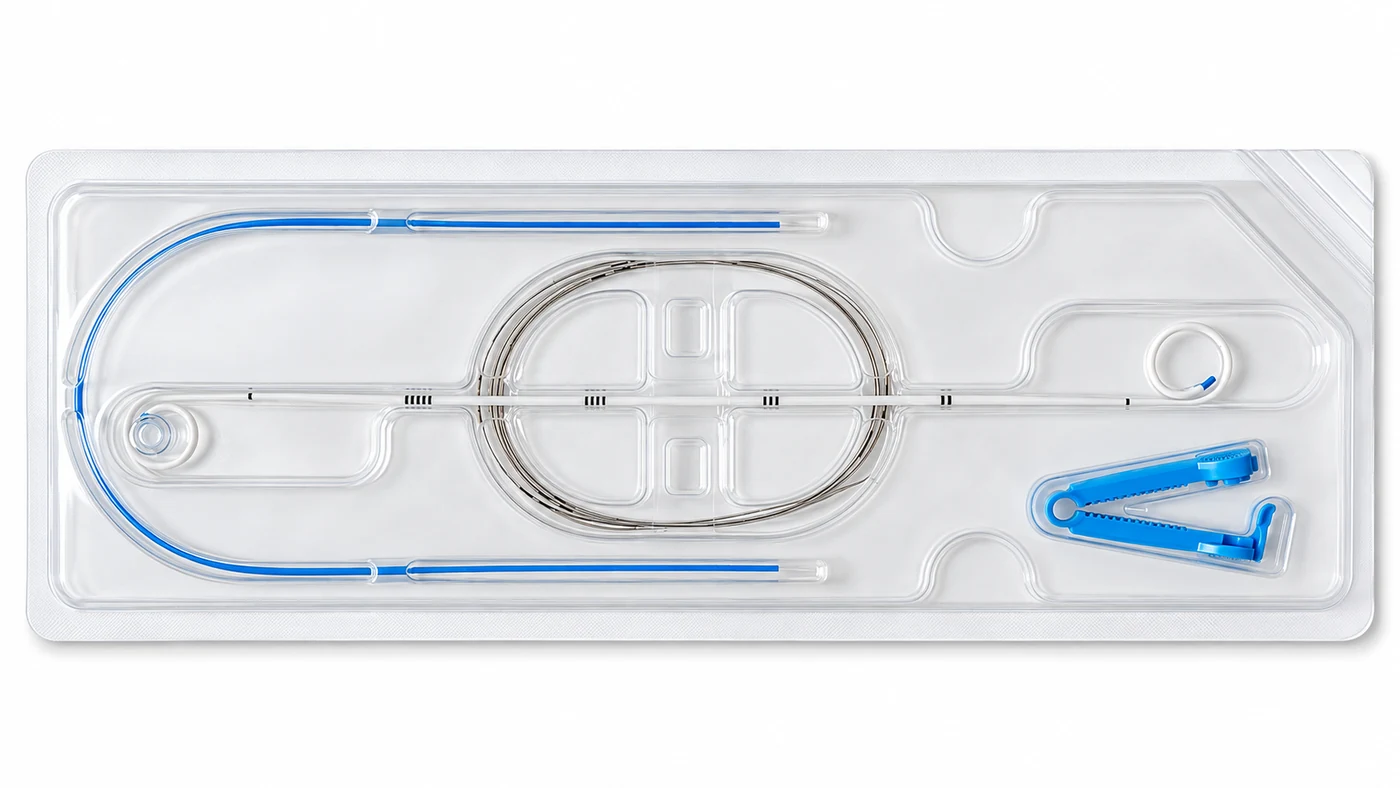
A 26 cm double-J in a patient who needed 24 is not a better or worse stent: it is the wrong stent. It is the one family in the urology catalogue where the right reference is not a product but a pair of measurements, size by length, and where the same unit consumes every combination in the same week. That is why it is ordered wrong so often: it gets bought like a Foley catheter, one reference and one quantity, and by mid-month the size that was needed has run out. Below is how each of the two measurements is decided, what changes between standard and hydrophilic and between open and closed tips, how it differs from the pigtail it gets confused with, and how all of that turns into an order with no gaps.
Why the double-J is bought in pairs, not references
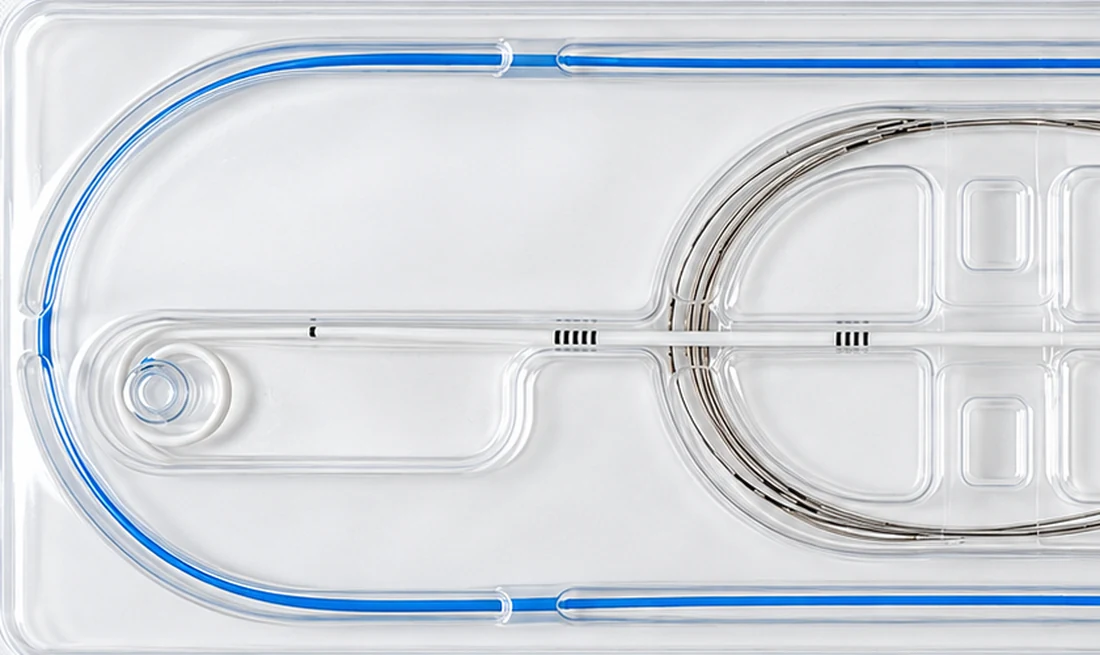
The stent has a curl at each end. The proximal one sits in the renal pelvis and the distal one in the bladder, and between them the shaft runs the length of the ureter. For both curls to sit where they should, the shaft has to match the length of the patient's ureter, and that length varies with height. Size, on the other hand, is decided by the indication: how much has to drain and along what track.
Two independent variables, decided by two different criteria, produce a matrix. With six sizes (4, 4.8, 5, 6, 7 and 8 Fr) and five lengths (20 to 28 cm in steps of two) there are thirty possible combinations, of which a real unit uses about ten regularly. None of them alone. That is the starting point of any order: you do not buy a double-J, you buy a distribution.
Which size? 4.8 and 6 Fr cover most of it
The useful range is 4 to 8 Fr. The bulk of consumption sits at 4.8 and 6 Fr, which give enough lumen to drain without forcing a normal-calibre ureter. Below that, 4 Fr for fine ureters and short patients. Above it, 7 and 8 Fr for specific indications that need more lumen or more stiffness, ordered in small counts.
To go from French to millimetres, divide by three: 4 Fr is 1.3 mm outer diameter, 4.8 Fr is 1.6 mm, 6 Fr is 2 mm, 7 Fr is 2.3 mm and 8 Fr is 2.7 mm. The conversion is worth keeping in mind because some tenders specify in one unit and some catalogues in the other, and a 2 mm stent and a 6 Fr stent are the same product. The full scale, with the other catheter families, is in the French to millimetre conversion chart.
Which length? The height rule
The patient decides length, and the practical rule units use is height. It is approximate and gets adjusted to what imaging shows, but it is what sets what has to be on the shelf:
| Patient height | Usual length |
|---|---|
| Under 1.50 m | 20–22 cm |
| 1.50 to 1.75 m | 24 cm |
| 1.75 to 1.90 m | 26 cm |
| Over 1.90 m | 28 cm |
Getting it wrong has different consequences in each direction. A short stent leaves the distal curl inside the ureter, with no anchor in the bladder, and does not do its job. A long stent leaves spare material in the bladder, and that spare material is what the patient feels for the whole dwell. That is why no unit fixes length at order time: it is fixed patient by patient, and the stockroom has to have every length available on the same day.
Standard or hydrophilic: when the difference shows
The hydrophilic coating activates with saline and reduces friction as the stent advances. Where it shows is in difficult placements: strictures, tracks with stone load, tortuous ureters. In a routine over-wire placement the difference is smaller, and standard handles it at lower cost.
The usual proportion in an assortment is standard for most units and a hydrophilic fraction for the cases that call for it. Both versions go on the same order and, with us, count together toward the minimum. A unit starting out usually opens with standard and adds hydrophilic when the urologist asks for it by name; one with stone volume carries it from the start.
Open-open or closed-open: what changes
The working configuration is open-open: both ends of the stent have a lumen, which allows placement over a wire from start to finish and, when exchange comes, replacement over a wire without losing the track. It is the one that covers the volume.
The closed-open tip has a closed proximal point. Some units prefer it for bladder comfort and ask for it by name. It is made to order, as an OEM configuration with per-reference quantities, and is worth raising at the first quotation if the customer uses it, because it does not come out of generic stock.
Double-J or pigtail: not interchangeable
They get confused because both have a curl, and more than one purchase order has arrived with them crossed. The double-J is internal: it runs from kidney to bladder inside the ureter and never exits the body. The pigtail drainage catheter is external drainage, with a single curl and a locking thread that fixes it, exiting through the skin to a bag. It is used when the ureter will not take the stent, or when diversion has to be percutaneous, and in that case it usually goes with the nephrostomy set.
A urology unit orders both, in different quantities and with different turnover. What it should not do is order one while thinking of the other.
Building the assortment: the bell curve
A unit's real consumption draws a bell curve. The centre is 4.8 and 6 Fr by 24 and 26 cm, and that is where most of the units go. To one side, 4 and 4.8 Fr by 20 and 22 cm, for short patients and fine ureters. To the other, 6 and 7 Fr by 26 and 28 cm, for tall patients and stone-loaded dwells. The 8 Fr, in small counts, for the indications that call for them.
The most common purchasing error is a minimum order set per combination, which forces whole quantities of the tails of the curve the unit will not consume. Our minimum applies to the assortment total, and both versions count together, so the whole curve fits in one proportioned order. If the customer has a consumption history, it beats any generic curve: send it and the quantities are fitted to theirs.
On top of that sits a second source of demand that usually gets left out of the calculation. The double-J is a dwelling device, with a removal or exchange date, and a unit with stented patients has an exchange calendar on top of its per-procedure consumption. That calendar can be forecast, and it belongs in the order.
Registration: a dwelling device
As a device that stays in contact with the urinary tract, the risk classification is high in most markets and the distributor registers it in the destination country. The file needs the technical data sheet with the full size and length chart, the manufacturer's ISO 13485 certificate, per-batch ethylene oxide sterilisation records and lot traceability.
It is worth requesting the file before the first order. For a device of this class the registration takes longer than the shipment, and a distributor who receives the goods without it under way has them sitting in the warehouse.
What to have to hand before quoting
A double-J order closes without back and forth with these figures:
- Assortment with quantities per combination, or the customer's consumption history, which is better
- Standard/hydrophilic split
- Interest in the closed-open tip as OEM, with volume, if the customer uses it
- Estimated monthly quantity, including the exchange calendar
- Private label, if packaging should carry the customer's brand
The double-J ureteral stent set covers all six sizes and five lengths in both versions, with pusher, wire and clamp in a sterile tray. It is placed over the zebra and superstiff urological guidewires and, in ureteroscopy, through the ureteral access sheath, which are the references the same unit orders alongside the stent. The five families make up the urology catalogue, and the urology consumables list for hospitals places them within the unit's full range.
If you are setting up the line for a distributor or restocking a hospital, send us the assortment or the history on WhatsApp and we will come back with a price; samples of both versions go out first if you want the urologist to trial placement.
Frequently Asked Questions
What sizes does a double-J stent come in?
Size runs from 4 to 8 Fr (4, 4.8, 5, 6, 7 and 8) and length from 20 to 28 cm in steps of two. The reference is defined by the pair size by length, for example 6 Fr by 26 cm, and a unit consumes several combinations at once because length is decided per patient and size per indication.
How is double-J length chosen?
By patient height, adjusted to what imaging shows. The usual rule is around 22 cm under 1.50 m, 24 cm up to 1.75 m, 26 cm up to 1.90 m and 28 cm above. Short leaves the distal curl inside the ureter; long leaves spare material in the bladder.
What is the most used size?
4.8 and 6 Fr carry most of the consumption. 4 Fr for fine ureters and short patients; 7 and 8 Fr for specific indications, in small counts.
How many millimetres is 6 Fr?
2 mm outer diameter. French divides by three: 4 Fr is 1.3 mm, 4.8 Fr is 1.6 mm, 7 Fr is 2.3 mm and 8 Fr is 2.7 mm.
What is the difference between standard and hydrophilic double-J?
The hydrophilic has a coating that activates with saline and reduces friction on advance; it shows in strictures, stone load and difficult tracks. Standard covers routine placement at lower cost. A usual assortment carries standard in volume and a hydrophilic fraction.
What does open-open mean?
That both ends of the stent have a lumen, which allows placement over a wire from start to finish and exchange over a wire without losing the track. It is the working configuration. The closed-open tip, with a closed proximal point, is made to order as OEM.
Are the double-J and the pigtail the same thing?
No. The double-J is internal, kidney to bladder inside the ureter. The pigtail is external drainage with one curl and a locking thread, exiting through the skin to a bag, for when the ureter will not take a stent or diversion has to be percutaneous.
How long can a double-J stay in?
The maximum is set by each version's data sheet and the actual time by the clinical indication within that limit. For purchasing, what matters is that it has a removal or exchange date, and that stented patients generate an exchange calendar that can be forecast.
Why does the minimum order apply to the assortment rather than each reference?
Because a unit consumes a bell curve of combinations, with the bulk at 4.8 and 6 Fr by 24 and 26 cm and tails both ways. A minimum per combination would force whole quantities of the tails that will not be consumed. A minimum on the total lets the curve be ordered in proportion.
What documentation is needed to register a double-J?
Technical data sheet with the full size and length chart, the manufacturer's ISO 13485 certificate, per-batch ethylene oxide sterilisation records and lot traceability. It is a dwelling device, high classification in most markets, and the distributor registers it in the destination country.