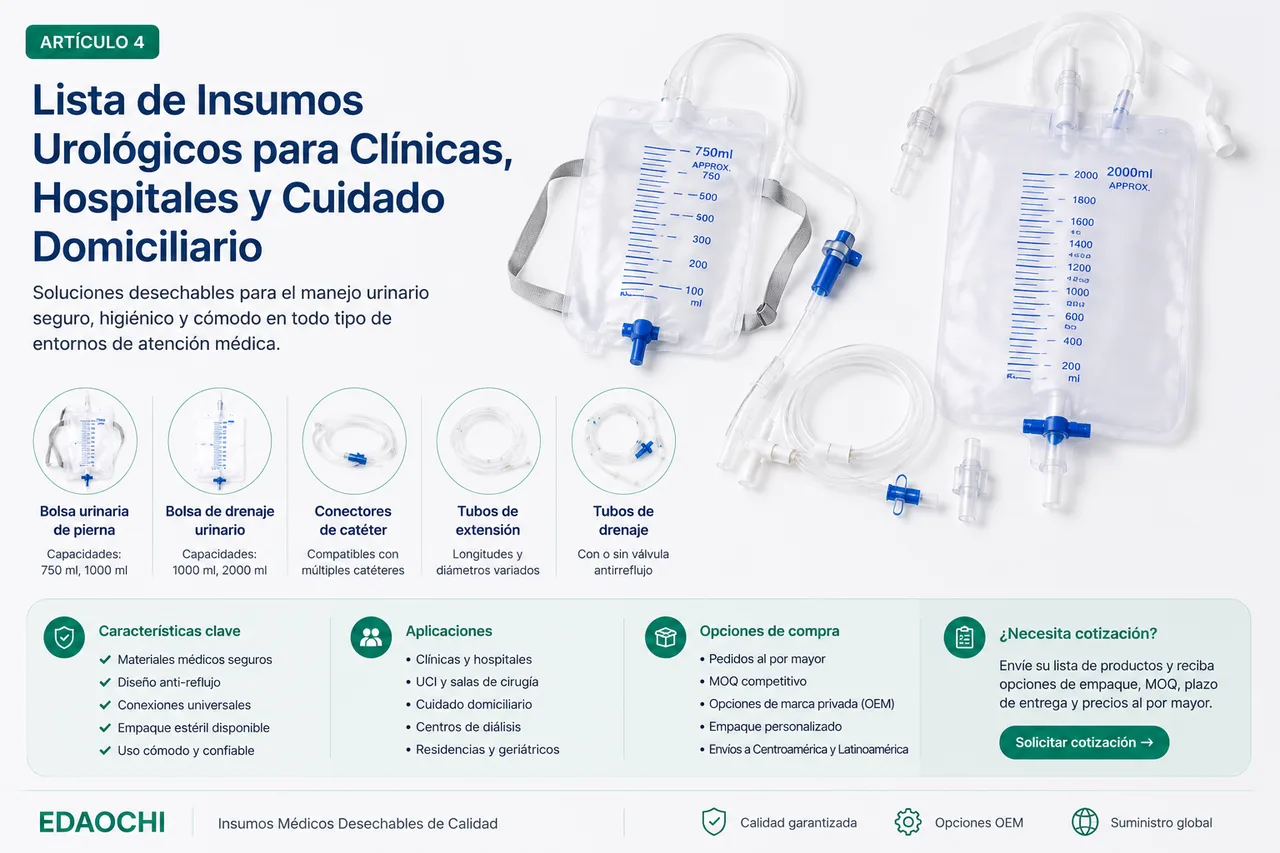
Urology accounts for one of the highest volumes of disposable consumables per bed per day in any hospital. A 24-hour shift in a geriatrics, ICU or maternity ward can go through dozens of Foley catheters, drainage bags, leg bags and neonatal collectors. This guide organises the complete list by category, explains the function of each component, how the items in the drainage system relate to each other, and what technical data to specify when placing a wholesale order.
Urinary catheters: Foley, nelaton and intermittent
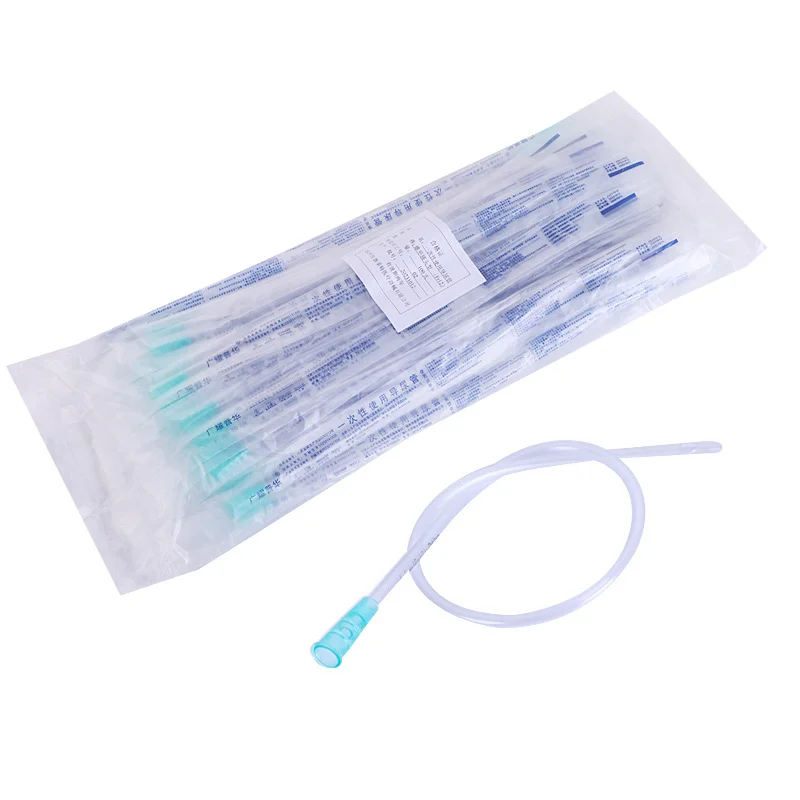
The Foley catheter is the highest-volume consumable in hospital urology. Its defining feature is the retention balloon: inflated with normal saline inside the bladder, it holds the catheter in place for continuous drainage without the patient needing to hold anything. There are two main configurations:
2-way Foley: One lumen drains urine, the other inflates and deflates the balloon. Standard for long-term catheterisation in ICU, geriatrics and post-operative care.
3-way Foley: Same as the 2-way plus a third lumen for instilling irrigation solution into the bladder. Used when haematuria is present or after prostate surgery, where continuous bladder irrigation (CBI) is needed to prevent clot formation.
The nelaton catheter (or straight catheter) has no balloon. It is used for single-episode bladder emptying or in clean intermittent catheterisation (CIC) programmes for patients with neurogenic bladder. In CIC, the patient or caregiver catheterises every 4–6 hours instead of keeping a catheter permanently in place.
When ordering, specify: French size (F12–F24 adult, F6–F10 paediatric), length (standard ~40 cm or female 20–26 cm), material (PVC for standard use, pure silicone for 4–8 weeks of prolonged catheterisation), tip type (Tiemann for narrow urethra, Couvelaire for post-operative), balloon volume (5 ml or 10 ml adult, 3–5 ml paediatric).
Closed urinary drainage system: the bedside bag
The 2000 ml drainage bag is the centrepiece of the closed drainage system. The complete circuit is: Foley catheter → collection tube with Luer connector → drainage bag → anti-reflux drainage valve.
The closed system concept is fundamental to CAUTI prevention (catheter-associated urinary tract infection): the catheter-bag junction is not broken except when clinically necessary. Every time the system is opened, bacteria can enter. The bag is emptied using the drain valve at the bottom when it reaches two-thirds of capacity — without opening the connection to the catheter. The entire bag is changed according to protocol (typically every 5–7 days, together with the catheter change).
The bag always hangs below bladder level and never touches the floor. The integrated anti-reflux valve prevents urine from flowing back to the catheter when the patient moves.
When ordering, specify: 2000 ml capacity, anti-reflux valve (always recommended), tube length (short 80 cm for bedside, long 150 cm for wheelchair or adjustable bed), graduation scale visible in 100 ml increments, protective cap on drain valve.
Leg bag: mobility with a catheter
The leg bag (750 ml or 1000 ml) is secured to the thigh or calf with elastic straps and allows the catheterised patient to move, dress and carry out basic activity without the drainage system getting in the way. It bridges the gap between hospital discharge and daily life for patients with long-term indwelling catheters.
750 ml: More discreet, easier to conceal under clothing. The choice for active patients or those who want to wear the bag under trousers. Emptied more frequently (every 3–4 hours). 1000 ml: Longer intervals between emptying (4–6 hours). The choice for patients with higher urine output or reduced mobility.
The standard routine combines both: leg bag during the day (mobility) and the 2000 ml bedside bag at night (greater capacity while the patient sleeps), connected by an adaptor to the same catheter. The leg bag is changed every 24 hours.
When ordering, specify: capacity (750 or 1000 ml), strap type (velcro or adjustable elastic), connection point position (top or side inlet), drain valve design (twist or push-pull), with or without short extension tube included.
Specialist collectors: neonatal, specimens and stomas
Neonatal urine collector: For hospitalised infants without bladder control. An adhesive collection bag applied to the perineum to collect urine — or faeces in the stool version — without catheterisation. Enables urinalysis, urine culture (urinalysis) and fluid balance monitoring in neonatal and paediatric wards. Typical capacity: 100–200 ml. Hypoallergenic adhesive for neonatal skin. Removed and changed when full or every 4–6 hours.
Urine specimen container: For collecting midstream urine samples for urinalysis, urine culture and pregnancy testing. Wide-mouth container with screw cap, 60–120 ml, sterile or non-sterile depending on the type of analysis. Sterile containers are required for urine culture.
Urine collection tubes with preservative: For delayed urine analysis or laboratory transport. The preservative (boric acid) stabilises the sample during transport, eliminating the need for cold chain storage.
Urinary ostomy bag: For patients with surgically created urinary diversions (radical cystectomy, cutaneous ureterostomy). Adhesive bag with flange and drain valve. Not interchangeable with catheter drainage bags — these are separate systems.
Buying in volume: specifications and documents needed
| Item | Key specifications | Typical packaging |
|---|---|---|
| 2-way Foley catheter | French size, length, material (PVC/silicone), balloon ml | 10–50 units/box |
| 3-way Foley catheter | French size, length, material, balloon + irrigation lumen | 10–20 units/box |
| 2000 ml drainage bag | With/without anti-reflux, tube length, valve type | 20–50 units/box |
| Leg bag 750/1000 ml | Capacity, strap type, drain valve | 20–50 units/box |
| Neonatal collector | Capacity, adhesive (hypoallergenic), with/without faecal separator | 100 units/box |
| Urine specimen container | Sterile/non-sterile, capacity (60–120 ml) | 100–200 units/box |
Minimum documentation for importation and tenders: CE certificate, ISO 13485, technical data sheet with ISO 10993 biocompatibility data, ETO lot traceability for sterile items, and a manufacturer letter for local regulatory registration (INVIMA Colombia, COFEPRIS Mexico, DIGEMID Peru, ANMAT Argentina or your country's equivalent regulator).
We manufacture Foley catheters, drainage bags, leg bags and neonatal collectors under ISO 13485 with CE marking. Message us on WhatsApp with your reference list, size mix and monthly volume — we'll send the technical data sheets and tiered pricing.
Frequently Asked Questions
What is the difference between a 2-way and 3-way Foley catheter?
A 2-way Foley has one lumen to drain urine and a second to inflate and deflate the retention balloon. A 3-way Foley adds a third lumen for instilling an irrigation solution (saline) to rinse the bladder, which is necessary in continuous bladder irrigation (CBI) after prostate surgery or when haematuria with clots is present. They are not interchangeable: the 3-way connects to an irrigation system, not to a standard drainage bag.
When should intermittent catheterisation be used instead of a Foley catheter?
Clean intermittent catheterisation (CIC) is indicated in neurogenic bladder (spinal cord injury, multiple sclerosis, spina bifida), chronic urinary retention or when a permanent indwelling catheter carries a high long-term infection risk. The patient or caregiver catheterises 4–6 times per day with a non-balloon catheter (nelaton or intermittent). It significantly reduces CAUTI rates compared to long-term indwelling catheters.
What is a closed urinary drainage system and why does it reduce infections?
A closed system integrates the catheter, collection tubing and drainage bag in a sealed circuit that should not be opened except to drain via the bottom valve. The catheter-bag junction is not broken. This substantially reduces CAUTI because ascending bacterial contamination occurs primarily when the system is opened. WHO and CDC guidelines recommend the closed system for all hospital indwelling catheterisations.
How often should urological consumables be changed?
PVC Foley catheters are changed every 2 weeks; pure silicone can be left for 4–8 weeks depending on the ward protocol. The 2000 ml drainage bag is changed every 5–7 days (never just for emptying). The leg bag is changed every 24 hours. The neonatal collector is changed when full or every 4–6 hours. These are standard intervals; each institution follows its own infection-control committee protocol.