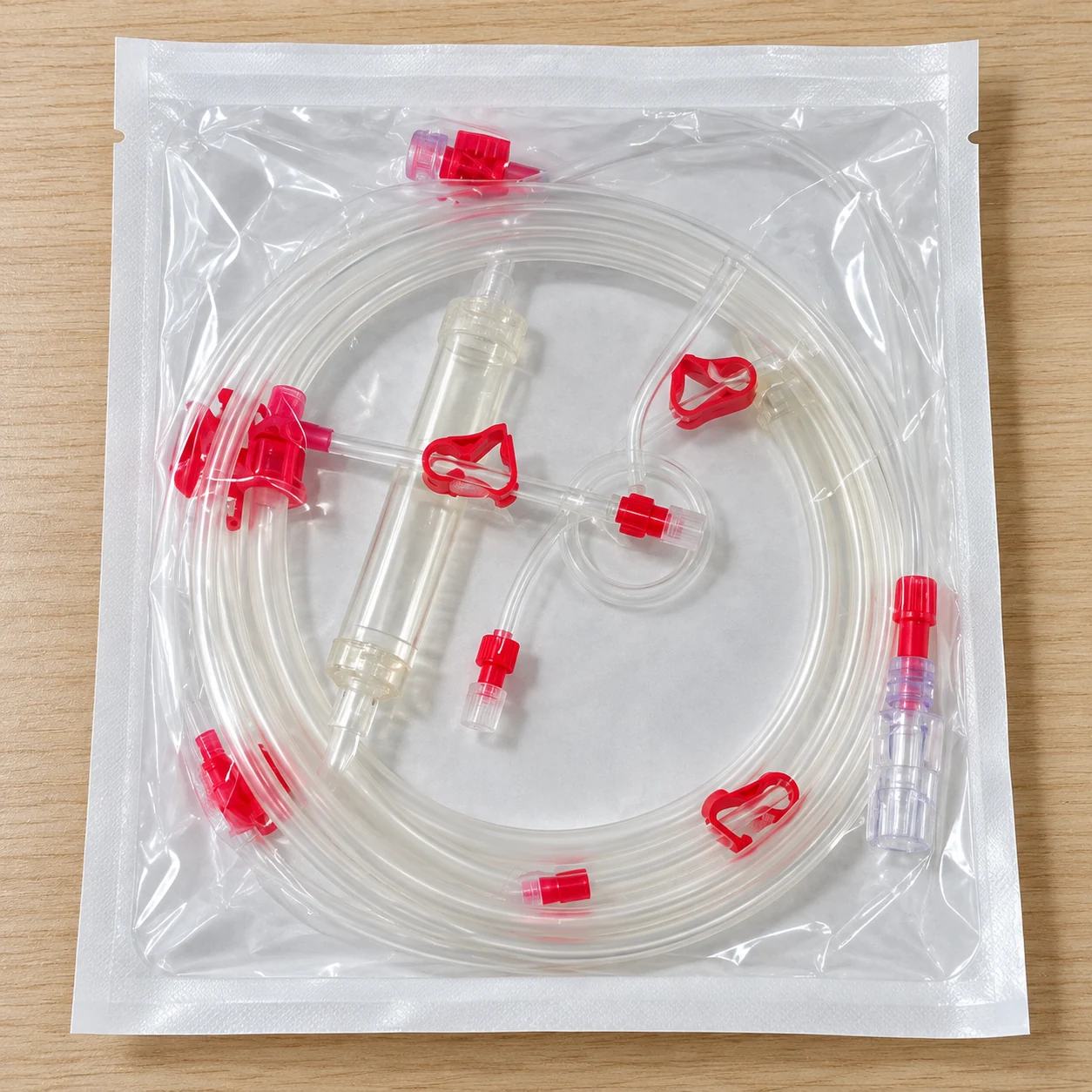
Of the whole extracorporeal circuit, one part decides whether a bloodline will work on your machine: the pump segment, the length of tubing that seats in the peristaltic pump head. A segment that does not seat will not pump and the entire set is unusable even when the rest of the circuit is perfect. It is the specification error that generates most returns in this category and it almost always happens the same way, the order is placed by catheter size, by dialyser brand, or by whatever was bought last year, without checking the one figure that governs. Below is what the pump segment is, why 12.1 mm and 9.75 mm are not interchangeable, how to verify compatibility before buying and what to have to hand in order to order correctly.
What the pump segment is and why it is the critical part
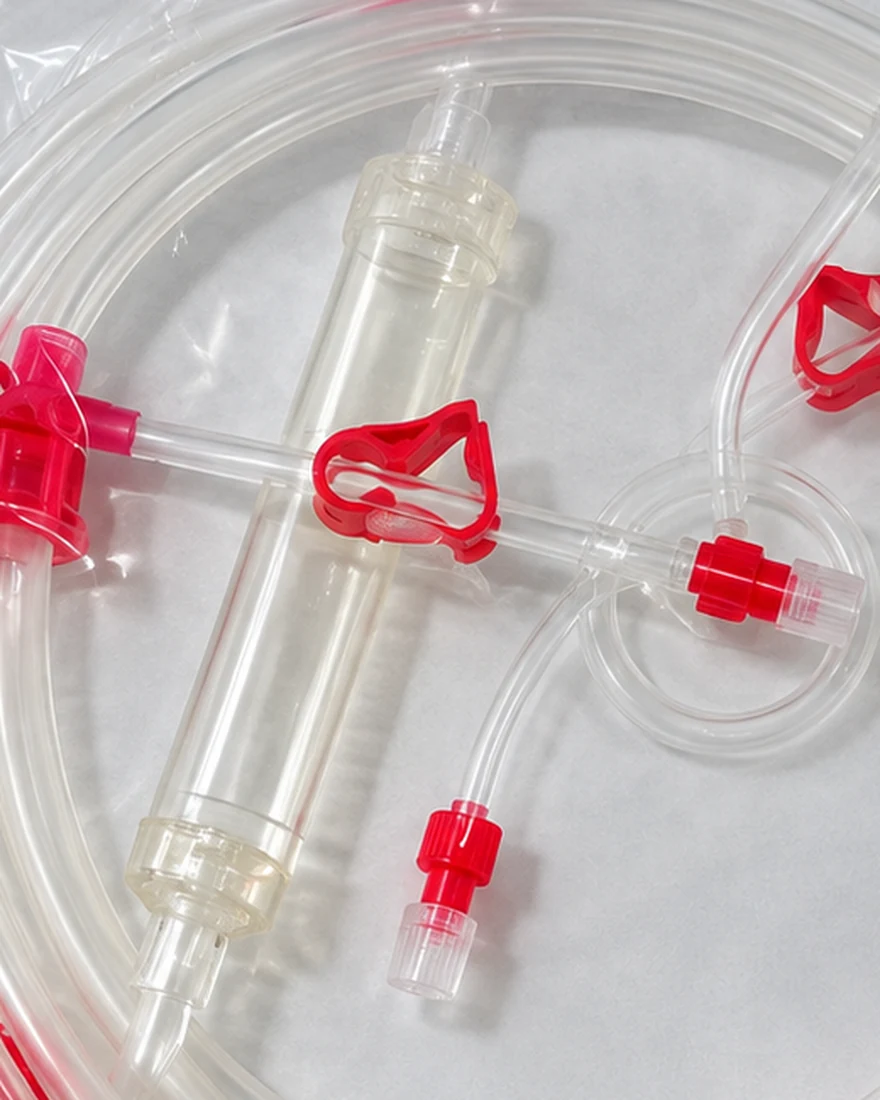
The pump on a hemodialysis machine is peristaltic: it never touches the blood. A rotor with rollers compresses a length of tubing against a curved raceway and the rollers advancing push the blood forward. That compressed length is the pump segment and it differs from the rest of the circuit in two ways.
First, it is thicker. The main tubing on a standard bloodline is 4.4 mm inner by 6.8 mm outer diameter; the pump segment is 8.0 × 12.1 mm. The wall goes from 1.2 mm to over 2 mm, because it has to be flattened thousands of times per session and recover its shape each time without fatiguing or shedding particles.
Second, its outer diameter is not a preference, it is a mechanical requirement. Each machine's pump head is built for one specific diameter: it sets the clearance between roller and raceway and with it the volume displaced per revolution. That volume is what the machine uses to calculate the blood flow it shows on screen. A segment that is too thin does not occlude fully and blood slips back between rollers; one that is too thick will not seat, or seats under strain and over-occludes.
The practical consequence of that second point is the one most often underestimated: if the segment does not match, the flow on the display stops being the real flow. The machine does not measure flow rate, it calculates it from revolutions and an assumed volume per turn. With the wrong tubing it will keep showing 300 mL/min with full confidence while delivering something else.
12.1 mm and 9.75 mm: two sizes, not two grades
The two sizes covering most of the installed base are 12.1 mm and 9.75 mm outer diameter. They are not a premium and a budget option, nor a new and an old version: they are two different pump-head formats.
| 12.1 mm OD segment | 9.75 mm OD segment | |
|---|---|---|
| Inner diameter | 8.0 mm | Smaller (confirm with the manufacturer) |
| Effective length | 330 ± 20 mm | 330 ± 20 mm |
| What decides it | The machine's pump head | The machine's pump head |
| Interchangeable? | No | No |
The temptation, when the wrong order arrives and patients are already scheduled, is to force whatever is on hand. It should not be done: a segment that does not match the head changes the relationship between revolutions and displaced volume, which means the delivered dialysis dose is not the prescribed one even though the screen says it is.
When ordering, the safest way to get it right is not to hunt for the number on an old sheet but to give the bloodline manufacturer the make and model of the machine. It is a figure the centre always has and that cannot be mistranscribed, whereas a diameter copied by hand from a previous order carries that order's error forward.
Compatibility: which machines take a generic line and which do not
Most hemodialysis machines on the market accept bloodlines from independent manufacturers. The circuit is, in essence, an industry standard: dialyser connectors, chambers with pressure ports, heparin line, sampling ports and recirculation connectors repeat across brands.
There are two exceptions worth knowing before quoting, because they are the usual cause of an order that cannot be used:
- Fresenius 5008 and 5008S. They do not take a generic bloodline. The circuit on these machines is designed as a proprietary assembly and third-party lines will not fit.
- Proprietary-circuit machines. Some manufacturers deliberately close the system so it accepts only their own consumable, usually through a pump-head or chamber geometry that does not reproduce the standard.
Outside those two categories, compatibility is broad. It is worth being wary of a supplier who promises "universally compatible" without qualification: universal compatibility does not exist in this category and whoever claims it either does not know the installed base or would rather not mention it before invoicing. A concrete exclusion list is a better signal than a broad promise. Our hemodialysis bloodline set publishes that list on the product page itself, alongside the dimensions of every run in the circuit.
The rest of the circuit: what to check besides the segment
With the pump segment settled, four points separate one set from another and are worth checking on the data sheet before comparing prices.
- Venous chamber with filter screen. It catches clots and traps air before blood returns to the patient. It is the safety component on the venous side, and not every data sheet says whether it is there.
- Transducer protector. Built in or not, depending on the centre's infection-control protocol. Some units require it factory-fitted and others buy it separately; settle it before the order rather than after.
- Heparin line. A fine run, 1.0 × 2.6 mm on standard sets, for continuous anticoagulation through the session.
- Colour coding. Arterial red and venous blue belong on the connectors, the clamps and the caps, not only on the pack label. It is what stops the lines being reversed when the circuit is assembled in a hurry and on a unit with rotating staff that redundancy is worth more than any label.
On top of this sits a decision that is commercial rather than technical: packaging format. In South America, buying practice is by individual line, while in most other markets the usual format is arterial and venous packed together. It changes nothing in the circuit specification, but ordering the wrong format complicates the sale to the end customer.
Sizing a dialysis centre's order
A bloodline is not bought the way a catheter is. The hemodialysis catheterization kit solves vascular access and is placed once per patient, lasting weeks. The bloodline is opened fresh at every session.
The base calculation for a centre is simple:
Patients × 156 sessions a year × a wastage factor
The 156 comes from three sessions a week, the standard schedule in chronic hemodialysis. The wastage factor covers sets lost to failed priming, early circuit clotting or compromised packaging. A 40-patient centre moves on the order of 6,200 sets a year; a 100-patient centre, over 15,000.
That figure is why the bloodline sets the reorder rhythm of a dialysis unit and why it is worth quoting on an annual horizon rather than order by order. It also explains why minimum order matters so much in this category: the norm is to quote by the container and simply not respond below a certain volume, which shuts out smaller centres and distributors who want to evaluate before committing.
Checklist before requesting a quote
With these five figures, a bloodline quote closes without back and forth:
- Make and model of your machines: better than a diameter copied from a previous order. The pump segment follows from this.
- Full set or single line: arterial + venous together, or individual packaging per line.
- Transducer protector: factory-fitted or not.
- Estimated quantity: annual rather than per order, using the calculation above.
- Private label: whether the packaging should carry your brand.
And two checks on receipt: pack integrity (a seal that is open, punctured or damp voids sterility even if the product looks perfect) and pump segment matching what was ordered, before the full carton is opened.
If you are building or extending a nephrology line, the catheter and the bloodline are the two references ordered together and the ones worth quoting at the same time, because their turnover is different and the supplier who understands that difference is the one who can sustain supply. Both sit in the ICU and procedures catalogue alongside the rest of the vascular access range; if the access is what you need to solve first rather than the circuit, the central venous catheter guide covers how it is chosen by lumen count and insertion type.
Frequently Asked Questions
What happens if I use a pump segment that does not match my machine?
If it is too thick, it will not seat in the head, or seats under strain and over-occludes. If it is too thin, it does not occlude fully and blood slips back between the rollers. In both cases the underlying problem is the same: the machine does not measure flow rate, it calculates it from revolutions and an assumed volume per turn. With the wrong segment the display keeps showing the prescribed flow while delivering something else and the dialysis dose delivered is no longer the one programmed.
Are the 12.1 mm and 9.75 mm segments interchangeable?
No. They are not two grades or two generations of the same product, but two different pump-head formats. Each machine takes one. The safest way to get it right is to give the bloodline manufacturer the make and model of the machine rather than copying a diameter from a previous order, which carries forward any error that order contained.
Will my machine take bloodlines from another manufacturer?
Most will. The extracorporeal circuit is essentially an industry standard and the components repeat across brands. The known exceptions are the Fresenius 5008 and 5008S, which do not take a generic line and some proprietary-circuit machines that accept only their own manufacturer's consumable. If your fleet is mixed, the practical move is to send the model list and ask for confirmation machine by machine before quoting volume.
Why is the pump segment thicker than the rest of the tubing?
Because it does a different job. The main tubing on a standard line is 4.4 mm inner by 6.8 mm outer diameter and only conducts blood; the pump segment is 8.0 × 12.1 mm and is flattened completely thousands of times in a session. The thick wall is what lets it recover its shape each time without fatiguing or shedding particles into the bloodstream.
How many bloodlines does a dialysis centre use per year?
The base calculation is patients × 156 × a wastage factor. The 156 comes from three sessions a week, the standard schedule in chronic hemodialysis and each session opens a fresh set. A 40-patient centre moves on the order of 6,200 sets a year; a 100-patient centre, over 15,000. That is why it is worth quoting on an annual horizon rather than order by order.
What is the difference between the arterial and the venous line?
They are not symmetrical. The arterial line, coded red, draws blood: it carries the pump segment, the arterial chamber with pressure port, the heparin line and the priming line. The venous line, in blue, returns blood: it carries the venous chamber with filter screen, which catches clots and traps air before return and the transducer protector. Both carry a sampling port and a recirculation connector.
Is the transducer protector always included?
It depends how it is ordered. Some centres require it factory-fitted on the venous line under their infection-control protocol and others buy it separately. It is worth settling before the order, because once the material arrives there is no way to add it without opening the sterile pack.
Why is the line packed individually in South America?
It is a difference in buying practice, not in the product. In South America the norm is to buy by individual line, while in most other markets the format is arterial and venous together in one pack. The circuit specification is identical; only the format changes. Ordering the wrong one does not affect clinical use but does complicate the sale to the end customer, so it is worth settling on the first order.
Can a bloodline be reused or resterilised?
No. It is single-use material, ethylene oxide sterilised and sealed in a sterile pack. The circuit has been in direct contact with blood and there is no way to clean it internally or to verify that it came clean. What does need checking on receipt is pack integrity: a seal that is open, punctured or damp voids sterility even if the product looks perfect.
What documentation should I require when buying bloodlines in volume?
CE marking, the technical data sheet, instructions for use and the conformity documentation your country requires for device registration. Check as well that the manufacturer can provide lot traceability: on a consumable used by the thousand every year, being able to isolate one specific lot is what separates a contained incident from a problem across the whole unit.