Urology Guidewires — Zebra & Super-Stiff PTFE
SKU: XY-UGW | Guías Urológicas — Cebra e Hiperrígida PTFE
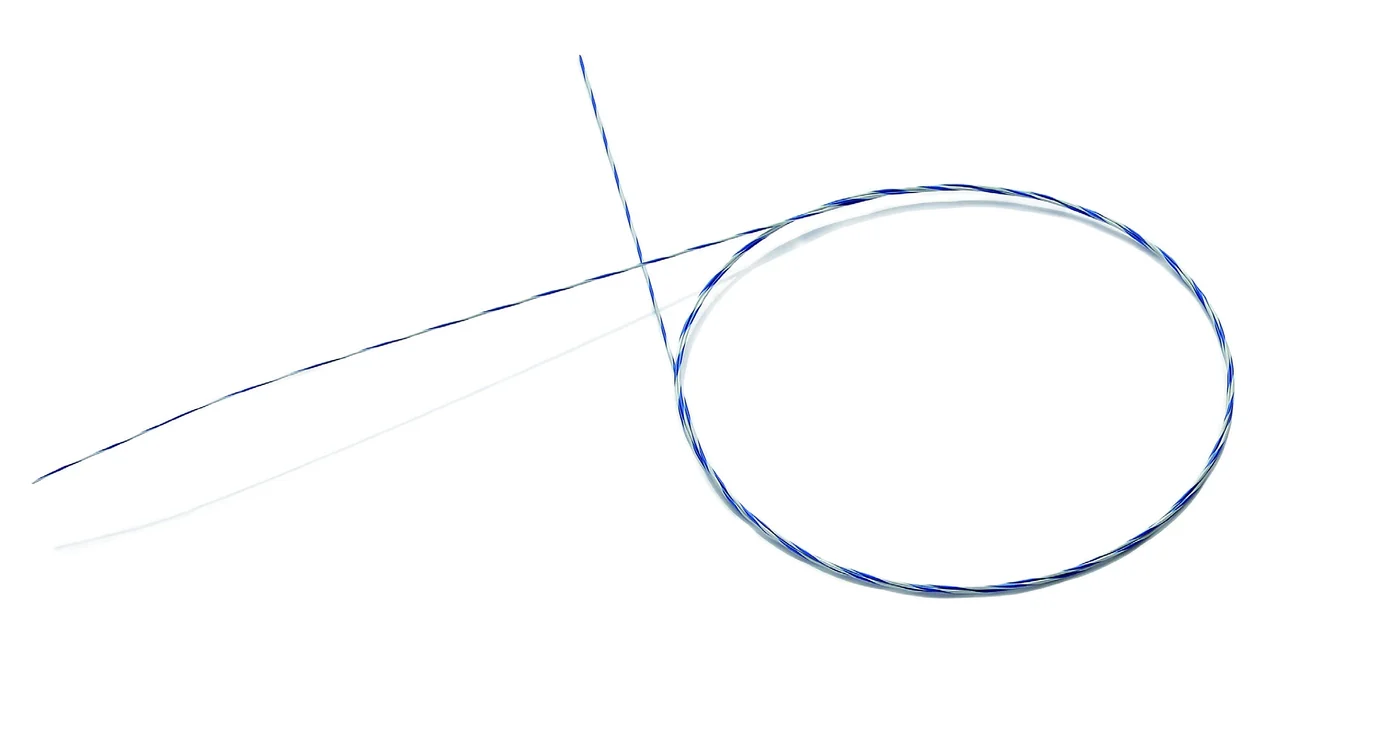
Two wires with opposite jobs, ordered on the same line. The zebra — nitinol core, striped polymer jacket — is endourology's navigation wire: the stripes give the visual movement reference under the endoscope (the same principle as in ERCP), nitinol refuses to kink in the tracts the ureter punishes, and the straight or angled tip negotiates the meatus and impacted stones. Diameters 0.025" to 0.038", lengths 150, 260 and 430 cm — the extreme length for exchanges holding position. The super-stiff is its opposite by design: maximum-column steel core with PTFE coating and a flexible J-tip, 0.032"/0.035" × 80 cm, built to hold nephrostomy-tract dilatation and sheath passage without the wire yielding. Navigating with the super-stiff or dilating over the zebra are the two classic errors — each to its job, and the order that brings both prevents both.
Technical Specifications
Clinical Uses
- Endourological navigation under vision (zebra)
- Nephrostomy and sheath dilatation support (super-stiff)
- Instrument exchange with the 430 cm zebra
- Joint replenishment of the urology theatre's wire pair
Which for what
Opposite roles by design. The correct purchase carries both in the unit's ratio.
| Wire | Designed for | Not for |
|---|---|---|
| Zebra | Navigating under vision: meatus, ureter, renal pelvis — scope and instruments ride it | Holding tract dilatation: it yields |
| Super-stiff | Support: nephrostomy dilators, access sheaths, push without flex | Fine navigation: its stiffness punishes the urothelium |
The zebra's 430 cm exists for long-instrument exchanges holding position — order it only if your technique uses it.
Frequently Asked Questions — Urology Guidewires — Zebra & Super-Stiff PTFE
Why does the zebra have stripes?
Movement reference under the endoscope: the image gives no depth and the alternating pattern sliding by is the immediate signal that the wire advances or retreats — the same principle as ERCP wires. In urology it also reads well against the irrigated field.
Can I dilate over the zebra if I lack a super-stiff?
That is the classic error. The zebra is built for flexibility and navigation: under a nephrostomy dilator's push it yields and the tract wanders or is lost. The super-stiff exists exactly for that — its steel column holds the push. Each to its job; hence they sell on the same order.
What is the 430 cm length for?
Long-instrument exchange holding wire position: the eternal rule — the wire must outmeasure the complete instrument plus the tract. If your technique does no long exchanges, 150 cm covers daily work.
How is it quoted?
Both families in one order: the zebra matrix (diameter × length × tip) plus the two super-stiff references. Documentation: technical file, ISO 13485, per-batch sterilisation.
Request a Quote — Urology Guidewires — Zebra & Super-Stiff PTFE
Reply within 24 business hours with FOB/CIF price, MOQ and lead time. SKU XY-UGW is already attached to your request — just add the quantity.
Request a Sample
Samples available for evaluation. Basic items: free sample. Higher-value items: a sample fee may apply. Shipping not included.
Full Description — Urology Guidewires — Zebra & Super-Stiff PTFE
Two wires, two physics
The zebra bends and survives; the super-stiff holds and pushes. One navigates a ureter under vision, the other anchors a dilatation. Their specs are opposite because their jobs are.
The stripes work
No depth on an endoscope image — the alternating pattern sliding across the field is the immediate movement signal, and it reads well against an irrigated field.
The two classic errors
Dilating over a zebra (it yields, the tract wanders) and navigating with a super-stiff (the urothelium pays). Both prevented by ordering the pair.
What to confirm before ordering
- Zebra matrix (diameter × length × tip) plus the two super-stiff references - 430 cm only if the technique exchanges long instruments