Sophora Flavescens Root Extract (苦参) — Ingredient Dossier for Buyers
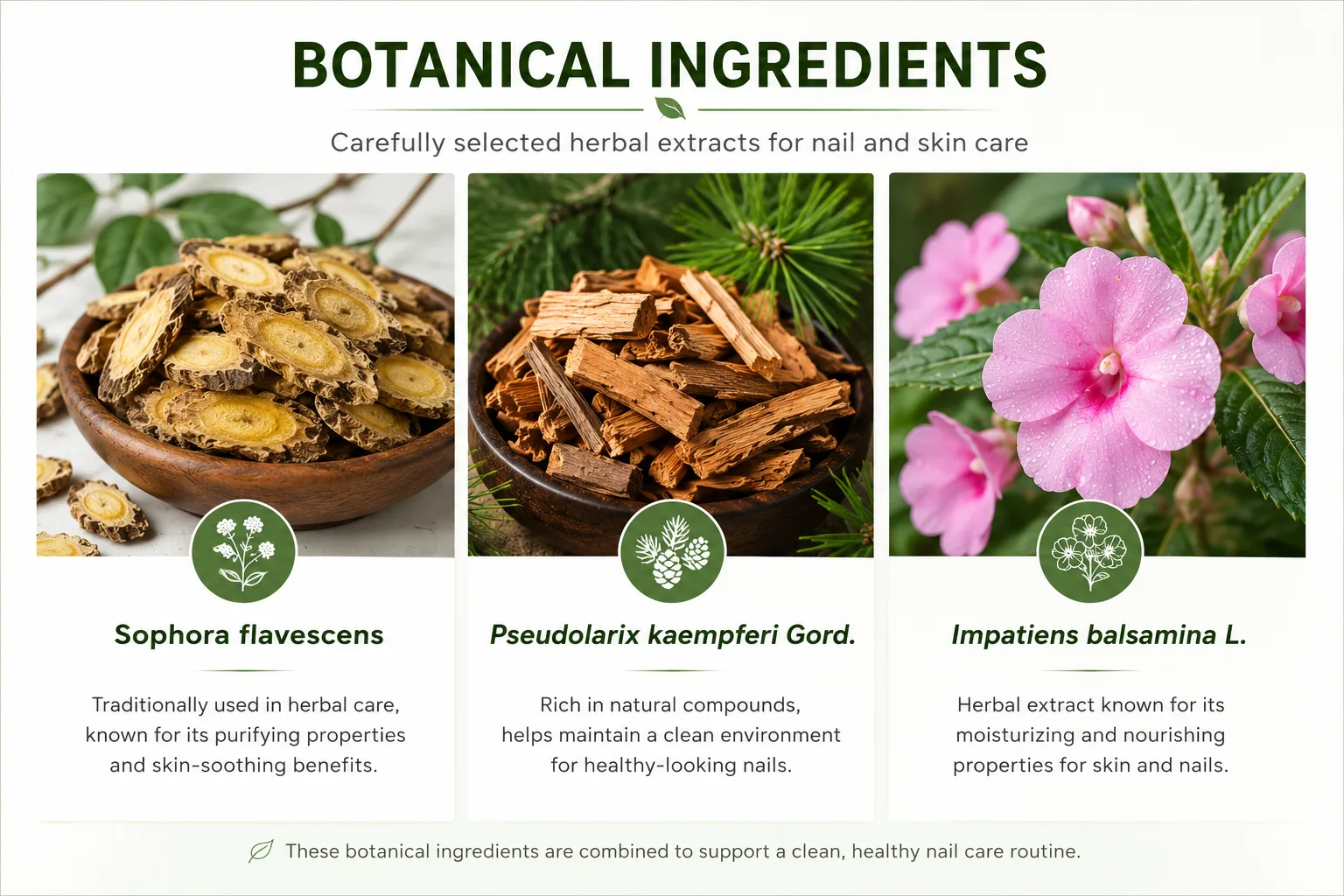
Sophora flavescens is the first of the three botanicals in the nail care cream we manufacture, and the one most often seen in Chinese herbal skincare. This page covers what they need from it: the correct INCI declaration, the functions that declaration supports, the chemistry behind it and the specification points that end up in your product information file.
The ingredient at a glance
CosIng is the European Commission’s cosmetic ingredient inventory. It records names and functions but is not legally binding, so your safety assessor checks the live record at the time of notification rather than relying on this page.
Why it is in a nail and foot cream
In Chinese practice 苦参 belongs to the small group of herbs used externally on the skin of the feet. It turns up in washes, soaks and ointments for skin that is damp, itchy and uncomfortable, which is why a buyer who knows Chinese herbal skincare at all will expect to see it in a foot product. That traditional association is the reason it is in the jar, and it is also the most a label can say about it.
The INCI entry gives it two cosmetic functions, antioxidant and skin conditioning. Those are the functions a cosmetic claim can rest on. Anything stronger has to come from a test on the finished product, and anything about killing or treating a fungus cannot be made for a cosmetic at all.
Getting the INCI declaration right
Two CosIng entries carry the plant’s name. The declaration has to match the extract the supplier made.
- Sophora Flavescens Root Extract (83737) is correct when the extract is made from the root, which is the part used in traditional 苦参 preparations and the part in our formula.
- Sophora Flavescens Extract (83736) carries no plant part in its name. Under INCI naming convention that describes the whole plant, so using it for a root extract misdescribes the ingredient, and a careful reviewer will query it.
- Sophora Flavescens Root Powder is a different ingredient, ground root rather than an extract, with different listed functions. It does not belong on this product’s list.
The INCI name is what goes on the pack. The Latin binomial and the Chinese name can appear in marketing copy and on a secondary panel, and for a herbal product they usually should, but they do not replace the INCI name in the ingredient list.
What the extract specification should tell your assessor
A botanical extract is not one fixed material. Two extracts both legitimately called Sophora Flavescens Root Extract can differ several-fold in what they contain. The specification is where that gets pinned down, and every point below ends up in your product information file.
- Plant part and botanical identity, with the authority for the name.
- Extraction solvent and the carrier the extract is supplied in, for example glycerin, butylene glycol or water. The carrier appears on your ingredient list too.
- Drug-to-extract ratio, so the assessor can relate the extract back to the amount of root it represents.
- Content of a marker compound, typically matrine or oxymatrine, so batches can be compared.
- Any preservative already in the extract, because it counts towards the finished product’s preservative system.
- Limits for heavy metals, pesticide residues and microbiology.
The safety assessor’s question
Matrine and oxymatrine are biologically active alkaloids that have been studied mostly as oral medicines in China. That does not rule them out of a cosmetic. The assessor will ask for three figures: alkaloid content in the extract, extract concentration in the cream, and the exposure.
The amount used is small, and the area is a nail and the skin around it. However, the leaflet tells the user to keep the cream under a wrap for five to seven days, and occlusion increases what passes into the skin. An assessment written for an ordinary leave-on cream does not cover that use. Ask for it to be addressed explicitly. Our salicylic acid guide raises the same point for the keratolytic.
What not to carry onto the pack
Search the plant’s name and you will find laboratory work on its antimicrobial chemistry. That work is about isolated compounds or crude extracts under laboratory conditions. It says nothing about what a cream containing the extract does on a nail. Quoting it next to a nail product reads as a claim to act on an infection, which makes a cosmetic an unapproved drug in the EU, the UK and the US alike. The regulatory routes guide sets out where that line falls.
Common questions
What INCI name goes on the label for 苦参?
Sophora Flavescens Root Extract, CosIng reference 83737, provided the extract is made from the root. The entry without a plant part, Sophora Flavescens Extract (CosIng 83736), describes the whole plant, and the two are not interchangeable on an ingredient list.
What cosmetic function does the INCI entry give it?
Antioxidant and skin conditioning. Those listed functions are what a cosmetic label and a cosmetic claim can lean on. They describe what the ingredient does in a cosmetic product, which is narrower than everything the plant has been studied for.
The plant has been studied for antimicrobial activity. Can I use that in my marketing?
No. That literature is about isolated constituents or crude extracts in laboratory conditions. It is not evidence about a finished cream, and quoting it next to a nail product reads as a claim to act on an infection, which is a drug claim in the EU, the UK and the US.
Are matrine and oxymatrine a safety problem in a leave-on cream?
They are pharmacologically active alkaloids, so the safety assessor will want their content in the extract and the extract's concentration in the finished product. The exposure to assess is a small area kept under a wrap for five to seven days.
Can the Sophora level be raised for a stronger product story?
Ratio changes are discussable for an OEM run, but a higher botanical load is not a stronger claim. The claim boundary is set by the cosmetic category, not by the dose, and a change has to go back through the safety assessment.
Ask for the specification
Tell us the market you are notifying in and we will send the extract specification with the full breakdown of the finished cream. Samples ship from one unit.
More sourcing guides
Sources and where to check
- European Commission — CosIng cosmetic ingredient database — search references 83736 and 83737
- Regulation (EC) No 1223/2009 on cosmetic products — Article 19 on ingredient labelling, Annex I on the safety report
- Our formulation overview — the keratolytic base and all three botanicals
Sourcing this product for your brand?
We are the factory. The pages below cover manufacturing terms rather than consumer advice — minimum quantities, customisation, formulation and distribution.
Looking for a herbal toenail fungus cream?
Our herbal nail care formula is available for sample orders, wholesale supply, OEM packaging and distributor cooperation. Contact us to get started.