Ultrasound-guided puncture has become the standard of practice for vascular access, regional anaesthesia and biopsies. Compared with blind or freehand puncture, seeing the needle in real time as it advances toward the target reduces attempts, complications and procedure time. The needle guide is the piece that makes this reproducible: it couples the needle's trajectory to the probe's imaging plane. This guide explains what it is, how it differs from the freehand technique, how to choose it by probe type, and what other supplies make up a complete interventional ultrasound system. Written for radiology, sonography, anaesthesiology, ICU, assisted reproduction and hospital procurement.
What is an ultrasound needle guide?
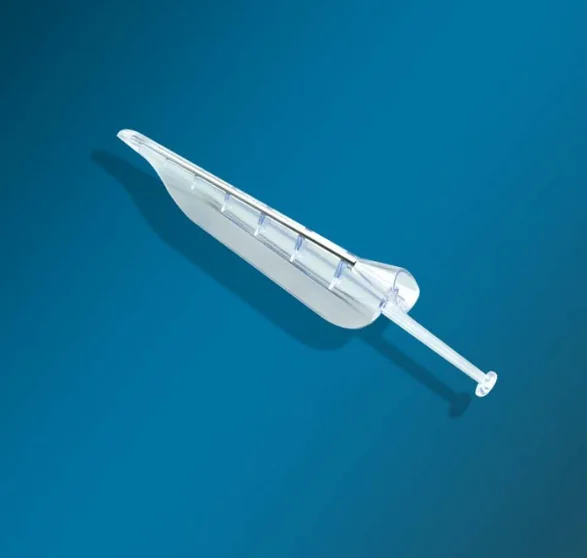
A needle guide is an accessory that attaches to the ultrasound probe (transducer) and fixes the needle's entry trajectory. Its function is simple but critical: to keep the needle within the imaging plane throughout its advance, so the operator sees it on screen in real time.
The system has two parts: a bracket specific to the transducer model, fixed to the probe, and a disposable guide insert that defines the needle's angle and gauge. The assembly mounts onto the probe — usually already covered with its sterile protective cover and gel — and the needle is introduced through the insert channel.
By predefining the entry point and angle, the guide removes much of the uncertainty of the puncture: the operator knows where the needle will appear in the image before even advancing it.
Needle guide vs freehand technique: which to choose?
There are two ways to perform an ultrasound-guided puncture, and it helps to understand when to use each:
Freehand technique: the operator holds the probe in one hand and the needle in the other, aligning them manually to keep the needle in the imaging plane. It offers maximum angle flexibility and allows correcting the trajectory on the fly, but demands experience and coordination; in small vessels or deep structures it often needs more attempts.
With a needle guide: the insert fixes the angle relative to the probe, so the needle appears consistently in the image. It reduces the learning curve, brings reproducibility and increases first-attempt success.
| Criterion | Freehand | With needle guide |
|---|---|---|
| Learning curve | High | Low |
| Angle flexibility | Maximum | Predefined by the insert |
| First-attempt success | Operator-dependent | Higher and reproducible |
| Best for | Cases needing fine adjustment | Routine vascular access and biopsies |
Practical rule:
- Use a needle guide for routine vascular access (PICC, CVC, arterial access), standard biopsies and whenever the operator is in training or the first attempt is critical.
- The freehand technique keeps an advantage in expert hands and in cases requiring real-time fine angle adjustments.
Many services combine both: guide for most cases and freehand for special situations.
How to choose the guide by probe: linear vs convex
The guide must match the exact transducer model, because the bracket is designed to the geometry of each probe. Broadly:
Linear probe (high frequency, superficial structures): used for peripheral vascular access, PICC, arterial access and superficial nerve blocks. Guides for linear probes typically offer angles aimed at targets a few centimetres deep.
Convex probe (low frequency, deep structures): used for liver and kidney biopsy, abdominal procedures and deep targets. Guides for convex probes allow for greater angles and depths.
| Feature | Linear probe | Convex probe |
|---|---|---|
| Frequency | High | Low |
| Target depth | Superficial | Deep |
| Applications | PICC, vascular access, regional anaesthesia | Liver/kidney biopsy, abdomen |
Besides the probe type, when choosing you must define:
- Insert gauge: must match the needle (usually 14G–23G by procedure). PICC, CVC and biopsy use larger gauges; regional anaesthesia, smaller.
- Fixed or multi-angle: multi-angle inserts give more versatility for different depths.
- Disposable vs reusable bracket: the insert in contact with the needle is single-use; some metal brackets are re-sterilisable.
Key buying tip: always state the brand and model of the transducer. Without it, bracket compatibility cannot be guaranteed.
Clinical applications of ultrasound-guided puncture
The needle guide is used across a wide range of procedures:
- Vascular access: placement of PICC and central venous catheter (CVC), where ultrasound guidance reduces complications (arterial puncture, pneumothorax) and failures. Arterial access also benefits in difficult vessels. See our central venous catheter (CVC) guide.
- Regional anaesthesia: ultrasound-guided nerve blocks improve the precision of anaesthetic deposition and reduce the dose needed.
- Pain management: image-guided injections and interventional procedures.
- Biopsies: liver, kidney, breast and thyroid; the guide keeps the needle on the target lesion and reduces the passes needed.
- Assisted reproduction (IVF): oocyte aspiration is performed with a needle guide on a transvaginal probe.
- General interventional ultrasound in radiology, oncology, ICU and the ER.
In all these cases the rationale is the same: more precision, more first-attempt success and fewer complications.
The full system: which supplies accompany the needle guide
The needle guide is rarely used alone. A sterile interventional ultrasound system includes several consumables worth buying in a coordinated way:
- Probe cover: covers the transducer to keep the field sterile. One of the highest-turnover consumables: mandatory single use.
- Sterile ultrasound gel: couples the probe to the skin (and inside the cover) without compromising sterility.
- Needle guide: the insert and bracket described here.
- Biopsy / introducer needle: by procedure (core, aspiration, introducer for a catheter).
- PICC or central line kit / regional anaesthesia kit: complete sets that integrate the procedure components.
For distributors and hospital procurement, approaching this category as a bundle (cover + gel + guide + needles) simplifies inventory and improves cost per procedure.
Edaochi Medical supplies the needle guide for linear and convex probes with a bracket adapted to the transducer model, along with probe covers, sterile gel and needles. Full CE and ISO 13485 documentation. Samples and quote on WhatsApp in under 24 hours.
Frequently Asked Questions
What is an ultrasound needle guide?
It is an accessory that attaches to the ultrasound probe and fixes the needle's trajectory so it stays within the imaging plane during the puncture. It consists of a bracket specific to the transducer model and a disposable insert that defines the needle's angle and gauge.
Why use a needle guide instead of freehand puncture?
The guide predefines the angle and entry point, so the needle appears consistently in the image. This increases first-attempt success, reduces complications and shortens the learning curve. The freehand technique keeps an advantage in expert hands due to its angle flexibility.
Does the guide work with any probe?
Not directly: the bracket is designed for the transducer model. There are versions for linear probes (superficial access) and convex probes (deep structures), adaptable to the main ultrasound brands. You must state the probe brand and model to confirm compatibility.
Which needle gauges is it compatible with?
The insert is available for different gauges, usually in the 14G–23G range by reference. PICC, CVC and biopsy use larger gauges; regional anaesthesia and fine procedures, smaller. Specify the gauge when requesting a quote.
Is the needle guide single-use?
The insert in contact with the needle is single-use and supplied sterile (EO) in an individual peel-pouch. Some metal brackets are reusable and re-sterilisable per the manufacturer, but the insert is discarded after each procedure.
What other supplies do I need for a sterile ultrasound-guided puncture?
Besides the needle guide, you need a probe cover, sterile ultrasound gel and the corresponding biopsy or introducer needle. Many procedures use complete PICC, central line or regional anaesthesia kits that integrate these components.