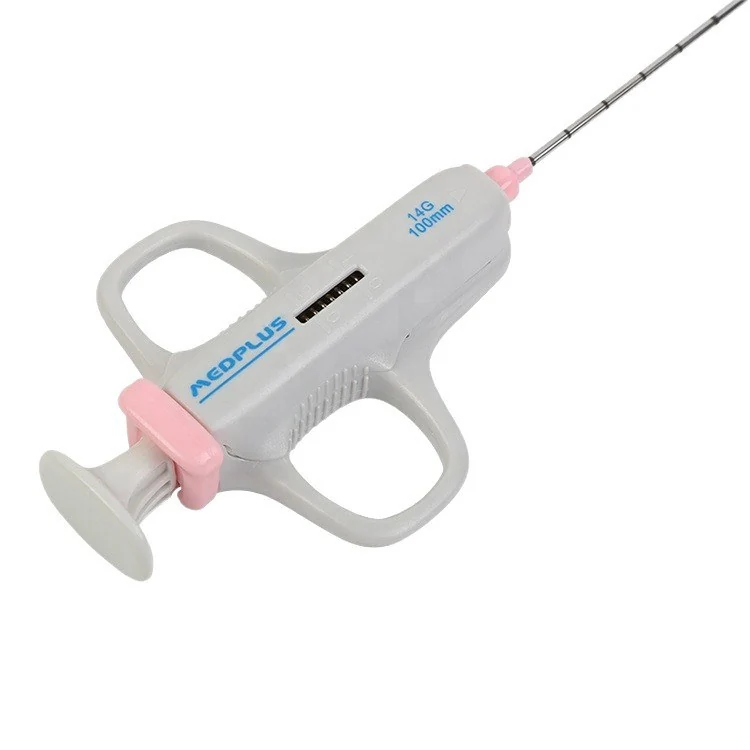
The bone marrow biopsy needle is a high-value, low-competition consumable: it is used in haematology and oncology to obtain bone marrow samples — and other tissues such as liver, kidney or lymph nodes — to diagnose leukaemias, lymphomas, anaemias and metastases. Choosing the right needle (gauge, length, sampling system) directly affects the quality of the tissue core obtained and patient comfort. This guide explains what it is, the difference between aspiration and trephine/core biopsy, how to choose gauge and length, and what to check before buying wholesale. Written for haematology, oncology, interventional radiology and hospital procurement.
What is a bone marrow biopsy needle?
The bone marrow biopsy needle is a single-use instrument designed to penetrate the bone cortex (usually the posterior iliac crest) and obtain a sample of the bone marrow inside. Unlike a conventional needle, it is built to cross bone tissue and extract an intact tissue core that the pathologist can analyse.
Two types of sample are sometimes obtained in the same procedure:
- Bone marrow aspirate: a liquid sample of marrow cells is aspirated with a syringe. Used to study cell morphology, flow cytometry and cytogenetics.
- Bone marrow biopsy (core / trephine): a solid core of bone and marrow is extracted that preserves the tissue architecture. Essential to assess cellularity, fibrosis and tumour infiltration.
Many modern needles allow both procedures, and some include an automatic spring-fired (gun-type) system to take the core in a single movement, improving precision and reducing discomfort.
Aspiration vs core biopsy: when to use each
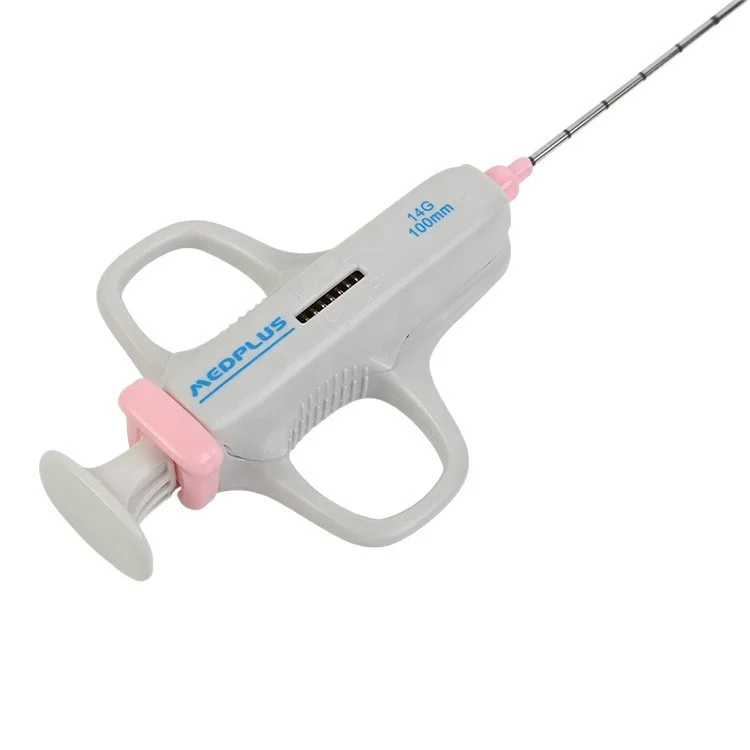
Although usually combined, aspirate and biopsy answer different questions:
| Aspect | Marrow aspirate | Core biopsy (trephine) |
|---|---|---|
| Sample type | Liquid (loose cells) | Solid tissue core |
| What it evaluates | Cell morphology, flow cytometry, cytogenetics | Cellularity, architecture, fibrosis, tumour infiltration |
| When it's key | Diagnosis of leukaemias, anaemias | Lymphomas, myelofibrosis, tumour staging, dry tap |
| Limitation | Doesn't show tissue architecture | Slower processing (decalcification) |
In practice, a complete work-up of many haematological diseases requires both samples: the aspirate for cellular detail and the biopsy for structure. That's why it helps to have needles that allow both procedures, or coordinated sets.
How to choose gauge and length
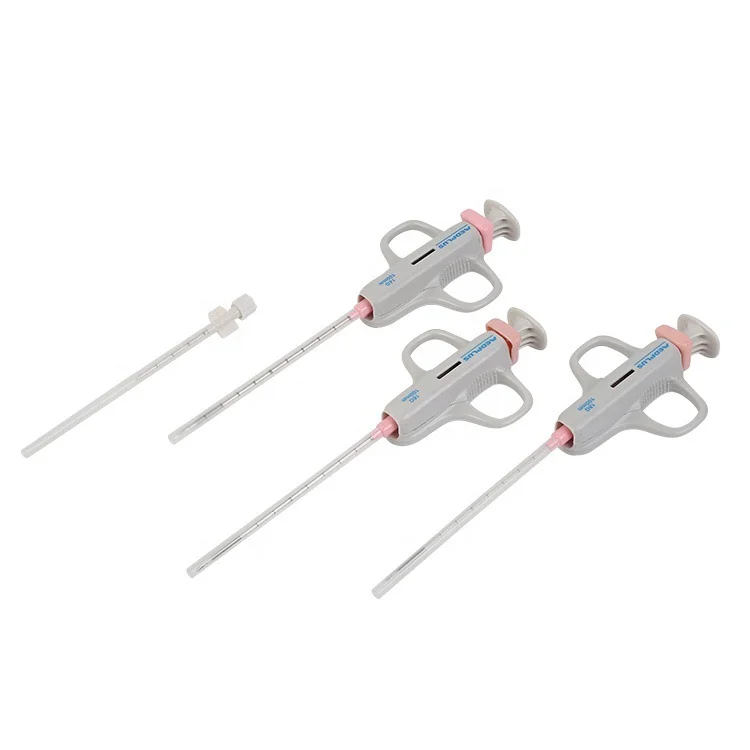
The two most important buying decisions are the gauge (thickness) and the length of the needle:
Gauge: the lower the number, the thicker the needle and the larger the core obtained. Common gauges are 11G, 14G and 16G.
| Gauge | Sample diameter | Typical use |
|---|---|---|
| 11G | Largest core | Adult bone marrow biopsy when a wide sample is needed |
| 14G | Intermediate | General use; balance of sample and trauma |
| 16G | Smaller core | Smaller patients or soft tissue (liver, kidney, nodes) |
Length: 10 cm versions cover most posterior iliac crest biopsies in average-build adults; 15 cm is reserved for patients with more soft tissue, where the bone must be reached.
Practical rules:
- For standard adult bone biopsy, 11G–14G at 10 cm is the most-used combination.
- For overweight patients or a deep iliac crest, prefer 15 cm.
- For soft-tissue biopsy (liver, kidney, nodes), 14G–16G is usual — often performed under image guidance with an ultrasound needle guide.
A tissue sample of about 20 mm in length is enough for a quality diagnosis in most cases.
Manual vs automatic (gun) firing system
Another relevant difference is how the tissue core is obtained:
Manual needle: the operator advances the needle and cuts the core with the classic technique. It gives full control but depends more on experience and can be somewhat more uncomfortable.
Automatic firing system (gun-type): a spring mechanism fires the inner needle and captures the core in a single fast movement. Advantages:
- Greater reproducibility of sample size.
- Less procedure time and less patient discomfort.
- A shorter learning curve.
The automatic firing system has become standard in image-guided soft-tissue biopsy (liver, kidney, nodes) and increasingly in bone biopsy. For high-volume services, it brings consistency between operators.
Applications and what to check before buying wholesale
The biopsy needle is used in haematology, oncology, interventional radiology and pathology, for:
- Diagnosis and follow-up of leukaemias, lymphomas, myeloma and myelodysplastic syndromes.
- Study of anaemias, cytopenias and marrow disorders.
- Staging of solid tumours (looking for marrow infiltration).
- Image-guided biopsy of liver, kidney and lymph nodes.
For hospital procurement and distributors, key points before an order:
- Tip sharpness and design: a well-sharpened tip penetrates the bone with less force and obtains an intact core.
- Gauges and lengths available: the supplier should cover 11G–16G and 10/15 cm.
- Sampling system: manual or automatic firing, by service preference.
- Core integrity: a mechanism that retains the sample without fragmenting it.
- Sterilisation and packaging: sterile (EO), individual, with indicator.
- Documentation: ISO 13485, CE marking and a datasheet for import and tenders.
- MOQ and private label (OEM): minimum order and private-label option for distributors.
Edaochi Medical manufactures the bone marrow and soft-tissue biopsy needle in 11G, 14G and 16G gauges, 10 and 15 cm lengths, with an automatic gun-type firing system and a 20 mm tissue sample, sterile in individual packaging. Full CE and ISO 13485 documentation, low minimum order, samples for evaluation and OEM option. Quote on WhatsApp in under 24 hours.
Frequently Asked Questions
What is the difference between a bone marrow aspirate and a biopsy?
The aspirate obtains a liquid sample of cells to study morphology, flow cytometry and cytogenetics. The biopsy (core or trephine) extracts a solid core of bone and marrow that preserves the tissue architecture, essential to assess cellularity, fibrosis and tumour infiltration. Many work-ups require both.
What gauge of bone biopsy needle should I choose?
Common gauges are 11G, 14G and 16G: the lower the number, the thicker the needle and the larger the sample core. For adult bone marrow biopsy, 11G–14G is common; for soft tissue (liver, kidney, nodes), 14G–16G. A 10 cm length covers most adults; 15 cm for patients with more soft tissue.
What is the advantage of the automatic firing system?
The gun-type system fires the needle and captures the core in a single movement, giving greater reproducibility of sample size, less procedure time, less patient discomfort and a shorter learning curve. It is widely used in image-guided soft-tissue biopsy.
Is it only for bone marrow?
No. Besides bone marrow, it is used for soft-tissue biopsy such as liver, kidney and lymph nodes, usually with 14G–16G gauges and under image guidance. Gauge and length are chosen by tissue and patient.
Is the biopsy needle single-use?
Yes. It is a single-use device, supplied sterile (EO) in individual packaging, to guarantee tip sharpness and avoid contamination. It must not be reused.
Do you offer different gauges and private label for distributors?
Yes. Edaochi Medical offers 11G, 14G and 16G gauges and 10 and 15 cm lengths, with an automatic firing system, CE and ISO 13485 documentation, low minimum order, samples and private-label (OEM) option. Price and MOQ are delivered on WhatsApp in under 24 hours.