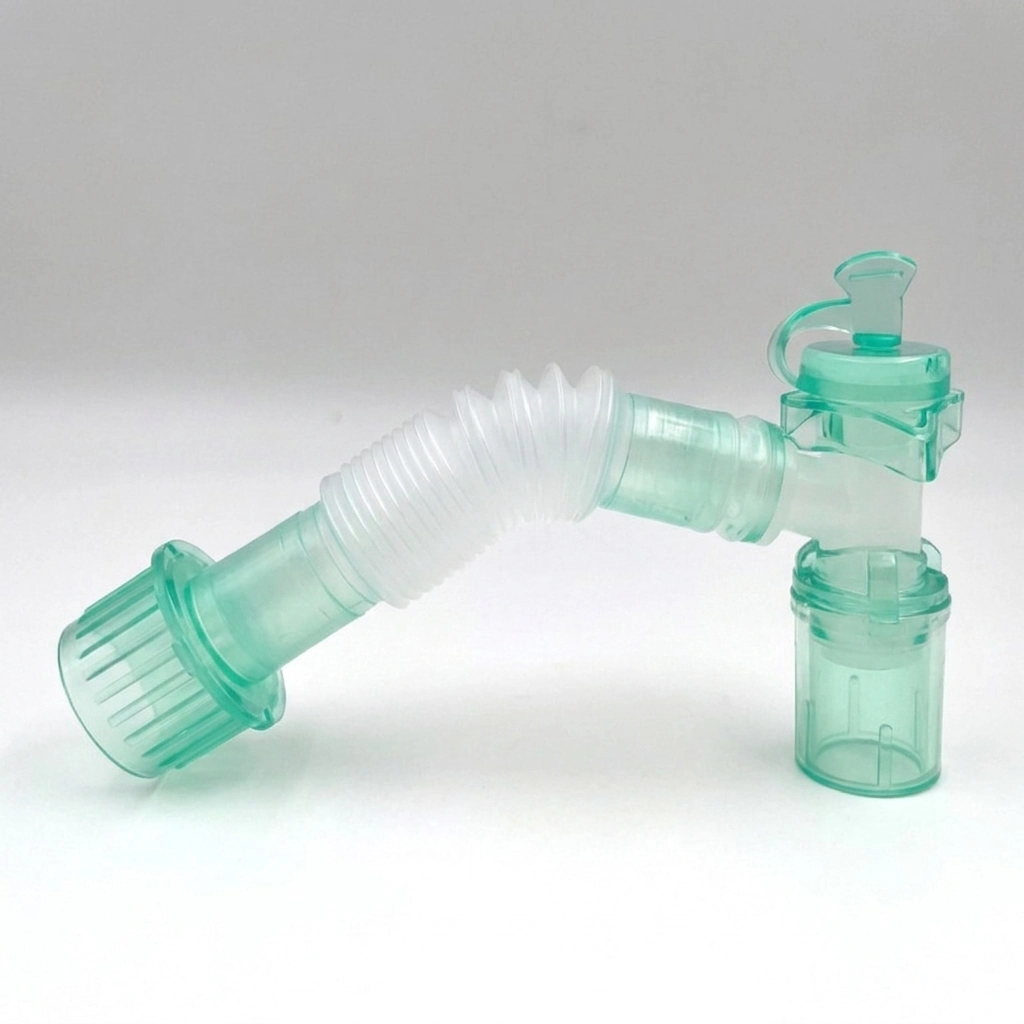
The catheter mount is one of the most-used consumables in anaesthesia and ICU, and at the same time one of the least understood outside the OR. It is not a filter, not a breathing circuit and not a suction catheter. It is the flexible connector between the patient's airway and the ventilator or anaesthesia machine circuit. This guide explains exactly what it's for, why the elbow type matters, what options exist and what to check when buying. Written for anaesthesia, ICU, OR procurement and distributors.
What is a catheter mount and where does it sit in the circuit?
The catheter mount (also called breathing circuit extension or swivel elbow connector) is a short disposable accessory placed between the patient's airway device and the main breathing circuit.
Position in the circuit:
Endotracheal tube (or laryngeal mask / tracheostomy cannula) → Catheter mount → Circuit Y-piece → Ventilator / Anaesthesia machine
Its typical length is 10 to 20 cm. Its connectors are the respiratory standard: the patient end has a 15 mm male connector and the circuit end a 22 mm female connector. This combination is compatible with virtually all endotracheal tubes, laryngeal masks, disposable breathing circuits and anaesthesia machines or ventilators on the market.
Important note: the catheter mount alone does not filter or humidify. If filtration or passive humidification is needed, an HME or HMEF filter is added in line. Many manufacturers offer the HMEF with an integrated catheter mount as a single device, but when an active humidifier is used, the catheter mount is used without a filter.
The real problem it solves: tension, kinking and accidental extubation
In an intubated patient, the endotracheal tube is fixed at the mouth or nose and passes through the glottis into the trachea. Any traction or torsion applied to the external end of the tube is transmitted directly to the trachea and vocal cords.
The sources of tension in a ventilated patient are constant: the weight of the circuit, ventilator movements during the cycle, repositioning by nursing, decubitus changes to prevent ulcers, transport for diagnostic studies. Without a catheter mount, all that tension goes straight to the endotracheal tube.
The clinical consequences of poor tension management are:
- Accidental extubation: the tube shifts or comes out of the trachea, requiring emergency reintubation.
- Endobronchial displacement: the tube advances further than intended and ventilates only one lung.
- Tracheal injury: chronic traction on the tube cuff causes pressure necrosis of the tracheal mucosa.
- Circuit disconnection: tension separates the circuit from the tube, with risk of acute desaturation.
The catheter mount eliminates these risks by absorbing tension in the stretch between the circuit and the tube. The corrugated or extensible tube deforms before transmitting force, and the swivel elbow lets the circuit change orientation without twisting the tube.
Types of catheter mount: corrugated, extensible and double swivel
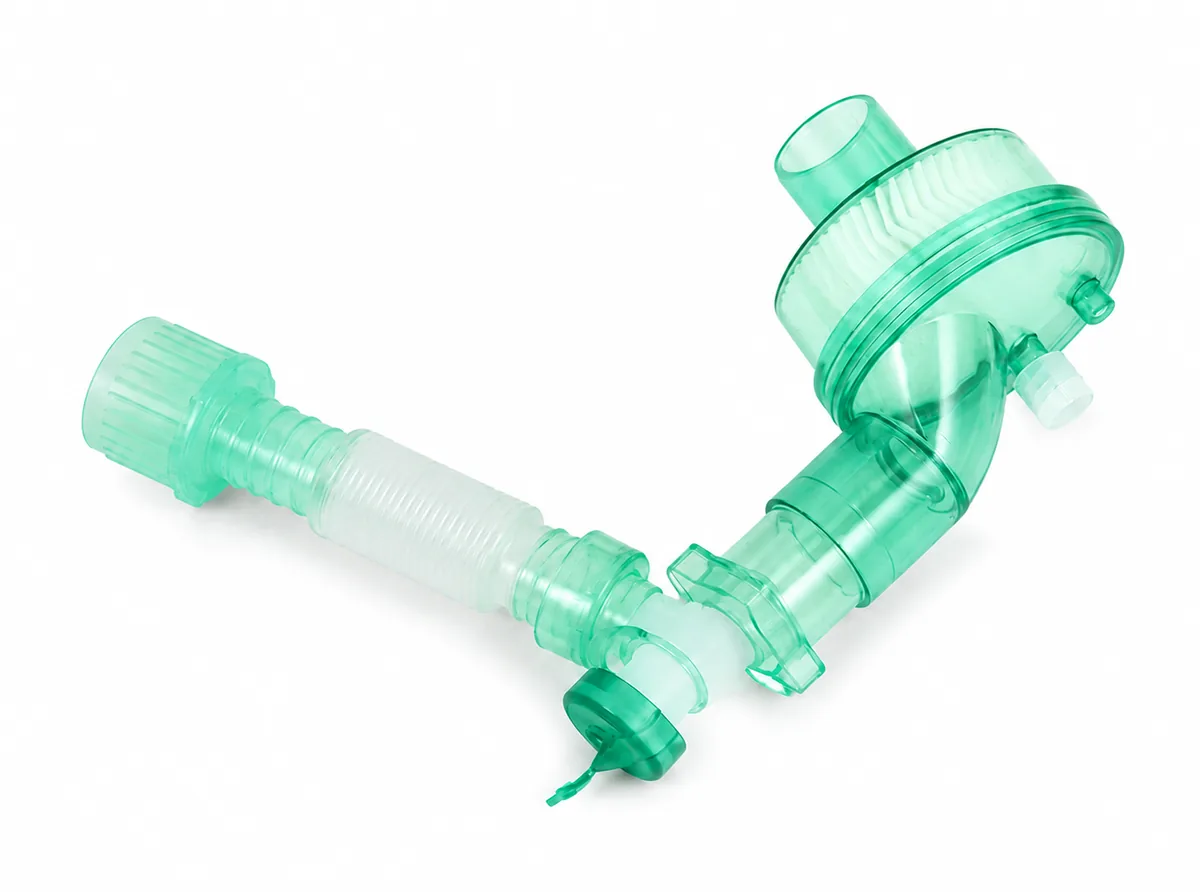
Type 1 — Corrugated tube (fixed length): the standard model. The corrugated tube has a fixed length (typically 15 cm) and can bend in any direction without collapsing. It is the most economical and common in short procedures. Limitation: it can't be lengthened if more distance is needed.
Type 2 — Extensible tube (variable length): the accordion tube extends from a compact length (6–8 cm) to a working length (up to 20 cm). Useful when the circuit must reach a position away from the patient, as in head and neck surgery where the anaesthetist needs to manage the circuit away from the surgical field.
Type 3 — Smoothbore tube: lower flow resistance than corrugated thanks to the smooth inner surface. Used where minimal flow resistance is critical, such as high-frequency ventilation or patients with severe obstruction.
Fixed vs single swivel vs double swivel elbow:
The fixed elbow doesn't rotate; the circuit must be oriented to the fixed elbow position, which can strain the tube in certain patient positions.
The single swivel elbow rotates 360° in one plane, allowing horizontal circuit orientation without disconnecting.
The double swivel elbow has two independent joints, one at each end. This allows any combination of angles on two axes. For lateral position surgery (thorax, kidney, spine) or prone (spine surgery, COVID), the double swivel is the only type that guarantees zero residual tension on the endotracheal tube.
Extra ports: gas sampling and suction
Most modern catheter mounts offer one or two optional ports that add function without changing the device's size or weight.
Gas sampling port (Luer): lets you connect the sidestream CO₂ sensor of the anaesthesia or ICU monitor directly on the catheter mount, with no extra piece. This simplifies the circuit and reduces disconnection points. It comes with a flip-top cap that closes the port when not in use. Important: check whether the monitor uses Luer lock (threaded) or Luer slip (push-fit) before ordering, as they are not interchangeable.
Suction port with hinged cap: lets you pass a suction catheter through the catheter mount without disconnecting the circuit. The hinged cap opens for the catheter and closes automatically on withdrawal, keeping the circuit closed. This is especially valuable in ICU, where secretion suctioning is frequent and each disconnection risks contamination and desaturation. For sizing the suction catheter that passes through, see our suction catheter sizes and types guide.
Applications by clinical area
OR — general anaesthesia: the catheter mount always goes between the endotracheal tube or laryngeal mask and the machine circuit. It allows rotating the circuit to the anaesthetist's position and absorbs movement without straining the airway. In short procedures (< 1 hour), the standard single-swivel model is enough. In long surgeries or special positions, the double swivel is the safest choice.
ICU — mechanical ventilation: the catheter mount works with the ventilator circuit. Frequent repositioning (every 2 hours for pressure-ulcer prevention) always justifies a double swivel elbow. If the service uses continuous CO₂ monitoring or capnography, order the model with a gas sampling port.
Emergency and transport: in emergencies, set-up speed is the priority. The standard corrugated catheter mount without ports is the quickest to place. For ambulance or helicopter transport, the extensible tube is useful because it adjusts the distance to the circuit without extra pieces.
Veterinary anaesthesia: the standard 15 mm (patient side) and 22 mm (circuit side) catheter mount is compatible with veterinary anaesthesia circuits for medium and large animals. For small animals, check the endotracheal tube connector diameter.
How to choose a catheter mount, clinically and for stock
On the clinical side, first confirm the connectors: 15 mm on the patient side and 22 mm on the circuit side for universal compatibility, and check on a sample that the connection comes apart without excessive force, because a stiff one risks accidental extubation when you rotate the elbow. The swivel elbow should turn with enough friction to hold its position but no more: too stiff leaves residual tension on the tube, too loose won't keep the circuit in place. Look at the packaging too, because a sterile peel-pouch should open with surgical gloves and no scissors, with the external sterility indicator visible before opening. And for paediatric intubation, weigh the whole assembly (mount plus filter), since the weight on a small tube matters.
For distributors, the standard double-swivel mount ships in boxes of 50 to 100 units, with a reference price around USD 2.50 to 3.50 per unit depending on configuration. For hospital stock in Latin America and Europe, CE and ISO 13485 are the floor; for the Middle East, check the local registration requirements (DOH in the UAE, SFDA in Saudi Arabia) before bidding.
We make the disposable catheter mount with corrugated, extensible or smoothbore tube and single or double swivel elbow, with optional gas-sampling and suction ports and 15 / 22 mm universal connectors, with full CE and ISO 13485 documentation and a low minimum order. The version with the filter already built in is the HMEF with catheter mount. Ask us for samples or an OEM version on WhatsApp.
Frequently Asked Questions
Can a catheter mount be reused?
No. The catheter mount is a single-use device. The PVC corrugated tube is not designed to withstand reprocessing by steam at 134°C or ethylene oxide. The elbow swivel mechanisms and ports also cannot be cleaned effectively and could retain secretions. Reuse risks cross-infection and possible mechanical failure.
What is the difference between the 15 mm and 22 mm connector on the catheter mount?
The 15 mm connector (patient side) is the standard size of the adapter on endotracheal tubes, laryngeal masks and tracheostomy cannulas. The 22 mm connector (circuit side) is the standard size of breathing circuit terminals and the Y-pieces of ventilators and anaesthesia machines. This combination guarantees universal compatibility.
Does the catheter mount go before or after the HME/HMEF filter?
It depends on the device. With an HMEF with integrated catheter mount, the combination goes complete between the endotracheal tube and the circuit. With a separate HMEF or HME filter, place the filter on the circuit side and the catheter mount on the patient side (endotracheal tube → catheter mount → filter → circuit). What matters is that the filter sits between the patient and the circuit.
How often is the catheter mount changed in ICU?
In ICU, the catheter mount is generally changed together with the complete breathing circuit, usually every 24 hours per the most common protocols. It is changed sooner if there is visible secretion contamination, if the swivel elbow loses friction and won't hold position, or if the packaging was opened incorrectly before use.