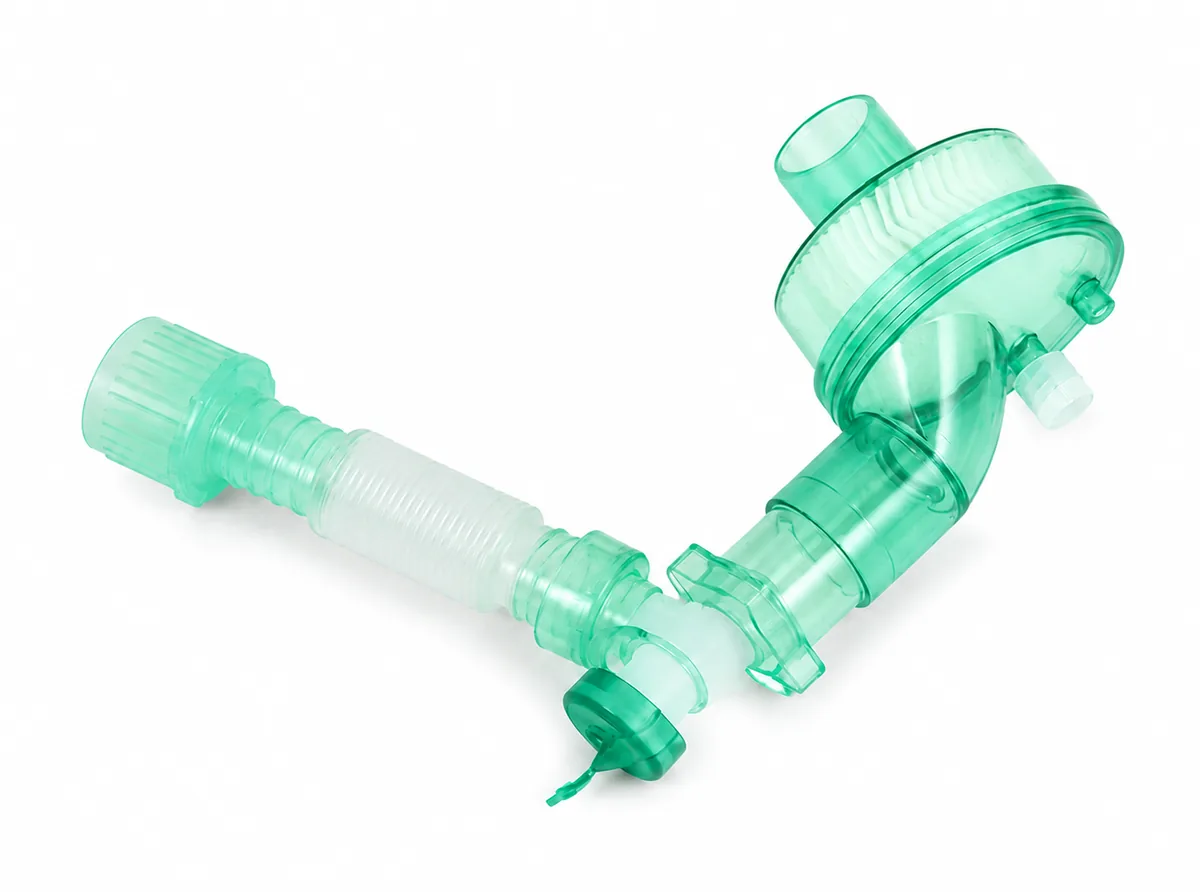
In most ORs and ICUs there's a device no one notices until it's missing: the HMEF filter with catheter mount. This component joins the patient's airway device to the ventilator or anaesthesia machine circuit and, at the same time, humidifies inspired air and blocks bacteria and viruses. A single accessory replaces three separate pieces. This guide explains how it works, which specifications matter and what to verify before buying it for clinical use or distribution inventory.
What is an HMEF with catheter mount and where does it go in the circuit?
The HMEF filter (Heat and Moisture Exchanger Filter) is a passive heat and moisture exchanger that also acts as a bacterial and viral barrier. Combined with a catheter mount — the flexible patient-side extension tube — you get an integrated device that performs three functions in one piece.
Position in the breathing circuit:
Airway device (endotracheal tube / laryngeal mask) → HMEF with catheter mount → Circuit Y-piece → Ventilator or anaesthesia machine
Without this component you'd place the filter and the extension tube separately, adding two more connections to the circuit. Each extra connection is a potential disconnection point and an entry point for contaminants. The integrated device removes those joints and simplifies the circuit without reducing function.
The patient end has a 15 mm male connector, compatible with the standard adapter of any endotracheal tube or laryngeal mask. The circuit end has a 22 mm female connector, compatible with the standard Y-piece of any disposable breathing circuit. The flexible extension itself is a catheter mount.
HME vs HMEF: key differences and when to use each
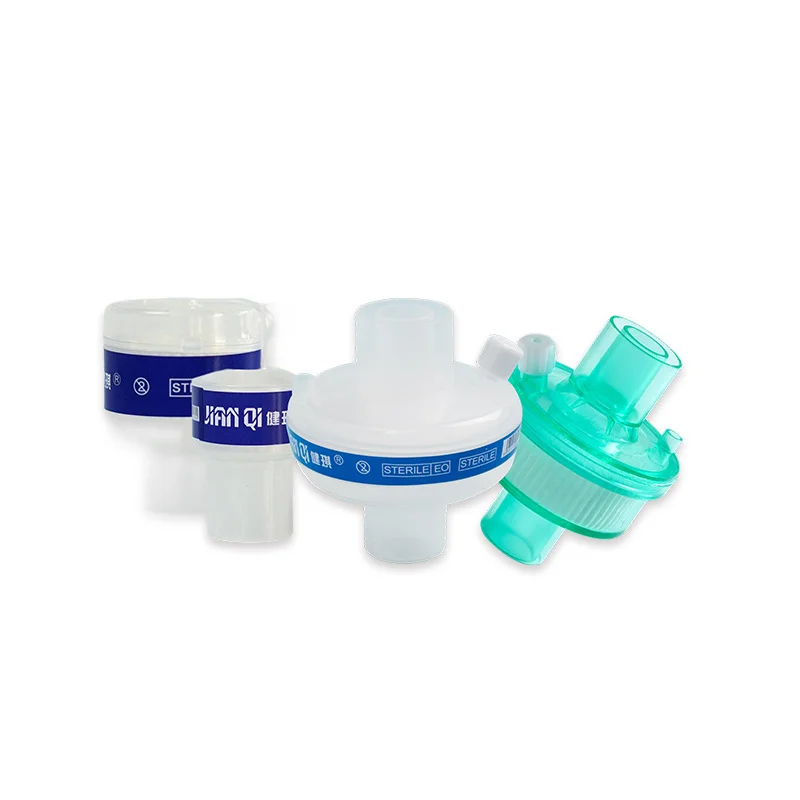
Although the terms are used interchangeably in catalogues and stores, there is an important technical difference:
HME (Heat and Moisture Exchanger): only exchanges heat and moisture. It collects humidity from exhaled air and returns it on the next inspiration. Typical efficiency: retains 60–70% of exhaled humidity. Does not filter bacteria or viruses.
HMEF (HME + Filtration): adds a bacterial and viral filtration membrane to the standard HME. BFE (Bacterial Filtration Efficiency) ≥ 99.99% and VFE (Viral Filtration Efficiency) ≥ 99.99% per EN 13328. Protects the breathing circuit and machine from cross-contamination.
When to use HME and when HMEF? Use HME when the patient has no active respiratory infection and the circuit is changed frequently. Use HMEF when the patient has a confirmed or suspected respiratory infection (tuberculosis, influenza, COVID-19, bacterial pneumonia), when the circuit is reused over 24 hours, or when hospital policy requires maximum equipment protection.
In practice, most Latin American and European hospitals have standardised HMEF as the single type for the whole floor, simplifying inventory and removing the risk of using the wrong type.
The integrated catheter mount: why it reduces accidental extubation risk
The catheter mount — the technical name for the patient-side extension tube — is the most underestimated component in circuit setup. Its job is not to filter or humidify: it is to absorb the mechanical tension between the circuit and the patient's airway.
In an intubated patient, any circuit movement — repositioning, decubitus change, transport, ventilator adjustment — generates a force transmitted directly to the endotracheal tube. If the circuit is rigidly connected to the airway, that force can displace the tube, cause accidental extubation or injure the trachea.
The catheter mount solves this two ways: the flexible corrugated tube absorbs movement without transmitting tension, and the swivel elbow lets the circuit rotate without twisting the endotracheal tube.
Single vs double elbow: a single elbow rotates in one plane. A double elbow rotates independently on two axes, allowing any circuit orientation with no residual tension. For lateral or prone position surgery, the double elbow is the clinically safest choice.
Technical specifications that matter when buying
When evaluating HMEF filters with catheter mount for hospital tenders or distribution stock, verify these parameters on the manufacturer's datasheet:
Dead space (mL): the internal volume between patient and circuit. This volume doesn't take part in gas exchange and increases rebreathed CO₂. For adults: ≤ 30 mL. For paediatric: ≤ 20 mL. Models without published dead-space data should be rejected for mechanical ventilation use.
Flow resistance (cmH₂O at 60 L/min): should be < 2.5 cmH₂O. High resistance increases the patient's work of breathing, especially critical in COPD or respiratory failure.
BFE and VFE (%): request a test certificate per EN 13328 or ASTM F2101. Don't accept only the manufacturer's claim; ask for the accredited-lab report. Minimum standard: BFE ≥ 99% and VFE ≥ 99%.
DEHP-free: for paediatric use and pregnant women, confirm the tube PVC is free of DEHP plasticiser. This must be on the datasheet or materials documentation.
Gas sampling port: confirm whether it comes standard or is optional. For ICU and anaesthesia with continuous CO₂ monitoring, this port is indispensable. Check whether it's Luer lock or Luer slip per the monitor used.
Clinical applications: when and how it's used
General anaesthesia in the OR: the HMEF with catheter mount is the standard connector between the laryngeal mask or endotracheal tube and the anaesthesia machine circuit. It protects the machine from the patient's secretions and provides passive humidification during the procedure. In long surgeries (> 2 hours), humidification is important to prevent drying of the tracheal mucosa.
ICU and mechanical ventilation: for short or medium-term ventilation (up to 24–48 hours per service protocol). It simplifies the initial setup because the filter, passive humidifier and extension tube come in a single sterile pack. Replaced every 24 hours or per protocol.
Emergency respiratory support: in emergency intubations, the HMEF with catheter mount allows a fast setup: a single accessory connects the endotracheal tube directly to the circuit with immediate protection.
Paediatric use: available in paediatric configurations with reduced dead space (≤ 20 mL) and light weight to avoid tension on the paediatric endotracheal tube. Confirm the catheter mount length and connector size when ordering neonatal or infant models.
Buying guide for hospitals, clinics and distributors
For hospitals and clinics: before standardising the service model, request samples from at least two manufacturers and compare: device weight, swivel elbow stiffness, ease of opening the peel-pouch with surgical gloves and the quality of the external sterility indicator. These operational details don't appear on datasheets but matter in daily use. Verify the chosen model has published data for dead space, flow resistance and BFE/VFE; for institutional tenders, include these three parameters as a minimum technical requirement.
For distributors: the HMEF with catheter mount is bought in boxes of 50. Reference price range is USD 3.50–5.50 per unit by filter spec, tube length, elbow type and certification requirements. Latin American public hospitals usually require CE and ISO 13485 as a minimum; some also require local approval. For the Middle East, confirm whether the end client requires DOH (UAE) or SFDA (Saudi Arabia) registration, as approval can take 6–12 months and should start before the first tender.
We manufacture HMEF filters with catheter mount in adult and paediatric configurations, with certified BFE/VFE, CE / ISO 13485 and full technical datasheets for tenders. Send us the ventilator model and estimated monthly volume on WhatsApp and we'll put together a quote.
Frequently Asked Questions
How often is the HMEF filter replaced in ICU?
Most hospital protocols set a 24-hour change. Some services apply a 48-hour change if there's no visible contamination and the patient has no active respiratory infection. The filter must be replaced immediately if visible secretion saturation is seen, if the circuit disconnects accidentally, or if the packaging breaks before use.
Can the HMEF with catheter mount be used with an active humidifier?
No. The HMEF provides passive humidification. If used simultaneously with an active heated-wire humidifier, the resulting condensation can saturate the filter and increase flow resistance. In patients needing active humidification, remove the HMEF and use only the catheter mount.
What do BFE and VFE mean on a breathing filter?
BFE (Bacterial Filtration Efficiency) is the filter's ability to retain bacteria: a 99.99% BFE means only 1 in 10,000 bacteria passes. VFE (Viral Filtration Efficiency) measures the same for viruses. Both should be certified by an accredited lab per EN 13328 (Europe) or ASTM F2101 (US). For ICU and intubation use, require the test certificates, not just the manufacturer's claim.
Does the HMEF filter protect both the patient and the anaesthesia machine?
Yes. The filter works both ways: it filters inspired air (protecting the patient from circuit contaminants) and exhaled air (protecting the circuit and anaesthesia machine from the patient's secretions). This reduces cross-contamination between patients and extends the life of the reusable circuit.