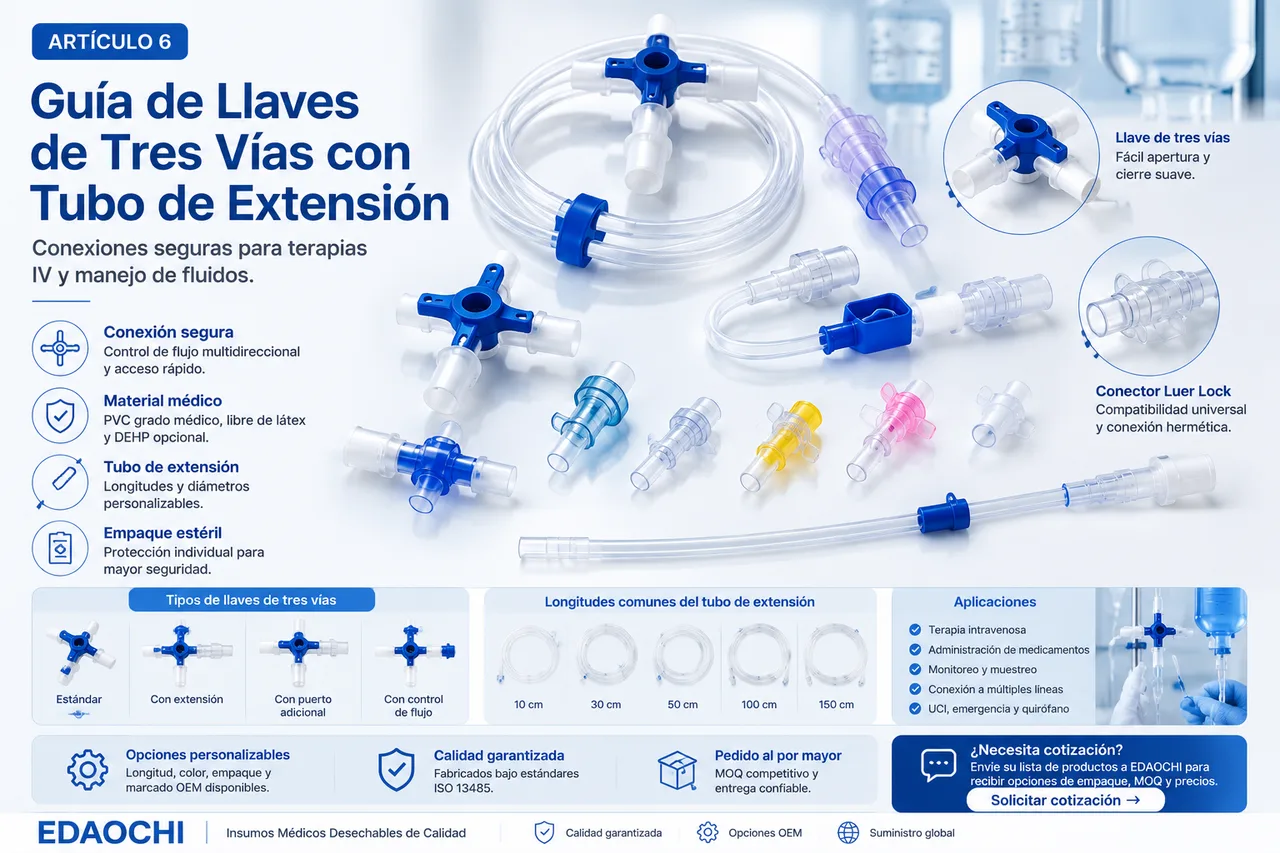
An ICU patient with sepsis can run vasopressors, antibiotics, sedoanalgesia and parenteral nutrition simultaneously through a single central venous catheter. The three-way stopcock is what makes that possible: three ports, a rotary handle and the ability to direct, block or cross flows without a new puncture. The extension tube adds the distance between the stopcock and the catheter insertion site, reducing mechanical phlebitis and simplifying set changes.
How a three-way stopcock works: mechanics and positions
A three-way stopcock has a body with three ports and a rotary handle. The key rule: the handle always points toward the closed port. When the handle points right, the right port is blocked. This convention is universal across Luer-lock designs in the market, but always verify it with the specific model before clinical use.
The three main working positions are: Port A open, B closed — the primary infusion flows directly to the patient. Port B open, A closed — a secondary fluid (bolus drug, flush solution) reaches the patient without mixing with the primary infusion. All open — for priming or a simultaneous flush. All closed — safety position when temporarily disconnecting equipment.
The body is transparent medical polycarbonate, allowing you to see flow and detect air bubbles or precipitates before they reach the patient. Luer-lock (threaded) closure is the safest option under pressure; Luer slip (friction) connects faster but is not recommended for high-pressure lines.
Stopcock alone, stopcock with extension, and manifold: when to use each
Three configurations are available, and the buyer needs to distinguish them before ordering.
Stopcock alone: Three ports, no tubing included. Used when a separate extension set is already in the line, or when the ward protocol specifies independent components so each can be changed separately.
Three-way stopcock with integrated extension tube: The most common configuration in general wards and emergency settings. The extension tube (10–100 cm depending on the model) distances the manipulation zone from the catheter insertion site, reduces mechanical drag on the cannula and lowers associated mechanical phlebitis. The advantage is a single ready-to-use set; the disadvantage is that when one component becomes contaminated, the entire set must be changed.
Multi-port manifold: Two, three or four three-way stopcocks integrated into a single moulded body. Designed for ICU settings where multiple infusions run simultaneously through a single venous access. The manifold simplifies circuit assembly but requires strict port assignment per drug.
With or without extension? What the clinical evidence says
Available clinical evidence recommends using short extensions with a clamp for intermittent medication administration: they distance the manipulation zone from the insertion site, reduce movement on the cannula and lower mechanical phlebitis. A short extension with a clamp also allows positive pressure to be maintained in the catheter when disconnecting the syringe — a recommended practice to prevent reflux and clot formation at the catheter tip.
An important technical point: the three-way stopcock should not be integrated into the extension tube if you want to change components independently. In practice, combined kits dominate the market for convenience and price, but some high-turnover ICUs keep the components separate by protocol — precisely so the stopcock can be changed every 4–7 days without disturbing the catheter extension.
For length selection: short extensions (10–25 cm) are standard for intermittent drug administration and ward infusions. Long extensions (100–150 cm) are appropriate when infusion pumps are far from the access point, such as in theatre or during patient transport.
Change intervals, flushing and priming: basic protocol
Standard hospital protocols establish a 4–7 day change interval for three-way stopcocks and extension sets in routine infusions (antibiotics, fluids, vasopressors). The exceptions are: total parenteral nutrition with lipids, blood products and propofol — these change every 24 hours. TPN without lipids changes every 24–48 hours.
Flushing after every use is mandatory: 5 ml of normal saline from a single-dose ampoule, using the positive-pressure technique (pulsatile injection, closing the clamp while maintaining syringe plunger pressure). Using a single-dose ampoule — not a multidose vial — prevents cumulative contamination.
Priming (air purging) is as critical as the change interval. A stopcock with an air bubble in the body can introduce air embolism if not purged before connecting to the catheter. The standard procedure: connect the infusion line, open all ports and allow fluid to flow until liquid exits from the third port without bubbles, then cap it.
Buying in volume: what to specify when ordering
For hospitals, distributors and procurement teams ordering stopcocks and extension sets in bulk, these are the critical parameters to specify:
- Format: stopcock alone / stopcock + short extension (10–25 cm) / stopcock + long extension (100–150 cm) / dual or triple manifold
- Closure type: Luer-lock (threaded, safest under pressure) or Luer slip (friction, faster to connect)
- Clamp: with roller clamp or slide clamp on the extension (recommended) or without clamp
- Third-port cap: with sterile cap included (standard) or without cap
- High-pressure version: for contrast injection in CT or MRI, rated to 150–300 psi
- Sterility and packaging: individual sterile EO peel-pouch (clinical use) or bag of 10 non-sterile units (non-critical use)
- Regulatory documentation: CE certificate, ISO 13485, technical data sheet for INVIMA / COFEPRIS / DIGEMID or your local regulator
We manufacture three-way stopcocks and IV extension sets under ISO 13485 with CE marking. If the line carries several drugs at once, the part that replaces a chain of loose stopcocks is a multi-port infusion manifold. Message us on WhatsApp with the configuration you need, monthly volume and destination country.
Frequently Asked Questions
How often should a three-way stopcock and IV extension set be changed?
For standard infusions (antibiotics, IV fluids, vasopressors), the typical interval is every 4–7 days. Exceptions are: total parenteral nutrition with lipids, blood products and propofol, which change every 24 hours. TPN without lipids changes every 24–48 hours. Each institution follows its infection-control committee protocol; these are the most widely adopted recommendations.
Can the same stopcock port be used for incompatible drugs?
Not directly. If two drugs are incompatible, they must be administered through separate catheter ports or via separate lines that do not mix before reaching the patient. In single-lumen catheters, incompatibility is an absolute contraindication for simultaneous administration without an intermediate flush and a waiting period between drugs.
What is the difference between a three-way stopcock and a manifold?
A three-way stopcock is a single unit with three ports and one handle that controls flow between those three ports. A manifold integrates multiple stopcocks (2, 3 or 4) into a single moulded body, allowing multiple simultaneous infusion lines on a single venous access entry. The manifold is the ICU standard when three or more drugs must infuse simultaneously.
Are there high-pressure stopcock versions for contrast injectors?
Yes. High-pressure versions are certified to withstand the pressure generated by automatic injectors used in CT and MRI, typically 150–300 psi. A standard infusion three-way stopcock must not be used for contrast injection at high pressure — it can disconnect or deform under that load. The correct model is marked with its maximum working pressure and typically has a reinforced body.