The manual resuscitator — bag-valve-mask, known as the Ambu or BVM — is the device used to ventilate a patient who is not breathing or breathing poorly, in arrest, the ER, transport or theatre. Doing it well is not just "squeezing the bag": the mask seal, volume, rate and oxygen use make the difference. This guide explains the step-by-step technique, the ventilation rate by age and in CPR, the most harmful mistakes, and what to check when buying resuscitators wholesale for crash carts, ambulances and distributors.
Parts of the resuscitator and what each does
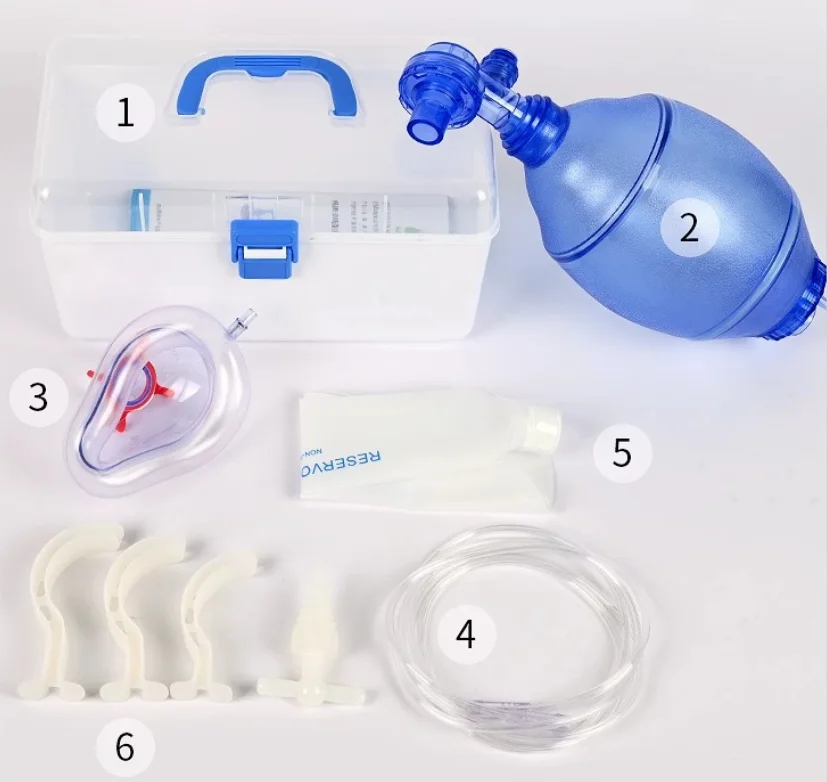
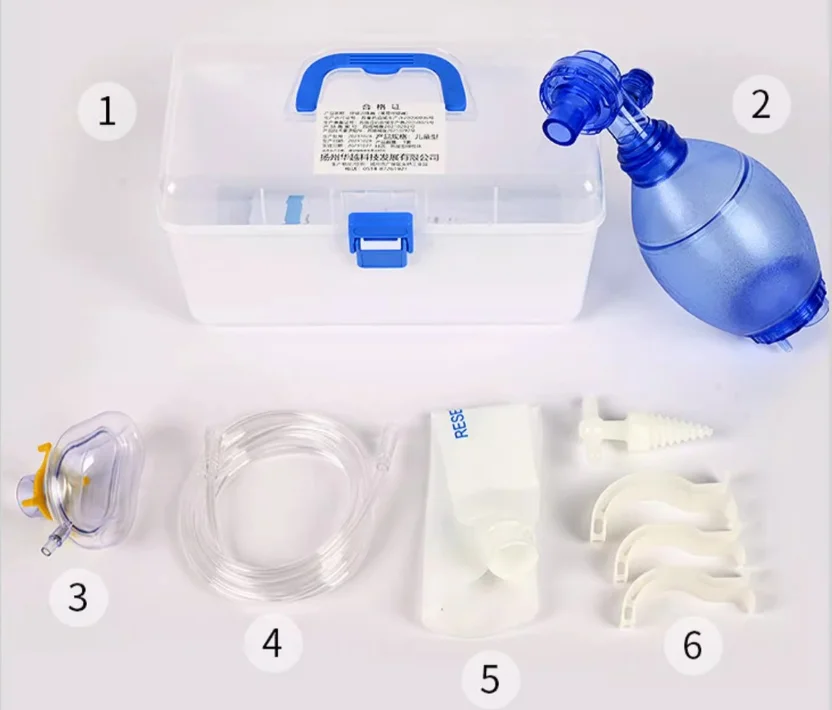
Understanding the parts is key to using and buying it:
- Face mask: seals over the nose and mouth; it must be the correct size and ideally have an inflatable cushion that improves the seal.
- One-way (non-rebreathing) valve: directs air to the patient when squeezed and diverts exhaled air outside, preventing rebreathing.
- Self-inflating bag: refills on its own when released; its volume defines how much air is delivered.
- Oxygen reservoir and tubing: connected to a high-flow O₂ source (10–15 L/min), they allow delivery of near-100 % FiO₂. Without the reservoir, FiO₂ is much lower.
- PEEP / pressure-limiting valve (model-dependent): helps avoid over-inflation, important in paediatrics.
The Ambu ventilates; it does not oxygenate on its own: for a high FiO₂ it must be connected to oxygen with a reservoir.
Step-by-step technique (C-E seal)
- Airway position: align, head-tilt-chin-lift (or jaw thrust if cervical trauma is suspected). Consider a Guedel airway if the patient is unconscious and the tongue obstructs.
- Choose the correct mask size: it should cover from the bridge of the nose to the chin cleft, without covering the eyes.
- C-E seal: with one hand, the thumb and index finger form a "C" pressing the mask onto the face, and the other three fingers form an "E" lifting the jaw to the mask. The two-person technique is ideal: one seals with both hands (double C-E) and the other squeezes the bag.
- Connect oxygen at 10–15 L/min with the reservoir for a high FiO₂.
- Ventilate: squeeze the bag gently and steadily for ~1 second, only until you see the chest rise visibly. Do not squeeze the whole bag at once.
- Allow full exhalation between breaths (inspiration/expiration ratio).
- Reassess chest rise, colour, SpO₂ and any leaks in the seal.
Ventilation rate and volume by age
Ventilating too fast or with too much volume is one of the most dangerous errors: it distends the stomach, promotes regurgitation and aspiration, and reduces venous return. Reference rates:
| Situation | Ventilation rate |
|---|---|
| Adult in respiratory arrest (with pulse) | 1 breath every 6 s (≈10/min) |
| Child / infant in respiratory arrest (with pulse) | 1 breath every 2–3 s (≈20–30/min) |
| Adult CPR, NO advanced airway | 30 compressions : 2 breaths |
| Adult CPR, advanced airway (intubated) | 1 breath every 6 s, without pausing compressions |
| Paediatric CPR, 2 rescuers | 15 compressions : 2 breaths |
Volume: just enough to make the chest rise visibly, no more. In an adult, one hand suffices; in children a paediatric bag is used and often a pressure limit. Always follow current CPR guidelines (AHA/ERC).
Common mistakes
- Hyperventilating (too fast or too much volume): distends the stomach, causes regurgitation and reduces cardiac output. Ventilate ~1 s and only until the chest rises.
- Poor mask seal: a leak prevents ventilation; if possible, use the two-person technique.
- Forgetting the reservoir and oxygen: without them FiO₂ is low. Connect O₂ at 10–15 L/min with a reservoir.
- Not opening the airway (no chin-lift or Guedel): air enters the stomach, not the lung.
- Wrong mask or bag size: an adult bag on an infant over-inflates. Use paediatric sizes.
- Not reassessing: check chest rise and SpO₂ continuously.
How to choose the manual resuscitator
For crash carts, ambulances or ICU, the first thing is the sizes: adult, paediatric and neonatal, each with its matching mask, because an adult bag is no good for a neonate. Then, reusable or single-use: autoclavable silicone withstands many sterilisation cycles and suits recurrent use with a cleaning protocol, while disposable fits emergencies and infection control. The non-rebreathing valve has to be reliable, and in paediatrics a pressure-limiting (pop-off) valve is worth having to avoid barotrauma. It should come with a reservoir and O₂ tubing, a mask with an inflatable cushion for a good seal and a standard 22/15 mm connection; latex-free, with transparent materials so you can spot regurgitation in time.
We make them with CE and ISO 13485 and lot traceability; ask us for samples of each size to check the seal and the bag recoil before buying volume, and we'll take it to WhatsApp.
Frequently Asked Questions
How many seconds apart do you ventilate with the Ambu?
In an adult in respiratory arrest with a pulse, one breath every 6 seconds (about 10 per minute). In children and infants, one every 2–3 seconds (20–30 per minute). In adult CPR without an advanced airway, 30 compressions to 2 breaths; with an advanced airway, one breath every 6 seconds without pausing compressions.
How much air should you give with each breath?
Just enough to make the chest rise visibly, no more. Squeeze the bag gently and steadily for about 1 second. Giving too much volume or too fast distends the stomach, promotes regurgitation and reduces venous return.
Does the manual resuscitator oxygenate the patient?
On its own it ventilates with room air (FiO₂ ≈21 %). To deliver high-concentration oxygen it must be connected to an O₂ source at 10–15 L/min with its reservoir bag: that reaches a FiO₂ near 100 %. Without the reservoir, the delivered FiO₂ is much lower.
How do you get a good mask seal?
With the C-E technique: the thumb and index finger form a "C" pressing the mask onto the face, and the other three fingers form an "E" lifting the jaw to the mask. The two-person technique is ideal: one seals with both hands and the other squeezes the bag, which reduces leaks.