Disposable Headset Nasal Oxygen Cannula with Head Strap
SKU: XY421C | Cánula Nasal de Oxígeno con Arnés Cefálico Desechable
Reference price. Contact our team for an exact quote.
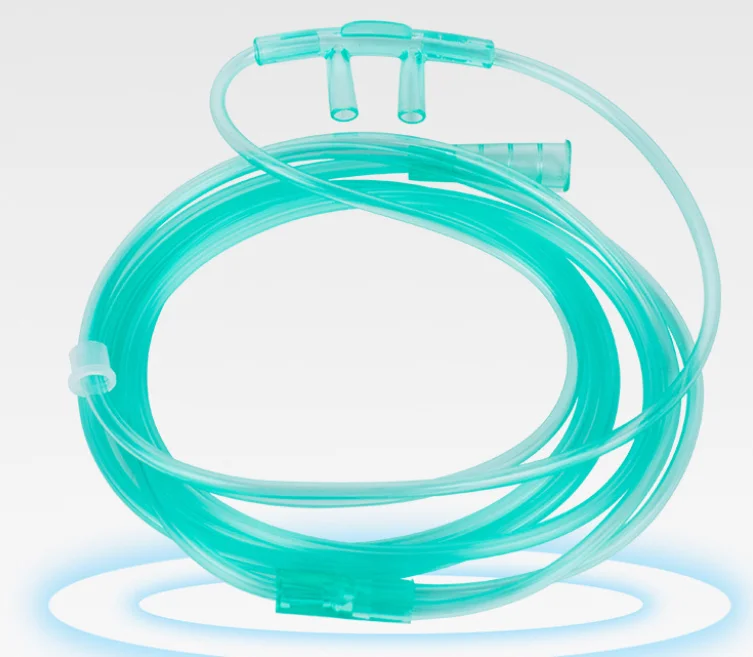
Nasal oxygen cannula with an integrated head strap (headband) for firmer fixation and comfort in active or restless patients. The soft, atraumatic prongs minimise irritation, and the strap distributes the load over the head so there is no pressure on the ears. Indicated for ambulatory oxygen therapy and paediatric patients on the move. Latex-free medical PVC. Single use.
Technical Specifications
Clinical Uses
- Ambulatory oxygen therapy in active patients
- Paediatric patients who dislodge a standard cannula
- Post-operative recovery with early mobilisation
Head strap or headset frame — which complaint are you solving?
| Head strap (XY421C — this part) | Headset frame (XY421D) | |
|---|---|---|
| The complaint it fixes | "It keeps falling off" — the patient moves | "It hurts my ears" — the ears are the pressure point |
| Retention method | Adjustable strap over the head | Rigid frame hugging the head, off the ears |
| Typical patient | Children, restless or ambulatory adults, early mobilisation | Hearing aids, glasses, ear-top pressure sores, long-term wear |
| Sizes | Adult and paediatric | Adult |
| Accounts that buy it | Paediatric and ambulatory oxygen therapy | Long-term therapy on ear-sensitive patients |
Both carry the load off the ears — but only one of them is adjustable and comes paediatric. Match the part to the complaint your account actually reports and the returns stop.
Frequently Asked Questions — Disposable Headset Nasal Oxygen Cannula with Head Strap
What is the advantage of a head strap over a standard nasal cannula?
The strap carries the cannula over the head rather than on the ears, removing ear pressure during prolonged therapy and improving retention in active or restless patients.
Is the head-strap cannula XY421C compatible with oxygen concentrators?
Yes. The tube connector is universal and compatible with home concentrators and standard hospital wall flowmeters.
Is it available in a paediatric size?
Yes, and for this particular cannula the paediatric size is the reason most buyers are here. We supply adult and paediatric versions — confirm exact sizes on WhatsApp when you request a quote, and tell us the split you expect between them so the case pack matches your demand instead of leaving you with a pallet of the wrong size.
Head strap or headset frame — which one do I stock?
They solve two different complaints and it is worth being precise, because a buyer who stocks the wrong one gets returns. Stock the head strap (this part, XY421C) when the problem is that the patient MOVES — active adults, restless patients, children who dislodge a standard cannula. The strap is adjustable and pulls the prongs back into place. Stock the headset frame (XY421D) when the problem is specifically the EARS — hearing aids, glasses, existing pressure sores on the ear tops — where a rigid frame that hugs the head without touching the ears is the point. Accounts running paediatric or ambulatory therapy want the strap; accounts running long-term therapy on ear-sensitive patients want the frame.
Does the 2.1 m tubing matter for an ambulatory patient?
More than the strap does, on some days. A patient who moves drags tubing around bed rails, chair arms and doorways, and tubing that kinks stops the therapy silently — no alarm, just a patient who quietly desaturates. The 2.1 m length gives usable range from a concentrator without a trailing extension, and the star-lumen profile keeps the lumen open when the tube is bent or trapped rather than letting it flatten. On an ambulatory patient the retention and the anti-kink lumen are solving the same problem from two ends.
Request a Quote — Disposable Headset Nasal Oxygen Cannula with Head Strap
Reply within 24 business hours with FOB/CIF price, MOQ and lead time. SKU XY421C is already attached to your request — just add the quantity.
Request a Sample
Samples available for evaluation. Basic items: free sample. Higher-value items: a sample fee may apply. Shipping not included.
Full Description — Disposable Headset Nasal Oxygen Cannula with Head Strap
Every oxygen-therapy account eventually has the same complaint: the cannula is on the floor again. A standard cannula is designed for a patient who mostly stays still. Put it on a toddler, a restless post-op patient or an adult walking to the bathroom and it comes off — and a cannula on the floor is a therapy that is not happening. This part exists for that patient, and for no one else.
Retention is the whole product
The integrated strap is adjustable and carries the cannula over the head rather than hooking it on the ears, so the prongs get pulled back into position instead of being dragged out of it. Soft atraumatic prongs, standard 1–6 L/min low-flow delivery (FiO₂ roughly 24–44%) — the therapy is identical to a standard cannula. What changes is whether it is still on the patient an hour later.
The tubing solves the other half of the same problem
This is the part buyers skip and then complain about. A patient who moves drags tubing around bed rails, chair arms and doorways, and kinked tubing stops the therapy silently — no alarm sounds, the patient simply desaturates. The 2.1 m length gives real range from a concentrator without adding a trailing extension line, and the star-lumen profile holds the channel open when the tube is bent or trapped instead of letting it flatten shut. Retention at the face and an open lumen at the floor are the same problem attacked from both ends, which is why this cannula carries both.
Paediatric is not a smaller adult order
The paediatric version is why most buyers reach this page, and it is where order sizing goes wrong. Children dislodge standard cannulas constantly, so paediatric accounts consume the strap version at a rate that has nothing to do with their adult volume. Tell us the split you expect between adult and paediatric and we build the case pack around it — a pallet weighted to the wrong size is dead stock in a line that otherwise turns quickly.
If retention is not actually your problem
Buyers land here having decided a standard cannula is not working, and sometimes the diagnosis is wrong. If the complaint is specifically the ears — hearing aids, glasses, pressure sores developing on the ear tops — the right part is the headset-frame cannula, where a rigid frame hugs the head and touches nothing. If the complaint is the skin and the mucosa over weeks of continuous therapy, no strap fixes that and the soft silicone cannula is the answer. If the patient is stable, compliant and stationary, the standard cannula is cheaper and does the job. And if the patient is fighting the cannula because they are air-hungry rather than restless, no strap fixes that either — a patient who needs more than a low-flow device needs HFNC, and strapping a cannula on tighter only delays the escalation. Our nasal oxygen cannula guide walks the whole range, and the oxygen delivery & FiO₂ flow chart shows where each device sits on flow and FiO₂.
Buying wholesale
Factory-direct, latex-free, EO sterile, adult and paediatric, universal connector for concentrators and wall flowmeters. OEM pouch print and samples available. Send your adult/paediatric split, monthly volume and destination country — Alex confirms the case pack and FOB price on WhatsApp, usually within 24 h.
This page is for medical consumables sourcing and procurement information. Clinical suitability and oxygen-therapy decisions should be confirmed by qualified professionals.