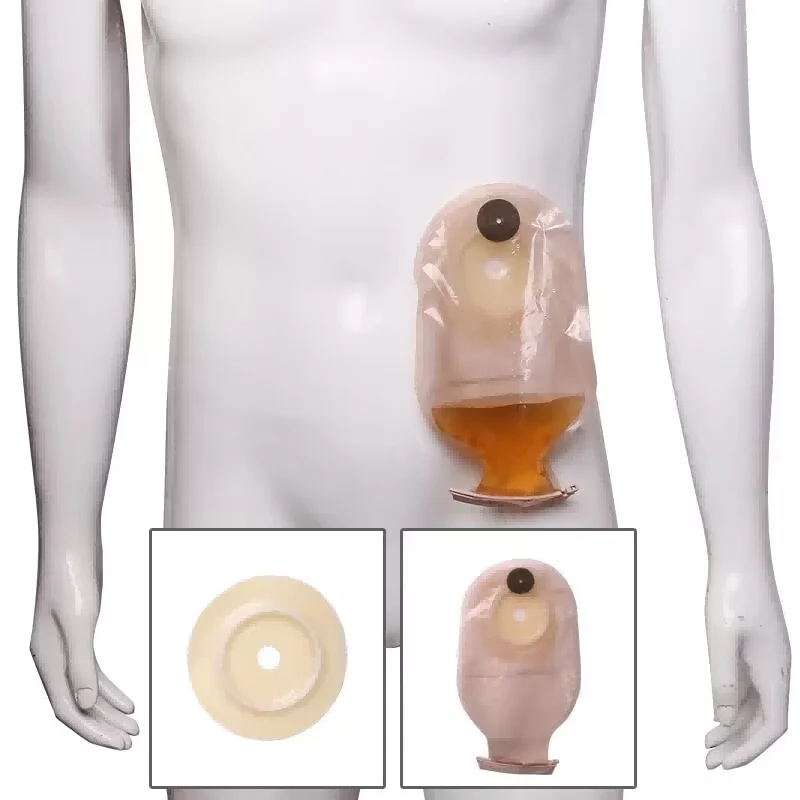
Changing an ostomy bag is the care that causes the most anxiety at first, but with an orderly technique it becomes a routine of a few minutes. This guide explains how often the bag is emptied and changed by stoma type (colostomy, ileostomy, urostomy), the step-by-step procedure, how to care for the peristomal skin to avoid irritation, and what to check when buying ostomy bags wholesale for clinics, care homes and home-care providers.
How often to empty and change the ostomy bag
Frequency depends on the stoma type and the system (one-piece or two-piece). Emptying and changing are different things: the bag is *emptied* several times a day and *changed* (with the adhesive barrier) every few days.
| Stoma type | Empty the bag | Change the system |
|---|---|---|
| Colostomy (formed stool) | When 1/3 full | Every 3 to 4 days |
| Ileostomy (liquid output) | Several times a day, at 1/3 | Every 3 to 4 days (durable barrier) |
| Urostomy | When 1/3 full; connect to night bag | Every 2 to 4 days |
The 1/3 rule: empty the bag before it fills to a third to stop the weight peeling off the adhesive barrier and causing leaks. Never wait until it is full.
Best time to change it: first thing in the morning or before eating, when the stoma is less active. In an ileostomy, have the materials ready before removing the bag, because output comes continuously.
Materials you need before you start
Preparing everything before removing the bag avoids interruptions and leaks during the change:
- New ostomy bag (and barrier/wafer if it is a two-piece system).
- Curved scissors and a stoma measuring guide (if the bag is cut-to-fit).
- A rubbish bag for waste.
- Soft cloths or gauze and warm water (soap is not needed at every change; if used, neutral and lotion-free).
- Paper towels to dry.
- Optional as needed: levelling paste or ring for creases, powder for irritated skin, skin-protective film, ostomy belt.
Avoid alcohol wipes, oils or greasy creams on the peristomal skin: they leave a film that stops the barrier adhering.
Step-by-step procedure to change the bag
- Wash your hands and put on gloves if appropriate.
- Remove the used bag gently, top to bottom, holding the skin with the other hand so you don't pull it. Never rip it off.
- Clean the stoma and skin with warm water and gauze, using gentle movements. The stoma may bleed a little when touched: this is normal because it is highly vascular. Discard the used bag in the rubbish bag.
- Dry the skin very well by dabbing. The barrier will not stick to wet skin.
- Measure the stoma with the template and cut the barrier opening 2–3 mm larger than the stoma — neither too tight (it injures it) nor too wide (it leaves skin exposed to output).
- Apply protection if the skin needs it: protective film, and paste/ring to level creases or scars.
- Place the new barrier/bag centred over the stoma, pressing from the inside out to remove wrinkles.
- Fix it with hand warmth: keep your palm over the barrier for about 30 seconds; the warmth activates the adhesive and improves the seal.
- Close the end of the bag (clamp or velcro) and check there are no creases where it could leak.
The whole procedure, with practice, takes between 5 and 10 minutes.
Peristomal skin care and common problems
The skin around the stoma should look the same as the rest of the abdomen. If it is red, moist or sore, it is almost always from contact with output due to a poorly fitted barrier.
Common problems and what to do:
- Irritation / leakage dermatitis: cut the opening more exactly, use stoma powder + protective film ("crusting" technique) and check creases with levelling paste.
- Repeated leaks: usually from an opening cut too large, skin not dry when applied, or creases/scars; consider a convex barrier and a belt.
- Mild stoma bleeding when cleaning: normal. Heavy bleeding or bleeding from inside the stoma: seek advice.
- Stoma changes: a very pale, dark/purplish, retracted or very swollen stoma needs professional assessment.
Signs to contact the stoma nurse or doctor: ulcerated skin that does not improve, severe pain, no output in a colostomy/ileostomy with pain and distension, or an abnormally coloured stoma.
Choosing ostomy bags well
For a clinic, a care home or a home-care distributor, getting the purchase right is what keeps leaks and complaints down. The first call is one-piece or two-piece: the one-piece, with barrier and bag joined, is more discreet and simple because it all changes together; the two-piece lets you change just the bag while the barrier stays in place, which fragile skin appreciates.
Next comes the bag type by stoma: open or drainable with a closure for ileostomy and liquid colostomy, closed for a formed-stool colostomy, and with a tap for urostomy; carrying variety is exactly what avoids returns. The opening can be cut-to-fit or pre-cut: cut-to-fit adapts to any diameter and works well as general stock, while pre-cut speeds up the change once the stoma is stable. On the barrier, look for a hydrocolloid that holds up to the output, consider a convex option for flat or retracted stomas, and a carbon filter for odour and gas.
The material should be hypoallergenic and latex-free. We make them with CE and ISO 13485, plus national registration wherever the market requires it; ask us for samples to validate adhesion on your patient population before buying volume, and we'll take it to WhatsApp.
Frequently Asked Questions
How often is an ostomy bag changed?
The system (barrier + bag) is changed every 3 to 4 days in colostomy and ileostomy, and every 2 to 4 days in urostomy. The bag is emptied much more often: whenever it reaches 1/3 of its capacity, several times a day in an ileostomy. It is best not to wait until it is full, because the weight peels off the barrier and causes leaks.
Is it normal for the stoma to bleed when cleaning it?
Yes. The stoma is a highly vascular mucosa and can bleed slightly when touched with gauze during cleaning; it stops on its own shortly. What is not normal and should be reviewed is heavy bleeding, bleeding from inside the stoma, or a stoma that is pale, dark or purplish.
Why does my bag come off or leak?
Leaks are almost always due to three causes: cutting the opening larger than the stoma, sticking the barrier onto wet skin, or creases and scars that prevent the seal. The fix is to cut 2–3 mm larger than the stoma, dry the skin very well, press from the inside out and, if there are creases, use levelling paste or a convex barrier.
Which is better, a one-piece or two-piece system?
The one-piece is more discreet and easy to use: barrier and bag are joined and changed together. The two-piece lets you remove and change only the bag while the barrier stays stuck, reducing skin handling — preferable for fragile skin or when the bag is changed several times. Many centres keep both formats in stock.