3-Way Extension Line with Needle-Free Connector
SKU: XY-NFE3 | Línea de Extensión de 3 Vías con Conector sin Aguja
Branch count moves the price most: a 1-way and a 4-way are not the same product. After that come tubing size (2.7 x 1.6 mm, 2.7 x 1.0 mm or 4.0 x 3.0 mm in medical PVC), made-to-order length, the DEHP-free version, volume and OEM customisation. Send the configuration and quantity for a firm price.
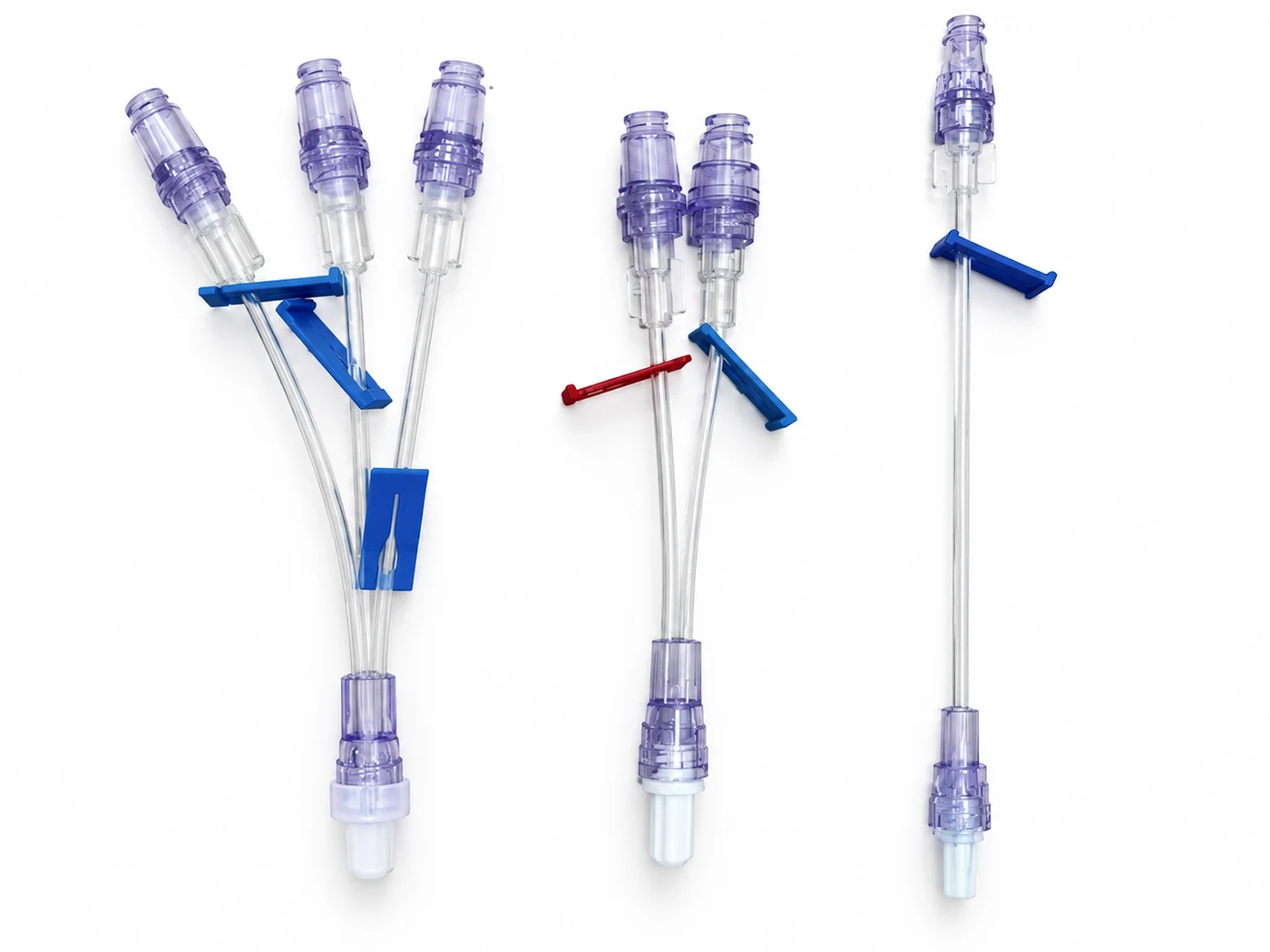
Pre-assembled IV extension line with a needle-free connector on every branch. The trunk ends in a rotating male Luer-lock toward the catheter; each branch ends in a Luer-activated needle-free valve with its own slide clamp to close the leg that is not in use. It replaces the improvised bedside build of extension tubing + stopcock + loose connectors: one stock reference instead of three, one sterile pouch and no open connection point at the patient. Tubing is medical PVC and comes in three sizes, which is the specification with the most weight: 2.7 × 1.6 mm, 2.7 × 1.0 mm and 4.0 × 3.0 mm. The 1.6 mm bore is the general-purpose size; the 1.0 mm bore leaves less dead volume for syringe pumps and vasopressors; the 4.0 × 3.0 mm opens the lumen where high flow or viscous fluid is needed. Length is made to order (per branch and per trunk) to the actual distance between pump and venous access. Available in 1, 2, 3 and 4-way configurations; the 3-way is the ICU build, where sedation, vasopressor and maintenance run in parallel on one access. Latex-free, DEHP-free version available. EO sterilised, individually pouched. CE marked and manufactured under ISO 13485, with private-label option.
Technical Specifications
Clinical Uses
- ICU and critical care: sedation, vasopressors and maintenance in parallel on a single venous access
- Oncology and chemotherapy infusion, closed, needle-free access without breaking the line
- PICC and central venous catheter (CVC) long-term IV therapy
- Paediatrics and neonatology, with short made-to-order lengths and a DEHP-free version
- Closed-system line flushing and blood sampling (SAS / SASH protocols)
- OEM assembly inside own-brand infusion kits and procedure sets
Available tubing sizes
Every size is made in 1, 2, 3 and 4-way, in medical PVC, with the same needle-free valve and the same clamp. What changes between them is the lumen and with it the flow and the dead volume left inside the line.
| Size (OD × ID) | Wall | Internal volume | What it is ordered for |
|---|---|---|---|
| 2.7 × 1.6 mm | 0.55 mm | 0.020 mL/cm | The general-purpose size. Enough flow for fluids and antibiotics while keeping the internal volume of the line low |
| 2.7 × 1.0 mm | 0.85 mm | 0.008 mL/cm | Same outer diameter, narrower lumen: around 60% less dead volume per centimetre. Syringe pumps, vasopressors and neonatology |
| 4.0 × 3.0 mm | 0.50 mm | 0.071 mL/cm | Wide lumen for high flow or viscous fluid: rapid replacement, blood products and parenteral nutrition |
Internal volume is what decides between the two 2.7 mm sizes: at equal length the 1.0 mm lumen holds less than half of what the 1.6 mm does. All three are made in medical PVC, with a DEHP-free version available. Length is made to order on all three: state branch and trunk length when requesting a quote, along with the tubing size, branch count, clamp colour and whether packaging carries your brand.
Frequently Asked Questions — 3-Way Extension Line with Needle-Free Connector
What tubing sizes are available?
Three and all three are made in 1, 2, 3 and 4-way. 2.7 × 1.6 mm is the general-purpose bore: enough flow for fluids and antibiotics without inflating the internal volume of the line. 2.7 × 1.0 mm keeps the same outer diameter but narrows the lumen (same handling, same clamps, roughly 60% less volume per centimetre) and is the one ordered for syringe pumps, vasopressors and neonatology. 4.0 × 3.0 mm opens the lumen for high flow or viscous fluid: rapid replacement, blood products and parenteral nutrition.
What material is the tubing and is a DEHP-free version available?
All three sizes are made in medical PVC, the standard material for the infusion line and the one that gives the best price/performance in volume. A DEHP-free version is available to order and it is worth asking for explicitly where the destination is paediatric ICU, neonatology, oncology or a European tender that requires it in writing: it is not supplied by default and it is the kind of thing discovered late, once the submission is already in.
Can I order a length other than standard?
Yes, on all three tubing sizes. Tell us the branch length and the trunk length and the set is assembled that way. It is a decision worth making on clinical grounds rather than assembly convenience: every centimetre of tubing adds dead volume and with vasopressors or pump-driven sedation that dead volume becomes delay at every syringe change. ICU orders tend toward the shortest length that still reaches the pump, and, where that delay is critical, the 1.0 mm lumen as well; general ward and ambulatory patients toward longer runs, because there the real risk is traction on the puncture site.
Is the product CE marked?
Yes. The extension line with needle-free connector is CE marked and manufactured under an ISO 13485 quality system with lot traceability. We supply the technical file and certificates for national device registration and for public tender submissions.
How is this different from a plain IV extension tube?
A plain extension tube is tubing with Luer fittings at each end: to get a needle-free injection point you add a separate connector at the bedside. Here the needle-free valve is factory-fitted and sterilised on every branch, with its clamp. That removes one bedside manipulation, reduces open connection points and leaves one stock reference instead of three. If you need the tubing without connectors, that is our IV extension tube reference.
How many branch configurations are there and which sells most?
It is made in 1, 2, 3 and 4-way. The 3-way turns fastest in ICU and coronary care, because it covers the standard sedation + vasopressor + maintenance regimen on one access. The 1-way is used as a needle-free cap on peripheral catheters on the ward and the 4-way appears in multi-drug regimens and oncology. Distributors usually open with 1 and 3-way and add the rest as end customers ask for them by name.
How much dead volume does the line leave and why does it matter?
The arithmetic is direct: the 1.6 mm lumen holds 0.020 mL per centimetre, the 1.0 mm holds 0.008 mL. A 50 cm branch in 1.6 mm retains about 1 mL of undelivered drug; the same length in 1.0 mm, about 0.4 mL. With fluids or antibiotics that millilitre is irrelevant. With norepinephrine on a syringe pump at 2 mL/h it is half an hour of lag between changing the syringe and the new drug reaching the patient. At that point the lumen choice and the length choice are the same decision.
Can the branches be colour-coded to tell drugs apart?
Yes. The slide clamp is blue by default and red is available; on the 3 and 4-way configurations it is common to order them mixed so each branch is identifiable at a glance. It is a customisation with no tooling cost, specified at order. On units with rotating staff it is worth more than any label stuck to the line.
What documentation do you provide for device registration?
The product is CE marked and manufactured under ISO 13485 with lot traceability. We provide the technical data sheet, instructions for use and the conformity documentation for registration and for tender files. If your market requires the DEHP-free version in writing, ask for it explicitly: it is made, but it is not the default configuration.
What do you need in order to quote?
Five things: branch count, tubing size, length per branch and per trunk, clamp colour and estimated quantity. If you need the DEHP-free version or packaging under your brand, say so in the same message. That is enough to quote directly; if you would rather evaluate first, ask for samples at the same time.
Do you offer OEM or private label?
Yes. We manufacture unbranded by default: the device ships neutral and the packaging carries your brand. Length, branch count, clamp colour, packaging format and printing are all customisable. Send us your specification and estimated monthly volume Message us on WhatsApp with the specification and the volume. We normally send samples before anyone commits to a large order.
Request a Quote — 3-Way Extension Line with Needle-Free Connector
Reply within 24 business hours with FOB/CIF price, MOQ and lead time. SKU XY-NFE3 is already attached to your request — just add the quantity.
Request a Sample
Samples available for evaluation. Basic items: free sample. Higher-value items: a sample fee may apply. Shipping not included.
Full Description — 3-Way Extension Line with Needle-Free Connector
The 3-way extension line with needle-free connector is the set that replaced what used to be built by hand at the bedside: an extension tube, a three-way stopcock and two or three loose connectors, joined together on the spot. Here it arrives assembled and sterilised as one piece, a trunk ending in a rotating male Luer-lock toward the catheter and three branches each ending in a Luer-activated needle-free valve with its own slide clamp.
The specification buyers actually order against: tubing size and length
Tubing is made in three sizes and choosing between them is the purchasing decision with the most clinical consequence on the whole sheet:
- 2.7 × 1.6 mm: the general-purpose size. Fluids and antibiotics pass without restriction while the internal volume of the line stays low. Absent a reason to deviate, this is the one.
- 2.7 × 1.0 mm: same outer diameter, narrower lumen. It handles identically, takes the same clamps and sits in the same holders, but encloses roughly 60% less volume per centimetre. This is the size ordered for syringe pumps, vasopressors and neonatology, where dead volume governs response time.
- 4.0 × 3.0 mm: a wide lumen for the opposite problem: high flow or viscous fluid. Rapid replacement, blood products, parenteral nutrition.
All three are made in medical PVC and a DEHP-free version is available to order. It is worth asking for explicitly: it is not supplied by default and it is a written requirement in paediatric ICU, neonatology, oncology and much of European tendering. It is the kind of thing discovered late, once the submission is in and the order has to be redone.
What actually separates the two 2.7 mm sizes is not material but internal volume: 0.020 mL per centimetre at the 1.6 mm lumen against 0.008 mL at the 1.0 mm. At equal length the narrow one holds less than half. From the outside they are the same tube (same handling, same clamps, same holders) so moving between them changes nothing about the setup.
Length is made to order on all three, state the branch length and the trunk length and the set is built that way, rather than forcing a choice between two or three catalogue lengths.
That decision deserves clinical judgement, not assembly convenience, because it plays on the same axis as the lumen. Every centimetre of tubing adds dead volume and dead volume is time: with norepinephrine, dopamine or pump-driven sedation, a long line delays onset by minutes at each syringe change. ICU buyers specify the shortest run that still reaches the pump and, where that delay is critical, the 1.0 mm lumen as well, the two decisions attack the same problem from opposite ends. General ward and ambulatory use specifies longer, because there the real risk is traction on the puncture site rather than pharmacological lag.
Why three branches instead of a three-way stopcock
They are not the same thing and the two get confused. A three-way stopcock is a valve that directs flow between three ports with a handle: one opens as another closes. This extension line does not direct, it splits. All three branches are open simultaneously on the same venous access, each with its own needle-free connector and its own clamp. That is why it is the ICU set: sedation, vasopressor and maintenance have to run in parallel and continuously and closing one to open another is not an option.
1, 2, 3 and 4-way configurations
- 1-way: closes a peripheral catheter with a single needle-free access point. The fastest-moving configuration on general wards. - 2-way: two drugs on the same access, each leg with its own clamp. - 3-way: the ICU and coronary care build. The most requested in the family. - 4-way: multi-drug regimens and oncology, where three branches run out.
A distributor opening this line usually starts with 1 and 3-way, which cover roughly 80% of consumption and adds 2 and 4-way once end customers ask for them by name.
Materials, sterilisation and packaging
Medical PVC tubing, with a DEHP-free version available for paediatric ICU, neonatology and European tenders that require it in writing. Connectors in medical polycarbonate, latex-free. Flat swabbable septum, suited to the 70% isopropyl alcohol disinfection protocol before every access (*scrub the hub*). Ethylene oxide sterilised, sealed in an individual sterile peel pouch. Single use.
Certification and documentation
The product is CE marked and manufactured under an ISO 13485 quality system with lot traceability. We supply the technical data sheet, IFU and conformity documentation for national device registration and for public tender files.
OEM and private label
We manufacture unbranded by default: the device ships neutral and the packaging carries our customer's brand. Branch and trunk length, branch count, clamp colour (blue standard, red for colour coding), packaging format and printing are all customisable. This is how importers and distributors with an existing catalogue normally work with us.
Related references on the same line
If you need the tubing without a fitted connector, that reference is the IV extension tube. If you want the needle-free connector on its own, as a component for assembling your own sets, it is on needle-free connector / Y injection site. For multi-port access with handle flow control, see the three-way stopcock manifold.
Quoting
Tell us the branch count, the length you need per branch and per trunk, whether you require the DEHP-free version, the clamp colour and your estimated monthly volume. That is enough for us to price it on WhatsApp. Samples go out first if you want to handle the product before committing, and CE and ISO 13485 come with the quote for your registration file.
*Please confirm product specifications, regulatory requirements and intended use with your local regulatory authority before purchase.*