Cath-Lab Manifold — 1 to 3 Stopcocks, 250 & 500 PSI
SKU: XY-CLM | Manifold de Hemodinamia — 1 a 3 Llaves, 250 y 500 PSI
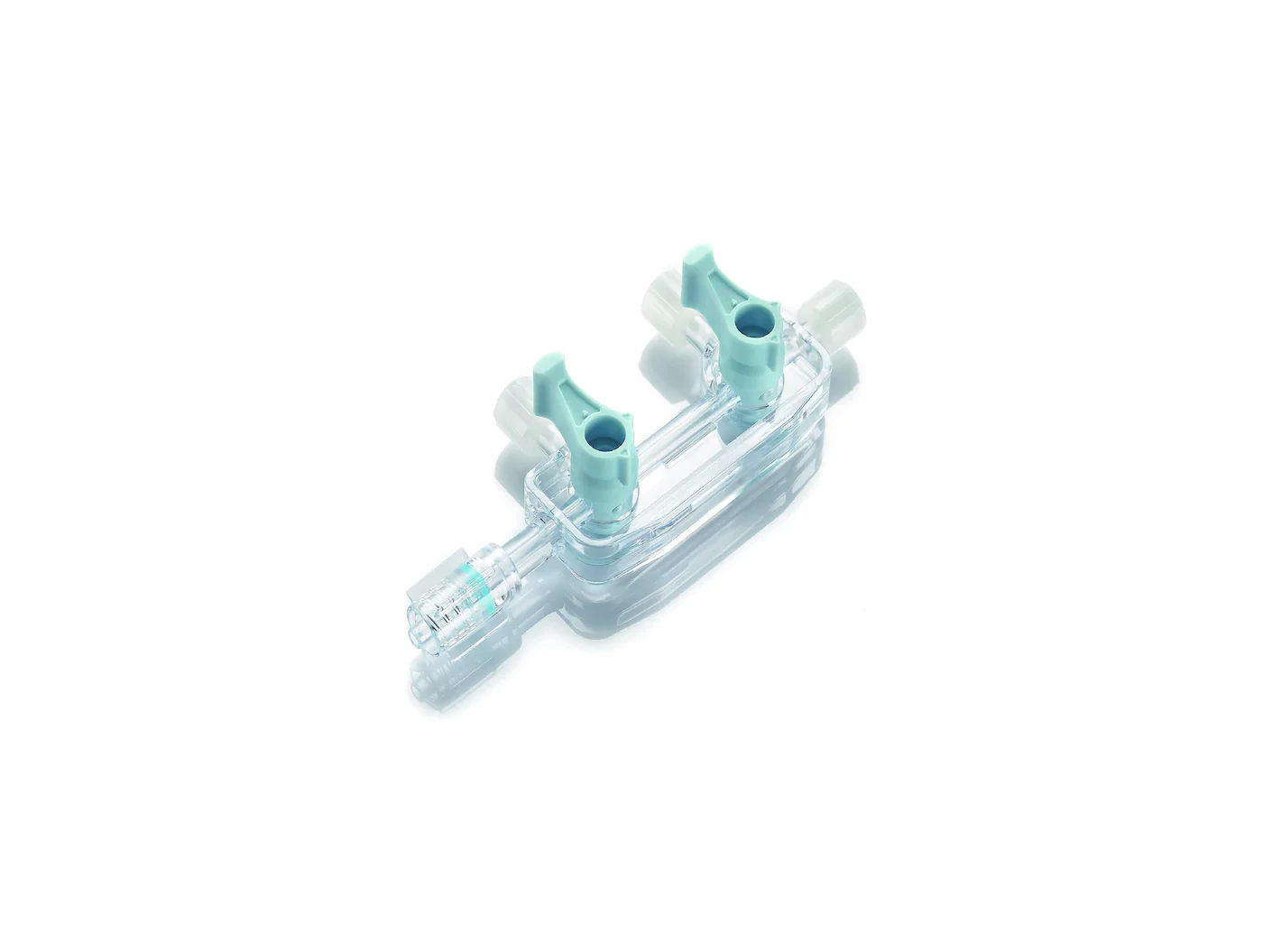
The cath-lab manifold is the procedure's fluid control panel: contrast, saline and pressure monitoring converge on one body with one, two or three stopcocks, and the operator switches between injecting, flushing and measuring without disconnecting anything. Not to be confused with the ward infusion manifold: this one works at injection pressure — built in 250 and 500 PSI — and its 2.3 mm inner lumen is sized for the flow of a manual contrast run. Configurations of one stopcock (with rotating adapter, ON or OFF positions), two stopcocks (block or half body) and three stopcocks, all right-handed with the levers facing the operator. Order it alone or as a sterile kit with the 12 ml dose-control syringe already connected — the assembly actually worked with, sterilised as one unit. Loose bodies and stopcocks for assemblers live on the OEM line.
Technical Specifications
Clinical Uses
- Contrast, saline and pressure control in coronary angiography
- Manual contrast injection with dose-control syringe
- Invasive arterial pressure monitoring during the procedure
- Complete table kit with 12 ml syringe
Configurations and pressures
Stopcock count follows the unit's protocol: every line converging on the manifold (contrast, saline, pressure) asks for its stopcock. Pressure is chosen by the room's most demanding use, not the average.
| Configuration | Body | Pressures | Usual use |
|---|---|---|---|
| 1 stopcock | Rotating adapter, ON or OFF | 250 · 500 PSI | Single injection line |
| 2 stopcocks | Block or half body | 250 · 500 PSI | Contrast + saline |
| 3 stopcocks | Block | 250 · 500 PSI | Contrast + saline + pressure monitoring — the coronary standard |
| Kit: 3 stopcocks + 12 ml syringe | Block | 250 · 500 PSI | Table assembly sterilised as one unit |
For pump injection at DSA pressures (up to 1200 PSI) the manual manifold is not the right part: see the high-pressure lines in the radiology category.
Frequently Asked Questions — Cath-Lab Manifold — 1 to 3 Stopcocks, 250 & 500 PSI
How does it differ from the IV infusion manifold?
Pressure and flow. The infusion one works at ward pump pressure; this one holds 250 or 500 PSI of manual contrast injection and its 2.3 mm lumen keeps run flow. Using the ward part in the lab is the classic purchasing error of unifying references by name — it swells or weeps at the first firm injection.
250 or 500 PSI?
By the room's most demanding use. Manual coronary injection lives comfortably at 250; units that push peripheral runs or want one margin for the whole inventory standardise on 500. The price difference is smaller than the cost of carrying two references if your volume does not justify it.
What does the 12 ml syringe kit add?
The dose-control syringe arrives connected to the manifold and both are sterilised as one unit: one fewer hand-made connection and one fewer pouch at the table. The syringe has three-finger rings and a solid piston stable under pressure, with a 0.5 ml reserve so the end of stroke never injects air.
Is there a left-handed or inverted-lever version?
The standard build is right-handed with levers facing the operator in the usual table position. Other orientations are evaluated as OEM by quantity; state it when quoting.
Request a Quote — Cath-Lab Manifold — 1 to 3 Stopcocks, 250 & 500 PSI
Reply within 24 business hours with FOB/CIF price, MOQ and lead time. SKU XY-CLM is already attached to your request — just add the quantity.
Request a Sample
Samples available for evaluation. Basic items: free sample. Higher-value items: a sample fee may apply. Shipping not included.
Full Description — Cath-Lab Manifold — 1 to 3 Stopcocks, 250 & 500 PSI
A control panel, not a splitter
Three lines converge at the operator's hand: contrast to inject, saline to flush, a transducer to read. The manifold's stopcocks switch between them without a single disconnection — which is the whole point, because every disconnection in a pressurised circuit is a leak path and an air-entry risk.
Why it is not the ward manifold
Injection pressure. A ward infusion manifold swells or weeps at the first firm contrast push; this body holds 250 or 500 PSI and its 2.3 mm lumen keeps the run's flow. Unifying the two references by name is the classic purchasing mistake in this family.
The kit logic
The 12 ml dose-control syringe — finger rings, solid piston, 0.5 ml reserve so the last push never injects air — ships connected and co-sterilised. One less hand-made connection at the table.
What to confirm before ordering
- Stopcock count and 250/500 PSI split - Kit vs bare manifold ratio - OEM components instead, if you assemble your own sets