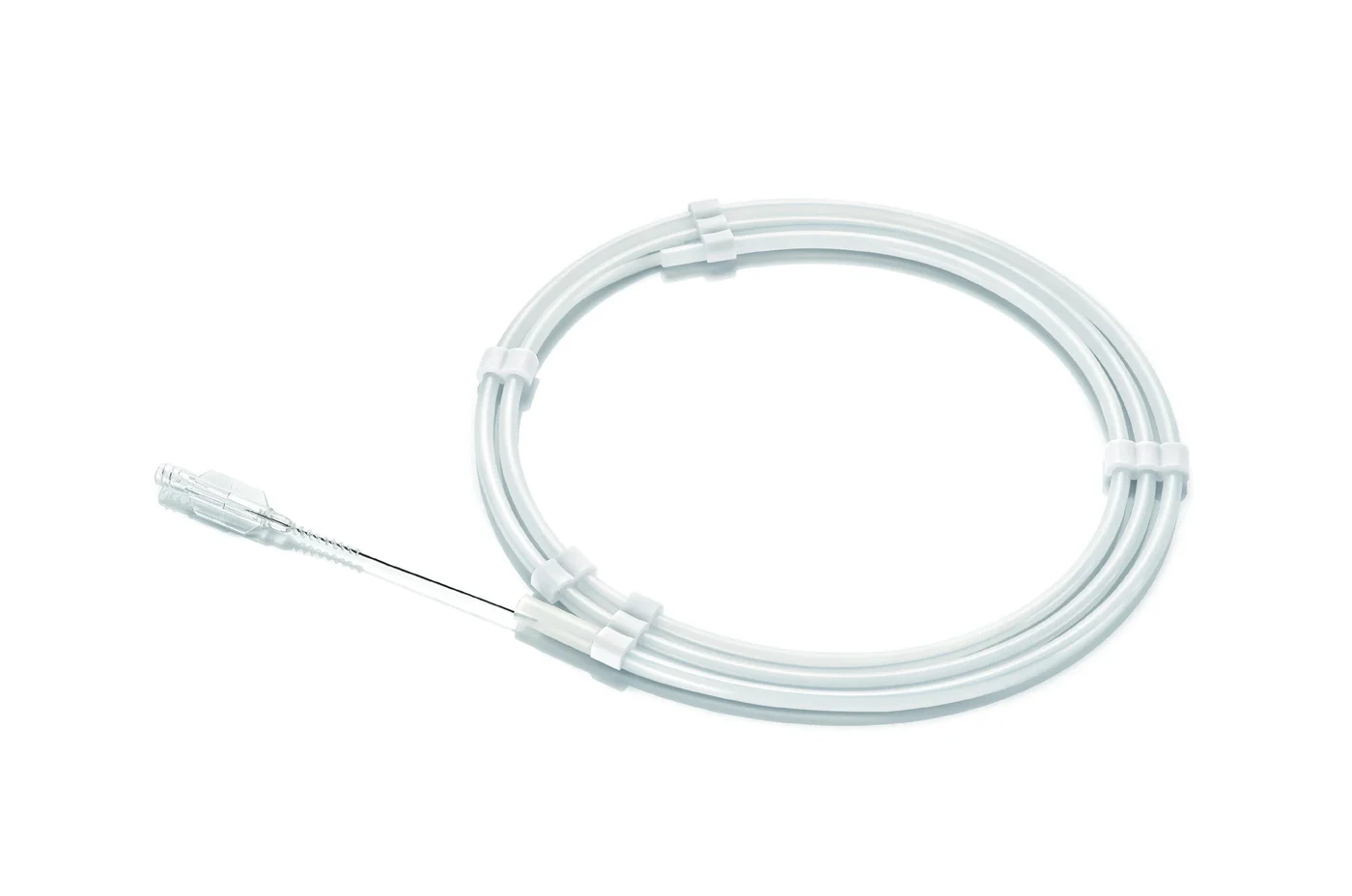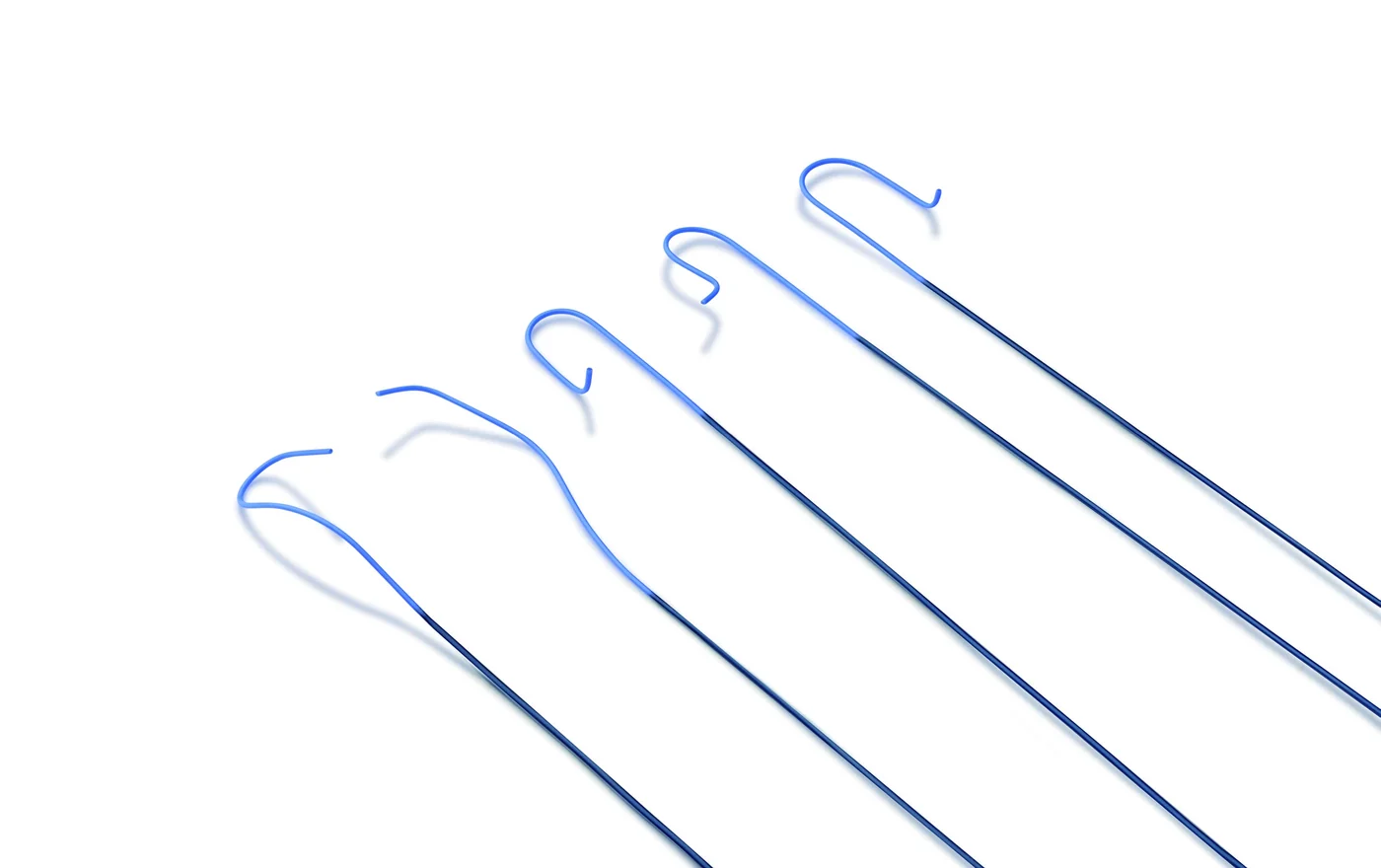
PTCA Guidewire 0.014" — Five Tip Loads
SKU: XY-PTW | Guía PTCA 0,014" — Cinco Cargas de Punta
PTCA guidewire at 0.014", made in five tip loads — extra-soft 0.7 g, soft 3 g, medium 5 g, stiff 9 g and extra-stiff 12 g — because tip load is not an operator preference but a working ladder: the lesion that will not cross with the soft is attempted with the medium, and so on upward. The distal 3 cm are solid platinum, radiopaque, so the tip is visible under fluoroscopy without relying on markers; the core is stainless steel with a PTFE coating to cut friction inside the catheter. Lengths of 190 cm (rapid exchange) and 300 cm (over-the-wire systems and long catheter exchanges), straight or pre-shaped J tip. A unit's typical purchase is not one reference but the whole ladder in proportion: plenty of soft and medium, less stiff and extra-stiff. We ship the mix as one order.
Technical Specifications
Clinical Uses
- Coronary lesion crossing in PTCA
- Load escalation on resistant lesions
- Balloon and stent delivery support
- Catheter exchanges with the 300 cm version
The tip-load ladder
Tip load is the force the tip exerts before it bends. Each step has its role; a unit's box reflects the whole ladder, not a single reference.
| Load | Grams | Usual role |
|---|---|---|
| Extra-soft | 0.7 g | First choice in uncomplicated lesions — maximum tip safety |
| Soft | 3 g | The daily workhorse |
| Medium | 5 g | The lesion that resists the soft |
| Stiff | 9 g | Occlusions and fibrosis — experienced hands |
| Extra-stiff | 12 g | Chronic total occlusion (CTO) — the last step |
Usual buying ratio: half the volume across soft and medium; extra-stiff by units, not boxes. Send your mix and we quote it as one order.
Frequently Asked Questions — PTCA Guidewire 0.014" — Five Tip Loads
What is tip load and why five values?
The force in grams the tip exerts before bending. A 0.7 g tip forgives error and is the first choice; a 12 g tip crosses a chronic total occlusion but demands control. Five values exist because operators escalate: soft fails, try medium, and so on. The right purchase is the ladder in proportion, not one reference.
190 or 300 cm?
190 cm for rapid-exchange systems — the bulk of daily work. 300 cm when catheters must be exchanged while the wire holds position: over-the-wire systems, microcatheters, CTO technique. Typical units order both at roughly 80/20.
Is the tip clearly visible under fluoroscopy?
The distal 3 cm are solid platinum, not a point marker: the operator sees the entire tip segment and its shape throughout, which is what makes navigation safe.
How is it quoted?
Send the load × length × tip-shape matrix with quantities. Extra-stiff usually goes by units; the rest by boxes. Documentation: technical file, ISO 13485 and per-batch sterilisation; destination registration by the distributor.
Request a Quote — PTCA Guidewire 0.014" — Five Tip Loads
Reply within 24 business hours with FOB/CIF price, MOQ and lead time. SKU XY-PTW is already attached to your request — just add the quantity.
Request a Sample
Samples available for evaluation. Basic items: free sample. Higher-value items: a sample fee may apply. Shipping not included.
Full Description — PTCA Guidewire 0.014" — Five Tip Loads
Why five loads exist
A 0.7 g tip forgives error and is the first choice; a 12 g tip crosses a chronic occlusion but demands control. Operators escalate step by step, which is why the correct purchase is the ladder in proportion, not one reference in volume.
Visibility without markers
The distal 3 cm are solid platinum rather than a point marker: the operator sees the whole tip segment and its shape throughout the procedure.
190 or 300 cm
190 cm serves rapid-exchange systems — most daily work. 300 cm keeps wire position through catheter exchanges: over-the-wire, microcatheters, CTO technique. A typical order splits 80/20.
What to confirm before ordering
- Load × length × tip-shape matrix with quantities - Extra-stiff usually ordered by units - Documentation set for your market's registration