Dose-Control Syringe — 10, 12 & 20 ml
SKU: XY-DCS | Jeringa de Control de Dosis — 10, 12 y 20 ml
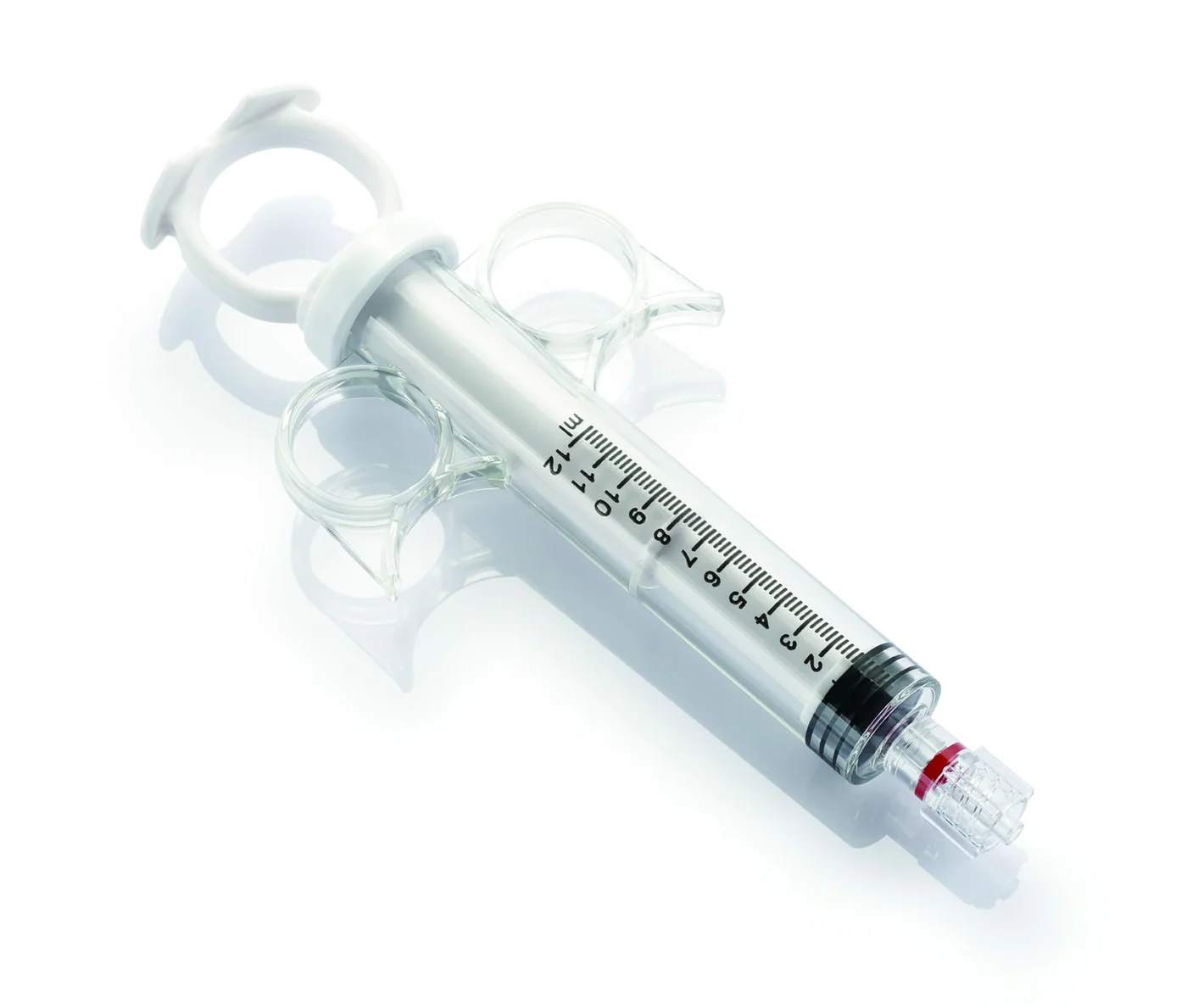
The dose-control syringe is the manifold's right hand: with it contrast is injected manually, run by run, at the force and rhythm the operator decides. Its anatomy is built for injecting hard while keeping control: rings for two fingers plus thumb rest (the grip that lets you push firmly without losing the hold), a solid piston that does not flex under pressure (a hollow one bows and steals precision at the end of the stroke) and a clear graduated barrel for bubbles and volume. The distinguishing detail: a 0.5 ml reserve at the bottom of the stroke, so the piston never bottoms out and the final push never injects the residual air. Capacities of 10, 12 and 20 ml, with rotating Luer tip (the line does not twist as you thread) or fixed. The 12 ml version travels in our manifold kit; this page serves it loose and in the other capacities.
Technical Specifications
Clinical Uses
- Manual contrast injection in coronary angiography
- Working partner of the cath-lab manifold
- Manual peripheral and visceral runs
- Loose replenishment of the manifold-kit syringe
Frequently Asked Questions — Dose-Control Syringe — 10, 12 & 20 ml
What does the 0.5 ml reserve do?
Air safety. In a normal syringe the final push drives the piston to the floor and with it any residual bubble gathered at the tip. Here the stroke ends 0.5 ml early: air that might remain has no path into the line. In arterial injection that detail is not cosmetic.
Rotating or fixed tip?
The rotating tip decouples the thread from the syringe: you tighten the connection without twisting the line — the classic complaint of fixed tips on a manifold. Fixed is simpler and cheaper for short-extension use. Most labs standardise on rotating.
Why does the solid piston matter?
Under a firm run's pressure a hollow piston flexes — bowing millimetres that translate into undelivered volume and a spongy feel exactly when the operator is dosing the end of the injection. The solid one transmits the whole force with direct feel from start to finish.
Can it be ordered with the manifold?
Yes, two ways: as the co-sterilised kit (manifold + connected 12 ml syringe, on the manifold page) or as loose references in the same order. Loose also serves the 10 and 20 ml capacities the kit does not include.
Request a Quote — Dose-Control Syringe — 10, 12 & 20 ml
Reply within 24 business hours with FOB/CIF price, MOQ and lead time. SKU XY-DCS is already attached to your request — just add the quantity.
Request a Sample
Samples available for evaluation. Basic items: free sample. Higher-value items: a sample fee may apply. Shipping not included.
Full Description — Dose-Control Syringe — 10, 12 & 20 ml
Built around one hand's job
Push hard, feel the column, stop exactly where intended. Rings and thumb rest anchor the grip; the solid piston transmits force without bowing; the clear barrel shows what is left and what should not be there.
The 0.5 ml that matters
A normal syringe's last push drives the piston to the floor — and any bubble gathered at the tip goes with it. Here the stroke ends 0.5 ml early: residual air has no path to an arterial line.
Rotating tip
Threading a fixed Luer twists the line with the nut. The rotating tip decouples them — connection tightens, tubing stays at rest. Most labs standardise on it.
What to confirm before ordering
- Capacity split (12 ml pairs with the manifold kit) - Rotating or fixed tip - Loose or with the manifold in one order