Disposable Infusion Pump / PCA — 100 ml
SKU: XY-DIP | Bomba de Infusión Desechable / PCA — 100 ml
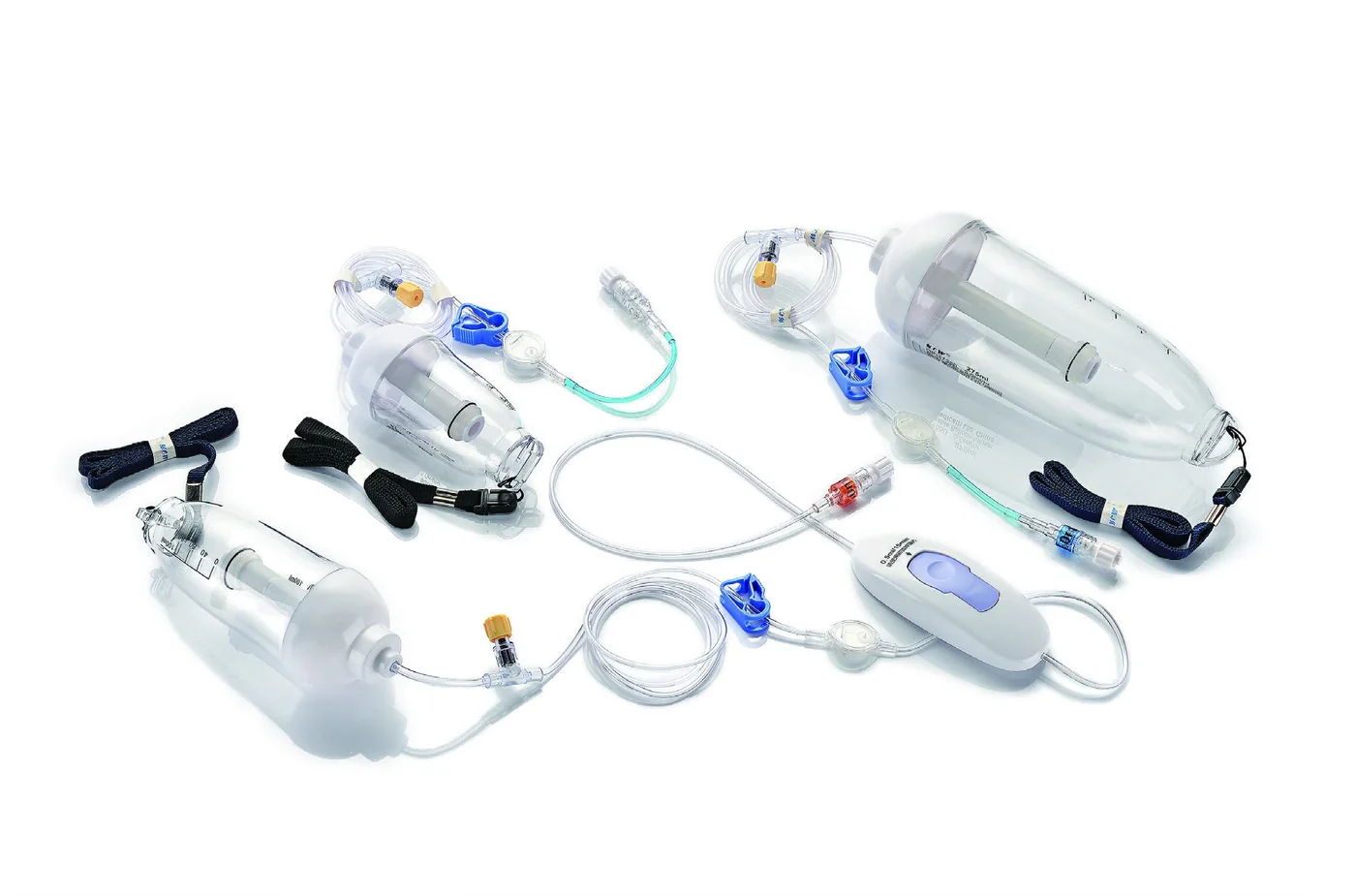
Single-use elastomeric infusion pump: the 100 ml reservoir drives the drug by the retraction of its own membrane — no batteries, no motor, nothing to program. That makes it immune to the two failure modes of ambulatory electronic pumps, the dead battery and the programming error, and lets the patient walk or go home with analgesia running. Two families. The PCA version carries a bolus button for patient-controlled analgesia: a continuous base of 2.0 ml/h plus a 0.5 ml bolus with a 15-minute lockout, limits set by the device's mechanics rather than by a configuration anyone could get wrong. The continuous version delivers 2.0 or 5.0 ml/h with no button, for steady analgesia or antibiotic infusion. Rigid clear housing: reservoir level is checked at a glance, and the shell protects the balloon from the accidental squeeze that alters flow in soft-shell pumps. Filled through a standard port in pharmacy or on the ward.
Technical Specifications
Clinical Uses
- Post-operative PCA analgesia on the ward
- Ambulatory analgesia — discharge with the pump running
- Continuous antibiotic infusion at home
- Regional blocks with perineural catheter
Available versions
The choice is binary: should the patient be able to self-administer boluses? If yes, PCA; if not, continuous — then just pick the rate.
| Version | Base rate | Bolus | Typical use |
|---|---|---|---|
| PCA | 2.0 ml/h | 0.5 ml / 15-min lockout | Patient-controlled post-operative analgesia |
| Continuous 2.0 | 2.0 ml/h | — | Continuous analgesia, slow infusion |
| Continuous 5.0 | 5.0 ml/h | — | Antibiotics and higher-rate regimens |
PCA bolus limits are mechanical: the device cannot deliver more than 0.5 ml per bolus nor sooner than 15 minutes, with no dependence on any programming.
Frequently Asked Questions — Disposable Infusion Pump / PCA — 100 ml
What is the difference between the PCA and continuous versions?
The button. PCA delivers a 2.0 ml/h base plus a 0.5 ml bolus when the patient presses, with a mechanical 15-minute lockout. Continuous delivers its fixed rate (2.0 or 5.0 ml/h) with no patient input. PCA is the post-operative analgesia reference; continuous serves steady analgesia or antibiotic regimens.
Does the 15-minute lockout depend on any programming?
No — it is mechanical. The bolus chamber takes 15 minutes to refill and physically cannot deliver more than 0.5 ml per press. No menu, no code, no possible configuration error — which is precisely the safety argument versus electronic PCA pumps on the ward.
Who fills the pump and with what?
Pharmacy or nursing, through the standard fill port with a syringe. Drug and dilution follow the hospital's protocol; the pump fixes the delivery rate. The clear housing lets staff verify volume and emptying without handling anything.
What is the minimum order and what documentation do you provide?
State the split across versions and monthly volume for a quote. We provide the technical file, ISO 13485 and per-batch sterilisation documentation; local registration is handled by the distributor. This is the category's highest-recurrence reference once an anaesthesia service adopts it.
Request a Quote — Disposable Infusion Pump / PCA — 100 ml
Reply within 24 business hours with FOB/CIF price, MOQ and lead time. SKU XY-DIP is already attached to your request — just add the quantity.
Request a Sample
Samples available for evaluation. Basic items: free sample. Higher-value items: a sample fee may apply. Shipping not included.
Full Description — Disposable Infusion Pump / PCA — 100 ml
Why elastomeric, in one sentence
No battery to die and no program to mis-set: the reservoir's own membrane provides the pressure and the flow restrictor sets the rate, so the two classic ambulatory-pump incidents cannot happen.
PCA limits you cannot misconfigure
The bolus chamber physically holds 0.5 ml and physically takes 15 minutes to refill. There is no menu. That is the safety argument against electronic PCA on a general ward, and the reason anaesthesia teams adopt it quickly.
The rigid shell earns its cost
Soft-shell pumps change flow when a patient sleeps on them. The rigid clear housing prevents compression and shows the remaining volume at a glance — the two things a ward round actually checks.
What to confirm before ordering
- Split across PCA / continuous 2.0 / continuous 5.0 - Monthly volume — recurrence is high once anaesthesia adopts it - Registration documentation for your market